
Table of Contents
The Bible names several places and metals linked to mining, from the gold of Ophir to the copper of Edom. Its clearest picture of a miner at work is in the Book of Job. Quotations below are from the King James Version, which often says “brass” where modern translations say copper or bronze.
The mines of Ophir
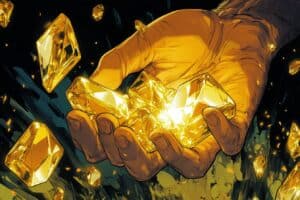
Ophir was a land famous for its wealth, above all its gold, which was brought to King Solomon. Where Ophir lay is still unknown. A pottery shard found at Tell Qasile, in present-day Tel Aviv, in 1946 and dated to the eighth century BC, reads “gold of Ophir”, which shows that it was a real place that exported gold. (For one 19th-century attempt to place it, see Onffroy de Thoron on the Amazon and Ophir.)
Solomon’s fleet brought gold from Ophir.
And they came to Ophir, and fetched from thence gold, four hundred and twenty talents, and brought it to king Solomon.
1 Kings 9:28, KJV
Job uses the gold of Ophir as a measure of great worth.
It cannot be valued with the gold of Ophir, with the precious onyx, or the sapphire.
Job 28:16, KJV
Copper mines in Edom
Edom lay in what is now southern Jordan, and the Bible counts it as a source of copper. Some link the Faynan mines to the time of King Solomon. At Khirbat en-Nahas in Wadi Faynan, the archaeologist Thomas Levy has dug up a copper-mining operation about 3,000 years old, so large that in his view only “an ancient state or kingdom” could have run it.
Deuteronomy promises a land of iron and copper.
A land wherein thou shalt eat bread without scarceness, thou shalt not lack any thing in it; a land whose stones are iron, and out of whose hills thou mayest dig brass.
Deuteronomy 8:9, KJV
Silver mines
Silver comes up often in the Bible, mostly in connection with wealth and trade. No silver mine is named, but the work of getting silver out of the ground is clearly known.
Mining and refining in Job
Chapter 28 of Job describes mining in detail. It shows a close knowledge of how metals were dug out and refined: the vein of silver, gold refined, iron taken from the earth and copper smelted from stone, the miner working in the dark, and the dust of gold under the ground.
Job describes the miner searching the dark for ore.
Surely there is a vein for the silver, and a place for gold where they fine it. Iron is taken out of the earth, and brass is molten out of the stone. He setteth an end to darkness, and searcheth out all perfection: the stones of darkness, and the shadow of death. The flood breaketh out from the inhabitant; even the waters forgotten of the foot: they are dried up, they are gone away from men. As for the earth, out of it cometh bread: and under it is turned up as it were fire. The stones of it are the place of sapphires: and it hath dust of gold.
Job 28:1 to 6, KJV
Iron and bronze
The Bible often mentions iron and bronze, which points to mining across the ancient Near East. Deuteronomy 8:9, quoted above, calls the promised land one “whose stones are iron”. Genesis names Tubal-cain as an instructer of every artificer in brass and iron.
Genesis names Tubal-cain as a teacher of workers in brass and iron.
And Zillah, she also bare Tubalcain, an instructer of every artificer in brass and iron: and the sister of Tubalcain was Naamah.
Genesis 4:22, KJV
The refining of silver and gold
The Bible also uses the refining of precious metals as a picture of spiritual cleansing. (For mines in other times and places, see mines.)
Proverbs compares the testing of hearts to refining metal.
The fining pot is for silver, and the furnace for gold: but the LORD trieth the hearts.
Proverbs 17:3, KJV
Malachi pictures the Lord as a refiner of silver.
And he shall sit as a refiner and purifier of silver: and he shall purify the sons of Levi, and purge them as gold and silver, that they may offer unto the LORD an offering in righteousness.
Malachi 3:3, KJV

