Table of Contents
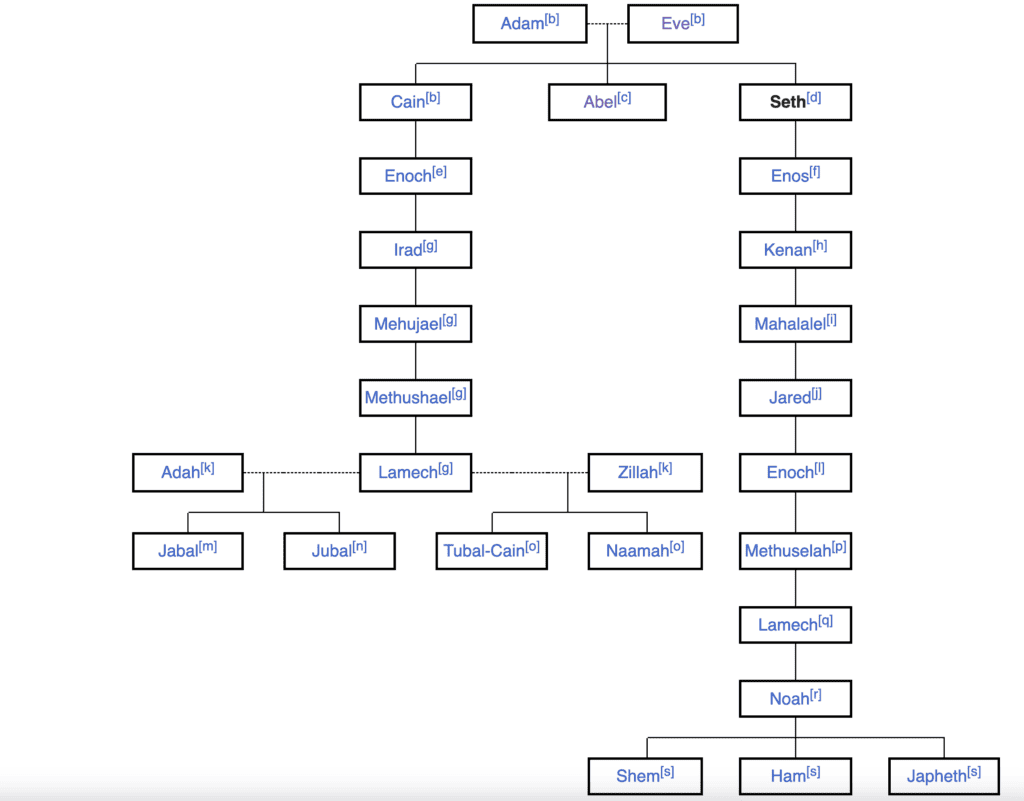
Genesis names two men called Lamech. One belongs to the line of Cain in Genesis 4, the other to the line of Seth in Genesis 5, where he is the son of Methuselah and the father of Noah. The two share a name and little else.
Lamech, son of Methuselah and father of Noah
Genesis 5:25 says Methuselah was 187 when Lamech was born. Lamech in turn was 182 when Noah was born, according to the Masoretic Text. The Septuagint gives 188, a difference Gerhard Larsson set out in his 1983 comparison of the two chronologies. Lamech lived 595 more years and had other sons and daughters, so the Hebrew count gives him 777 years in all. By that count he died five years before the Flood.
The one thing Genesis has him say comes at Noah’s birth. The name is explained as a hope for relief from the hard work of farming, which reaches back to the curse on the ground in Genesis 3:17.
Lamech names his son and says what he hopes the boy will bring.
And he called his name Noah, saying, This same shall comfort us concerning our work and toil of our hands, because of the ground which the LORD hath cursed.
Genesis 5:29, KJV
The Book of Jasher, in the 1840 translation, gives two names for the child. Methuselah calls him Noah, and Lamech calls him Menachem:
And Methuselah called his name Noah, saying, The earth was in his days at rest and free from corruption, and Lamech his father called his name Menachem, saying, This one shall comfort us in our works and miserable toil in the earth, which God had cursed.
Book of Jasher 4:14 (1840 translation)
The New Testament keeps him in the family tree. Luke 3:36 lists Noah as “the son of Lamech” in the genealogy of Jesus.
Lamech in the Dead Sea Scrolls, Enoch and Jubilees
Later Jewish writings give him a much larger part. The Genesis Apocryphon (1Q20), an Aramaic scroll from Qumran dated c. 25 BC to 50 AD, is also known as the “Apocalypse of Lamech”. In the early columns, which Sidnie White Crawford notes are told by Lamech in his own voice, he grows afraid that the newborn Noah came from one of the Watchers. His wife swears the child is his. He then sends Methuselah to Enoch, who confirms that Noah is Lamech’s son and a righteous man.
The Book of Enoch tells the same story in chapters 106 and 107. The baby’s body is white as snow and red as a rose, his eyes light up the whole house like the sun, and he praises God in the midwife’s hands. Lamech runs to his father in fear.
Lamech tells Methuselah he doubts the child is his own.
And it seems to me that he is not sprung from me but from the angels, and I fear that in his days a wonder may be wrought on the earth.
1 Enoch 106:6, trans. R. H. Charles, 1912
Enoch answers that angels in the days of Jared sinned with women and fathered giants. A flood will cleanse the earth, and this child and his three sons will be saved. Lamech is to name him Noah.
The Book of Jubilees adds a wife. In the fifteenth jubilee, in the years it counts as 701 to 707 from creation, Lamech married Bêtênôs, daughter of Bârâkî’îl, a brother of his father. In that same week she bore Noah.
Lamech in Islam and in Afghan tradition
Islamic tradition knows him as Lāmik, the father of the prophet Nuh. He appears in the collections of tales of the prophets in much the same way as in Genesis. In Afghanistan a shrine about (31.1 miles) from Mihtarlam is held to be his grave. Mahmud of Ghazni, the Ghaznavid sultan, built a tomb and gardens over the site, and the town of Mihtarlam is said to take its name from Lamech.
In Darren Aronofsky’s 2014 film Noah, Marton Csokas plays Lamech. The young Noah watches the king Tubal-cain kill his father for his land.
Lamech of the line of Cain
The other Lamech appears in Genesis 4:17 to 24. He is the seventh generation from Adam through Cain, the son of Methusael, and the first man in the Bible said to have two wives, Adah and Zillah. Adah bore Jabal, father of those who live in tents and keep cattle, and Jubal, father of those who play the harp and organ. Zillah bore Tubalcain, who worked brass and iron, and a daughter, Naamah.
He is remembered for a short song to his wives. In it he says he has killed a man for wounding him, and he outdoes the vengeance promised for Cain.
Lamech claims a vengeance far larger than Cain’s.
If Cain shall be avenged sevenfold, truly Lamech seventy and sevenfold.
Genesis 4:24, KJV
Richard Hess, writing in 1991, reads him as the end point of the murderous streak that runs through Cain’s family. The list of his sons, who start herding, music and metalwork, has been compared by Jeffrey S. Rogers to the Mesopotamian tradition of seven heroes before the flood who brought arts and crafts to humankind.
Lamech kills Cain
Rabbinic tradition explains the song. Baring-Gould gives the story from the Book of Jasher in Legends of Old Testament Characters (1871). The blind Lamech, guided by the boy Tubal-cain, shoots at what he takes for a beast. It is Cain, known by the horn on his forehead.
Now Lamech became blind in his old age, and he was led about by the boy Tubal-cain. Tubal-cain saw Cain in the distance, and supposing from the horn on his forehead that he was a beast, he said to his father, “Span thy bow and shoot!” Then the old man discharged his arrow, and Cain fell dead.
But when he ascertained that he had slain his great ancestor, he smote his hands together, and in so doing, by accident struck his son and killed him.
Sabine Baring-Gould, Legends of Old Testament Characters (1871), chapter 12, pp. 82-83