
Table of Contents
Chapter 17
A very good and necessary revelation for those that are weak in faith.
1. “Dear children:”
If we turn away from our own Reason and give ourselves into God’s will, then He can work in us and make us what He desires. When we trust in Him, we go rightly into the hands of our true Father and become His children.
2. As Christ says: “Seek first the kingdom of God and His righteousness, and all these things shall be added unto you.”
- The world worries about food and clothing.
- But God provides these for His children, as a father provides for his family.
- Therefore do not be anxious, but put your trust in Him.
3. The soul knows that the earthly garment (flesh and blood) is fragile, and that food and clothing cannot save us from death.
- They are necessary for the moment, but they pass away.
- Yet God’s grace is eternal, and if we abide in Him, we are clothed in His righteousness forever.
4. The devil tries to sow doubt and fear, whispering that God will not provide.
- He tempts us with anxiety and greed.
- But faith says: “My Father knows what I need, and He will give it.”
5. Thus the righteous live in simplicity, without over-anxious care.
- They seek God first.
- They use their work, gifts, and callings in service, but trust God to bless it.
- They avoid restless greed and anxiety, which bring many sins.
6. For anxiety opens the door to envy, deceit, theft, oppression, and countless evils.
- But trust in God brings quietness, blessing, and sufficiency.

Page 274–275
Ch. 17 – Of God’s Blessing in this World
7. Dear children, be rightly informed: our outward earthly life is fallen to the Spirit of this World. The belly needs earthly food, and the outward body must eat and live.
Thus it is said: “In the sweat of your face shall you eat bread, till you return to the earth from whence you were taken” (Genesis 3:19).
8. For the body was taken from the matrix of the earth, and has imagined (fixed) its mind into the earth. Therefore the earth has captivated man again, so that he eats earthly fruit, and is nourished by the earth, until he returns again to the earth.
9. For God took it from the earth (Adam = red earth), mixed with the fire’s centre and the water’s centre; both fire and water-breaths are united in the breath of man, inspired by the Spirit of the eternal world, which introduced the second principle (Spirit) into the heart.
If the soul goes outward only, it is captivated in outward life; but if it turns inward, it may rule over the outward.
10. And this was the reason God forbade Adam to eat from the Tree of Knowledge of Good and Evil:
- outward earth had not yet lost Paradise.
- If Adam had stood, he would have ruled as king over the earth, but without painful labour and death.
But since Adam fell, the earth captivated him again, so that now he must till and work in the sweat of his brow.
11. Therefore man must labour and trade with the outward earth. But the blessing of God is also in this labour.
For the soul catches heavenly breath in the inward, but the outward body eats bread of the earth.
12. All trades, business, and conditions are God’s ordinance, and stand in the hand of God.
- In the soul: in God’s works of wonder.
- In the body: in earthly works and ordinances.
God holds no displeasure at human labour in itself, but looks at the spirit in which it is done.
13. The outward life consists in three parts:
- Dominion of the stars (astrological fate).
- One element divided into four forms (fire, air, water, earth).
- The dominion of God’s Spirit moving upon the waters (Genesis 1:2).
Thus man lives both outwardly and inwardly. If he trusts only in the flesh, he falls into vanity. But if he sets his work in God, the Spirit of God flows through him and blesses his hands.
14. Therefore the soul should not forsake the body, nor despise earthly work. For the Spirit of God works through the outward life also, and man’s calling (Beruf) is an ordinance of God.

Page 276–277
19. As thorns and thistles grow out of the earth, and choke and spoil many good seeds, so covetousness and care choke the heart of man. He says: “I have my God in my chest; I will hoard and leave my children great treasure.”
But Christ warns: “Lay not up treasures on earth, where moth and rust consume.”
Riches are deceitful: many have wealth but no happiness, for wealth cannot satisfy the soul. He who thinks riches are his god will perish with them.
Scripture says: “For the dainty of the rich help not; but he that gives bread to the hungry, it is as if he gave it to God.”
20. It is lamentable that man runs eagerly after wealth, which ruins his soul.
- He craves more and more, never satisfied.
- He builds larger houses, fills them with goods, yet cannot rest.
- He torments himself with anxious care, as if his life depended on possessions.
Christ says: “Woe to you rich, for you have received your consolation.”
21. Such a man is like a devil to himself, tormenting his soul with endless desire. He heaps up treasure for others, but cannot keep it for himself. He leaves it behind, and in the end suffers harm.
His covetousness makes him a servant of the spirit of this world. If he continues, he becomes bound to the devil.
22. Thus man is captivated in anger and lust. He thinks: “Why should I not gather treasure? Heaven and earth are mine.” But he does not know that all prosperity belongs to God, and that true blessing comes only with humility and love.
23. Many are blinded by the Babylonish whore (Revelation 17), the spirit of covetousness that rules the world.
- They heap up goods as if serving God, but it is idolatry.
- They load their souls with care and darkness.
Paul says: “Some have pierced themselves through with many sorrows, having loved this world.”
Christ says: “Woe to you that are rich.”
See: The “Whore of Babylon” is a symbolic figure described in the Book of Revelation
24. Wealth in itself is not evil, but when it is sought for pride and security, it becomes a snare. True blessing is to seek God’s kingdom first.

Perfect — now we enter Chapter 18: Of Death, and of Dying. This marks a new section in the work, where the author reflects on mortality, the soul’s journey in death, and the mysteries beyond. Let me render this passage clearly.
Page 278–279
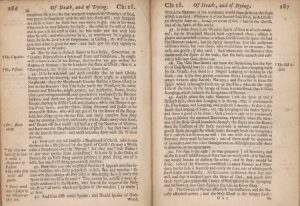
Chapter 18 – Of Death, and of Dying
How Man is when he dieth, and how it is with him in Death. A Great Gate of Wonders.
1. Know that Reason will say: “Though I have never died, yet I live in this world and do not know how death is; how then can I know this?”
Indeed, dear Reason, according to outward man, you cannot know. But I say the truth: as the outward man dies, so the inward man lives.
Man can live both with God and in this world together. When he gives himself into God’s will, he enters through a narrow, strait gate, through which the soul must pass. This is a memorial of death while still living.
So the soul that dies into God’s will has already undergone death in spirit, and though outward judgment is not yet executed, the soul is secure.
2. When earthly life ceases, we speak of “life in death,” which we know well and understand.
For there is no knowledge in the matrix of Nature if the spirit does not ride upon its wings. It must go through the three principles. If it does not, then it passes through death and hell. Who can hinder it?
If the Spirit of God is present, then man beholds wonders of God, especially when his time is complete and he must pass over.
3. We speak not of souls alone: the stars are also signs, showing when the soul’s way is at hand. When the stars break their seal, then time is over.
4. All that has beginning must end.
- If man had lived in this world without sin, he would not have needed to die, but would have been transfigured like Enoch or Elijah.
- These two were taken up without dying, a sign of the eternal dominion.
But because man fell, now all must die. Yet at the last trumpet, resurrection will follow, and eternal life.
5. The true Man (in the heavenly image) has no time, for his time is a round crown (a circle). His beginning is in God, and his end is God.
This heavenly image lives in God’s will, manifest in obedience, doing God’s works, shining forth in wonders.
6. But the outward man, without body or substance, must pass through the gate of death.
There, the eternal principle is revealed:
- Three Mothers (principles) stir.
- The soul passes into its eternal order.
This is why death is the gate of separation — it is not the end, but the passage into eternal manifestation.

Page 280–281
8. The life consists in three parts:
- inward (God’s eternal hidden mystery in the fire),
- middle (the created soul-image, likeness of God in wonders),
- outward (fleshly body from earth).
Man is made to reflect God’s image; in creation he was given a glass or mirror of the Spirit, by which he might behold divine majesty.
But because he has bound himself to the outward principle (nature), the body must break apart and die, while the inward goes on eternally.
9. Thus, death = breaking of bonds between outward and inward.
- Outward: goes into earth.
- Inward: returns to eternity.
10. The outward man is subject to the stars and time, their courses, seasons, and limits.
Every planet and star has its dominion and influences earthly life, health, and death.
But the inward man is not bound to the stars. He begins a new eternal circle.
11. Each planet has its influence — Saturn, Mars, Jupiter, etc. — which govern earthly life, health, and fortune.
But when the body dies, these influences lose their power.
12. For example, a child in the womb receives its form and limit according to the stars, which mark its earthly destiny. But these limits belong only to outward man.
13. Inward man is led not by stars, but by the eternal Spirit. The outward man is subject to number, period, and constellation; the inward is beyond all limits.
14. Behold then the danger: we live outwardly under the stars, and inwardly we are strangers here. We are awakened into the outward life, but cannot remain in it; the soul must be generated again.
The three mothers (principles) work in man, but only one (Spirit) brings eternal life.
15. God gave man this image of Himself. But Adam, before Eve was made, was not yet divided. When Eve was taken from him, the tinctures of fire and water were divided, and man lost unity.
Thus man’s life became earthly, needing food, and he fell from heavenly image.
16. The eternal part of man is not generated from outward life, but from God. Outward life belongs to earth and decays; inward life belongs to eternity.
17. A dead man has no breath, no fire in his body. Earthly essence goes back to the earth, and his elements (fire, air, water, earth) dissolve.
But the inward man remains, hidden in eternity.
18. Thus the outward image is corruptible; the inward eternal image remains unbroken, though hidden. The soul enters eternity when freed from the corruptible husk.

Page 282–283
20. If the will (in this life, in the body) goes out of falsehood and wickedness, and yields itself to God’s purpose, it receives a figure of eternity.
- If the soul works in the will of God in the centre, it gains strength from the Spirit.
- If it works only in the flesh and blood, it becomes vain, like the “scary spirit” (shadow or phantom).
21. Whatever the soul does in this life, it carries in its principle into eternity.
- If it sought God, it becomes divine.
- If it lived in wickedness, it must remain so, unless the will be renewed in the centre.
Thus even evil substance, when renewed in God, is turned to good.
22. This shows the condition of the wicked soul:
- Living in covetousness and pride, it goes into eternal misery.
- Its will becomes eternally fixed, unless turned back to God in this life.
- What it desired here, it must carry beyond death: fire, wrath, torment.
So the wicked soul remains in its own false fire, where the will is inflamed and never satisfied.
23. Such a soul falls into fear, dread, and torment. It kindles itself with wrath, but has no light to quench it.
- It falls into endless heaviness, lamentation, and dread.
- It is handed over to its tormentor (driver), with no remedy.
24. Every damned soul goes forth in its wickedness and false pride. It is cast into the angel of God’s severity (the strict Judge), where it bears its deeds. It is a traitor to the eternal substance, and its will is only self-love.
25. But the souls that at the end narrowly escape the devil, and yield into the will of God, when the body dies, are like naked souls, having little of heavenly substance.
- They are taken into quietness, waiting for the last judgment, hoping for clarification (transfiguration).
- They rest in humility, lowly, until raised.
26. But the zealous souls that lived under the Cross, working God’s wonders in obedience, walk in God’s power after death.
- They dwell in right and truth.
- They walk in righteousness, shining in love and mercy.
- Their joy is to serve God, glorify Him, and to love one another in eternity.

Page 284–285
31. “The Kingdom of God consists in power, not in earthly substance.”
- Earthly substance is not eternal; it cannot endure.
- If you will not receive heavenly substance now, you will perish with your earthly goods.
- The Spirit of God must enlighten you into the heavenly being; otherwise, all is lost.
The author warns: do not trust in Reason alone, for Reason sees only glimpses, not the eternal essence.
32. Hypocrites are called God’s hammers:
- They hammer only on the belly and external things.
- They cannot awaken the heart into God’s Spirit.
- They are “jugglers,” only striking the ears, not touching the heart.
33. Those who dwell only in the outward spirit live in shadows. They may hear the Word, but it only strikes their ears. They fall into hypocrisy, judging others but blind themselves.
34. The Word must awaken the soul into repentance, breaking the hard will. Otherwise the soul remains dead, bound in outward things.
35. If man lives blindfolded, chasing outward show, without Spirit, he becomes full of hypocrisy. He may try to shepherd others, but he is blind himself.
This leads to Noetical (intellectual) Christianity without Spirit — “notional knowledge and matter without spirit.”
37. Address to Christendom:
“O Europe, Asia, and Africa, open your eyes! Look upon yourselves. Do not be drunken with the whore of Babylon, who has filled herself with abominations.
The author proclaims:
- Many Christians are asleep, like drunkards.
- They are lulled into worldly comfort and religion without Spirit.
- But judgment is coming: the Whore of Babylon (Rev. 17–18) is the worldly church and its pomp.
38. The Whore cannot be converted. She must drink the cup of God’s wrath:
- the lake of fire,
- famine, pestilence, and plagues.
This is both personal (soul-judgment) and cosmic (nations judged)

Page 286–287
39. He who truly works in God, works the wonders of God, and lives simply in God’s will. But man has two choices:
- To follow his belly (lust and self-will), which is the devil’s way.
- To follow God’s Spirit, which is life.
40. He who is called to be a Ruler, Shepherd, or Pastor, must care for God’s flock.
- A true shepherd feeds the sheep faithfully.
- A wolf devours the sheep, caring only for honor, wealth, and power.
Thus, false shepherds are wolves in disguise. They do not care for souls but for their own belly, lust, and gain.
41. The true shepherd is guided by the Spirit of Christ. He does not seek pomp or riches but serves the flock with humility.
- But many are “simple shepherds,” called not by the Spirit but by outward appointment.
- Such pastors are wolves in sheep’s clothing, serving their belly more than God.
42. These false leaders bring the flock into confusion. They scatter the sheep, letting them be torn by wolves.
43. A faithful shepherd, however, stands under the Cross, walking in obedience to God. He does not speak empty words, but the Spirit of God works through him to touch hearts.
44. Without the Spirit of God, there is only false teaching and empty hammering. The soul remains unawakened.
45. Even if an ass could speak the wonders of God, it would still not have the Spirit. Words alone do not save; only Spirit-filled truth awakens hearts.
46. The awakened soul is drawn by God’s Spirit, which strikes in the heart like a hammer.
- This hammer breaks the hard will.
- Flesh must yield to Spirit, otherwise man remains in death.
47. Without the Spirit of God, man has no true dominion. He may have outward power, but it is empty. The Spirit of God alone rules inwardly.

Page 288 – Conclusion
51. The devil has no kingdom of his own — he only twists God’s power into wrath. His “kingdom” is the dark nature in man, not a true creation.
52. Therefore, man should take care of himself, and strive to bring forth good fruit from the Spirit.
- If he brings forth fruit according to darkness, it belongs to the abyss.
- If he brings forth fruit from the Spirit of God, it belongs to eternity.
“For whatsoever grows out of the power of the Light belongs to God’s kingdom; whatsoever grows out of darkness belongs to wrath and death.”
53. After this life, time becomes reaping.
- What was sown in life, will be reaped in eternity.
- If the soul sowed wrath and darkness, that is what it will reap.
- If the soul sowed God’s Spirit, it will reap eternal life.
54. Therefore let every soul examine itself, and consider what fruit it bears. For the evil branch will be cast into the fire; the good branch will be gathered into God’s barn.
55. Thus the end is judgment and separation: wheat into the barn, chaff into the fire.
56. “We have here faithfully opened what God has given, according to our gifts.” Those who hunger may be filled; those who thirst may drink. Our joy in God may be full — and we may eat together in the world to come.
Hallelujah. Amen.


Comments are closed.