
Table of Contents
The eight elephants of the quarters
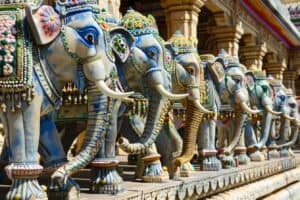
Hindu cosmology names eight great elephants, the Ashtadiggajas, whose title in Sanskrit means “eight elephants of the quarters”. Each one guards one of the eight zones of the universe, and each has a female partner standing beside him. These eight cow elephants are called the Ashtadikkarinis.

Airāvata holds the east with his mate Abhramu. Puṇḍarīka and Kapilā keep the southeast, and Vāmana and Piṅgalā the south. Kumuda and Anupamā stand in the southwest, Añjana and Tāmrakarṇī in the west, and Puṣpadanta and Śubhradantī in the northwest. The north belongs to Sārvabhauma and Aṅganā, and the northeast to Supratīka and Añjanāvatī.
The Matanga Lila makes them the mounts of the eight divine guardians of the directions. In its account the Creator held the two halves of the cosmic egg. As sages chanted, the eight bull elephants, led by Airāvata, came out of the half in his right hand, and their eight mates came out of the half in his left. Their offspring filled the forests and mountains with elephants, and the eight later helped the gods defeat the demons.
The elephants under the earth
The Ramayana tells of four more elephants, deep in the underworld, that hold the earth up from below. In the first book, the sixty thousand sons of King Sagara dig down toward Rasātala in search of a stolen horse. In the east they find Virūpākṣa, as large as a mountain, carrying the whole earth on his head. When he tires and shakes his head, the ground quakes. To the south they meet Mahāpadma (sometimes given as Mahāpadmasama), to the west Saumanasa, and to the north Bhadra, who is white as snow. The sons honour each one before digging on, and soon afterwards meet the sage Kapila, whose anger burns them to ash.
The elephant on the turtle
The familiar Western image places the world on elephants that stand on a giant turtle. A letter by Emanuel de Veiga already described it in 1599. In 1689 the British philosopher John Locke turned it into a joke about explanations that rest on something nobody can name.
Wilhelm von Humboldt offered a reason for the mix-up. The Sanskrit word nāga can mean both “serpent” and “elephant”, the second sense coming from the snake-like trunk. On his reading, the elephant under the world may be a garbled memory of a world serpent.
Brewer’s Dictionary of Phrase and Fable (15th edition, 1995, page 1087) gives the names Maha-pudma and Chukwa for a popular version in which the tortoise Chukwa carries the elephant, and the elephant carries the world. The spelling “Mahapudma” goes back to a misprint of Mahapadma in Sri Aurobindo’s 1921 poem Love and Death, a retelling of a tale from the Mahabharata. In that poem the creature is not an elephant at all but a hooded serpent who forms the base of the throne of Yama, lord of death.
Terry Pratchett gave the image a modern life. In his Discworld novels the flat world rides on four elephants standing on the shell of a great turtle.

