
Table of Contents
The Discovery of Olmec Heads
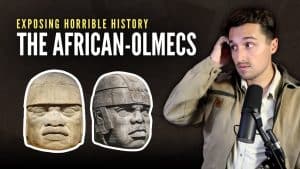
In 1862, José María Melgar y Serrano made the first recorded discovery of an Olmec head at the site of Tres Zapotes, Mexico. Throughout the late 19th and early 20th centuries, archaeologists and historians debated the origins of these monumental sculptures, speculating about the civilization responsible for their creation. Early observers noted the prominent facial features of the heads, which led some to hypothesize that they represented individuals of African descent.
The African-Olmec Hypothesis
During the 20th century, this idea gained traction through works such as Leo Weiner’s Africa and the Discovery of America, R. A. Jairazbhoy’s The Ancient Egyptians and the Americas, and Ivan Van Sertima’s They Came Before Columbus (1976). These works argued that during the height of Olmec civilization (approximately 800–600 BCE), a hypothetical African civilization crossed the Atlantic Ocean, settled in the Gulf of Mexico, and influenced the development of Mesoamerican cultures.
The core of these theories relies on perceived visual similarities between the Olmec heads and stereotypical African features, as well as speculative cultural parallels. According to Van Sertima and others, this hypothetical African influence laid the groundwork for Mesoamerican civilizations, and in some interpretations, civilizations across the Americas.
Issues with the Theory
The theory has been widely criticized for its reliance on tenuous visual and cultural parallels. DNA analysis of indigenous Mesoamerican populations has found no evidence of pre-Columbian African ancestry. The first documented arrival of Africans in Veracruz, Mexico, occurred in 1570, when escaped African slaves from the Caribbean reached the region.
Additionally, the theory overlooks the diversity of physical traits among indigenous populations in the Americas, which vary significantly across regions. For example, indigenous groups in southern Mexico often exhibit facial features similar to those of the Olmec heads.
Skin Color and Historical Context
The focus on attributing cultural achievements based on skin color reflects modern postcolonial constructs rather than historical realities. In ancient societies, social divisions were based on culture, language, and ancestry, rather than skin color. Historical records and evidence suggest that concepts of racial prejudice tied to skin color emerged in the past 500 years, particularly during the colonial period.
Van Sertima’s argument also disproportionately emphasizes Egypt’s 25th Dynasty (circa 780–650 BCE), ruled by Nubian kings, as the source of African influence on Mesoamerica. This focus overlooks the broader history of Egypt as a diverse civilization influenced by Africans, Middle Easterners, and Mediterranean populations.
The Egyptian Connection
Van Sertima claimed cultural parallels between ancient Egypt and the Olmec civilization, particularly during the Nubian Dynasty. These claims include the development of a solar calendar and architectural similarities. However, no evidence supports Egyptian expeditions to the Americas or their colonization of Mesoamerica.
Egyptians were largely isolationist, focusing on the Nile Valley. They lacked a tradition of maritime exploration comparable to that of the Phoenicians or Greeks. Egyptian ships were primarily designed for river navigation, and the establishment of Egypt’s first significant Mediterranean port, Alexandria, occurred only in 300 BCE under Greek rule.
Furthermore, Phoenicians, not Egyptians, constructed the city of Lixus in modern Morocco, cited by Van Sertima as evidence of Egyptian influence in Africa.
Other Theories of African Influence
Another version of the African-Olmec theory attributes Olmec civilization to the Moors or the Mali Empire. While both were advanced civilizations capable of navigating the Atlantic Ocean, their peak periods (800–1400 CE) occurred more than a millennium after the rise and fall of the Olmec civilization.
Evidence for transatlantic contact includes linguistic similarities, such as the Taino word “guanín,” used to describe a metal alloy believed to have African origins. However, no physical evidence, such as artifacts, inscriptions, or ship remains, supports sustained African influence on Mesoamerican civilizations.
Alternative Theories of Transatlantic Contact
Some suggest that Phoenician sailors might have reached the Americas. Monument 13 from La Venta, known as “The Traveler,” depicts a figure holding a flag, wearing what resembles a turban, and sporting facial hair uncommon among indigenous Mesoamericans. While this suggests the possibility of transatlantic contact, it does not indicate that such visitors influenced Olmec civilization.
Conclusion
No evidence supports the theory that Africans or any other external civilization founded the Olmec culture. The Olmec civilization emerged independently, shaped by its local environment and indigenous populations. The reattribution of indigenous achievements to external civilizations reflects modern biases rather than historical facts.
Egyptians, except for a brief Nubian Dynasty, were primarily isolationist and focused on the Nile Valley. The Mali Empire and the Moors, while advanced, existed far too late to influence the Olmecs.
Historical revisionism that applies modern racial constructs to ancient civilizations is misleading and detracts from the unique achievements of indigenous cultures in the Americas. The evidence supports the conclusion that the Olmec civilization was entirely indigenous to Mesoamerica.
For further discussion of historical revisionism and related topics, viewers are encouraged to explore additional episodes of HistorBabble.
Comments are closed.