
Table of Contents
Tiahuanaco, also written Tiwanaku, is the ruined city on the Bolivian altiplano near Lake Titicaca. It keeps turning up in my research: in an Inca flood story, in Ignatius Donnelly, in Chan Thomas, in the Akakor chronicle and in several videos. These are the pages where I wrote about it.
Where the flood survivors landed
On Flood Stories from Around the World I give the Inca account that Cristóbal de Molina, a priest in Cusco, recorded in the 1570s:
No living things survived except a man and a woman who remained in a box.
Cristóbal de Molina, Fables and Rites of the Yncas, translated by C. R. Markham
When the waters fell, the box was carried to Tiahuanaco, and there the Creator began again, making each nation out of clay. Is There an Andean Version of Atlantis in Quechua Traditions? follows Viracocha and the Tiwanaku ruins through the Quechua tales, and also notes that Tiwanaku was never submerged.
The ruins the Spaniards saw
In The Peruvian Colony, Ignatius Donnelly cites Cieça de Leon, who saw great ruined buildings at “Tiahuanaca”, an artificial hill raised on a stone groundwork, and two stone idols in long robes. Cieça de Leon wondered how human power could have moved stones so large. Paul Schliemann, in How I found the lost Atlantis, the source of all civilization, quotes notes he attributes to his grandfather Heinrich Schliemann, who claims he found objects from Tiahuanaca in the Louvre in 1883 that matched finds from Troy.
Derek Olson, on Matthew LaCroix’s podcast, reads Cieza de León’s own account of asking the local people whether the buildings dated from the time of the Inca (at 18:26).
They laughed at the question, affirming that they were made long before the Inca reign.
Pedro Cieza de León, read by Derek Olson
A drowned or shaken city
Chan Thomas, in The Adam and Eve Story, claims that Tiahuanaco stood at sea level, that its astronomers used telescopes, and that astronomers from Potsdam dated a shift of the earth’s crust to 9550 B.C. from writings in the ruins. On The Chronicle of Akakor the German-Bolivian scientist Posnansky is said to estimate that Tiahuanaco was destroyed around 10,000 B.C. On Moon I note that symbols at Tiwanaku are read as showing a sky before the moon came into orbit.
In the same talk, Olson gives Arthur Posnansky’s date of about 17,000 years for Tiwanaku and Puma Punku, worked out from sky alignments. LaCroix says he agrees with it (at 42:57).
If this is 17,000 years, try to imagine how unbelievably sophisticated this would be to not only survive that long, but to survive in that kind of condition.
Matthew LaCroix
Why build so high?
In The Problem of Atlantis Lewis Spence asks why the builders of Tiahuanaco chose a cold and barren plateau. He suggests that the land has risen since it was occupied.
The greatest mystery of all regarding the ruins at Tiahuanaco is the selection of the site. For what reason did the prehistoric Andeans build here ? The surroundings are totally unsuited to the raising of such edifices, and the tableland upon which they are placed is at once desolate and difficult of access. The snow-line is contiguous, vegetation will not grow, and breathing at such a height is no easy matter. There is, however, reason to believe that the plateau has risen considerably since it was occupied by the Andeans.
Lewis Spence, The Problem of Atlantis (1925), chapter 15, p. 191
From Antilia by the Amazon
He then places the earlier Andean stock on the shores of Brazil after the fall of Antilia, and has them reach Peru by working their way up the Amazon.
But the earlier stock, the Andeans, almost certainly arrived, after the fall of Antilia, on the shores of Brazil, and working their way by degrees up the Amazon, arrived at last in Peru.
Lewis Spence, The Problem of Atlantis (1925), chapter 15, p. 192
In the videos
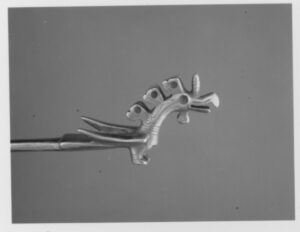
In Built by Ancient Civilisations?, Graham Hancock dates Tiwanaku to roughly 300 to 1000 CE and looks at the Akapana pyramid and the precise stonework of Puma Punku. In The Philosophers of Atlantis with Jason Reza Jorjani, Jorjani points to stellar misalignments and high-altitude port structures. In Bloodlines of Noah, Lake Van & the Anunnaki., Matthew LaCroix compares structures near Lake Van with those in Peru and Bolivia. And Bird Pin of Spatula shows a small object worked in the Tiwanaku style.
Related pages
- Flood Stories from Around the World
- Is There an Andean Version of Atlantis in Quechua Traditions?
- The Peruvian Colony
- How I found the lost Atlantis, the source of all civilization
- The Adam and Eve Story
- The Chronicle of Akakor
- Moon
- Built by Ancient Civilisations?
- Bird Pin of Spatula
For every page I tagged with Tiahuanaco, see the Tiahuanaco tag archive.

