
Table of Contents
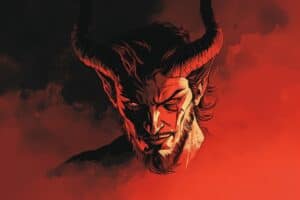
According to Scripture, Satan is a fallen angel (Ezekiel 28, Isaiah 14). He is the enemy of God. He seeks to steal, kill, and destroy (John 10:10).
The Old Testament presents a different angle on this story through the account in Genesis. Many religious scholars link the serpent in Genesis 3 to Satan. For evidence, the New Testament in Revelation 12:9 and 20:2 calls Satan “that ancient serpent” who deceives the world. This connects the Genesis serpent directly to the devil. Christian traditions, such as those in writings by early church fathers like Justin Martyr and Augustine, also identify the serpent as Satan or a form he took to tempt humanity.
In Genesis 3, the serpent tells Eve that eating from the Tree of Knowledge will open her eyes and make her like God, knowing good and evil. This suggests the serpent offers maturity and wisdom. In contrast, God commands avoidance of the tree to keep humans in a state of innocence and simplicity. From this view, God aims to maintain naïveté, while the serpent challenges this by providing access to divine knowledge.
Another perspective comes from the Book of Enoch, a text found among the Dead Sea Scrolls in 1948. It describes the “Watchers”—200 angels led by Samyaza, often associated with Satan or fallen angels. These angels were sent to oversee humans but rebelled. They mated with women and taught forbidden skills, such as metalworking, astrology, and medicine. This act can be seen as giving humans the tools of civilization and advancement. Some interpretations suggest that ancient texts may have portrayed these figures as evil, but perhaps the opposite is true: they were the ones promoting human growth and knowledge.
Ezekiel 28
Focus on verses about the king of Tyre, seen as a reference to a fallen being
The word of the Lord came to me: “Son of man, say to the ruler of Tyre, ‘This is what the Sovereign Lord says: In the pride of your heart you say, “I am a god; I sit on the throne of a god in the heart of the seas.” But you are a mere mortal and not a god, though you think you are wise as a god.’”
Verses 1-2
“Son of man, take up a lament concerning the king of Tyre and say to him: ‘This is what the Sovereign Lord says: You were the seal of perfection, full of wisdom and perfect in beauty. You were in Eden, the garden of God; every precious stone adorned you... You were anointed as a guardian cherub, for so I ordained you. You were on the holy mount of God; you walked among the fiery stones. You were blameless in your ways from the day you were created till wickedness was found in you... So I drove you in disgrace from the mount of God, and I expelled you, guardian cherub, from among the fiery stones. Your heart became proud on account of your beauty, and you corrupted your wisdom because of your splendor. So I threw you to the earth...’”
Verses 12-17 (the lament, often connected to a fallen angel)
“Son of Man” means beings who appear “like humans” but are not fully human. Kab states this describes Pleiadians, who are leaders in the Galactic Federation and Earth’s protectors.
Isaiah 14
focus on verses about the king of Babylon, often linked to Satan
“How you have fallen from heaven, morning star, son of the dawn! You have been cast down to the earth, you who once laid low the nations! You said in your heart, ‘I will ascend to the heavens; I will raise my throne above the stars of God; I will sit enthroned on the mount of assembly, on the utmost heights of Mount Zaphon. I will ascend above the tops of the clouds; I will make myself like the Most High.’ But you are brought down to the realm of the dead, to the depths of the pit.”
Verses 12-15
Background on possible changes over time
The Hebrew Bible texts come from ancient manuscripts. The main source today is the Masoretic Text (MT), from around 900–1000 AD. Older evidence includes:
- The Dead Sea Scrolls (DSS, from about 250 BC–68 AD): The Isaiah scroll (Great Isaiah Scroll) matches the MT very closely for Isaiah 14, with only minor differences (spelling, small words). No major changes alter the meaning.
- For Ezekiel 28, DSS fragments exist but are limited. They align well with the MT in general.
- The Septuagint (LXX, Greek translation from 3rd–2nd century BC): Shows some differences in Ezekiel 28. For example, in verse 14, the MT calls the figure “an anointed guardian cherub,” while the LXX separates the king from the cherub more clearly (e.g., “with a cherub” instead of “you were”). Scholars debate if the LXX preserves an earlier Hebrew version or if the MT added details later. These are small textual variants, not core changes to the story of pride and fall.
Overall, the core message in both passages has remained stable across manuscripts for over 2,000 years. Minor variants exist (as in most ancient texts), but they do not change the main ideas of arrogance, divine judgment, and downfall. The link to Satan comes from interpretation, not from major textual shifts.
Read more
Could the Ancient Serpent relate to the negative group of Sirian beings?


Comments are closed.