
Table of Contents
Mammoths turn up on this site wherever the end of the Ice Age is discussed. They are evidence in the catastrophe debates, animals that Atlanteans had to live with, figures on American monuments, and bones frozen in Alaskan muck and piled up in Siberian river beds. I gathered the passages here.
Living beside them
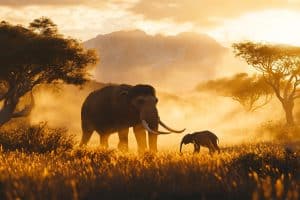
In the Atlantis literature, mammoths are part of daily life. On Early Atlantis until 48,000 BCE, the book Atlantis: Insights from a Lost Civilization describes the land the first settlers faced:
Numerous species of elephants, mammoths (4.27 meters) high at the shoulders, massive herds of mastodon, hungry cats and wolves, and large wild horses roamed freely where people attempted to live.
Atlantis: Insights from a Lost Civilization
W. Scott-Elliot, on The Story of Atlantis, says the beasts hunted in that very early period were mammoths with long woolly hair, elephants and hippopotami. The Chronicle of Akakor describes Stone Age man as a hunter of mammoth, wild horses and reindeer, and the video Interview with a Neanderthal (Part 2) adds that Neanderthals hunted woolly mammoths only rarely, because they were so hard to bring down.
The sudden end
The extinction is where the debate starts. Chan Thomas, on The Adam and Eve Story, quotes Frank C. Hibben’s The Lost Americans on the Alaskan finds:
"... Mammoth and bison were torn and twisted as though by a cosmic hand in a godly rage... In many places, the Alaskan muck blanket is packed with animal bones and debris in trainload lots..."
Frank C. Hibben, The Lost Americans
The earth to spin off balance describes the Berelekh bone-bed in Arctic Siberia, where more than 9,000 bones from at least 156 woolly mammoths lie in one deposit about (65.6 feet) long. Events leading to the final destruction of Atlantis dates the extinction of the woolly mammoth to around 12,000 years ago, beside the giant ground sloth and the short-faced bear. Dangerous large animals points to genetic bottlenecks in mammoths, horses, bison and cave lions much earlier, around 50,000 to 35,000 years ago.
Ignatius Donnelly had his own answer. Ignatius Donnelly summarizes Ragnarok (1883), where a comet’s near-collision with the Earth caused the Flood, the destruction of Atlantis and the extinction of the mammoths. On The Legend of Starcrash, a nearly complete mammoth skeleton found in 1989 at (2,743 meters) in central Utah was believed to have become mired in a bog at the edge of a glacier 10,000 to 15,000 years ago.
Frozen meat and images in stone
Where Was Atlantis retells Dale Guthrie’s account in Frozen Fauna of the Mammoth Steppe, where his team found a thirty-six-thousand-year-old bison near Fairbanks and cooked some of the meat. On American Evidences of Intercourse with Europe or Atlantis, elephant figures on American monuments suggest either that the monuments date back to when mammoths roamed North America or that their makers knew elephants from elsewhere.
The videos add human traces. Mysterious Ice Age Relics shows a plate made from mammoth ivory that is thought to represent a map, and The Cosmic Hunt Myth notes that a mammoth appears in the Siberian version of the Cosmic Hunt but not in the European or American ones. In Life on Doggerland Documentary, Kayleigh traces the mammoths of Doggerland from the southern mammoth to the steppe and woolly mammoth.
The Oahspe takes the long view on Book of Jehovih:
Let no man marvel because of the size of the mammoth and the ichthyosaurus, for there was a time for them as there is a time for the infusoria of this day.
Oahspe, Book of Jehovih
Donnelly on the frozen mammoths
Ignatius Donnelly, the Minnesota politician who wrote Atlantis: The Antediluvian World, followed it in 1883 with Ragnarok: The Age of Fire and Gravel. He used the frozen mammoths of Siberia as evidence that, in his account, a comet brought a sudden catastrophe.
Frozen as soon as killed
Donnelly quotes the French naturalist Georges Cuvier on the frozen carcasses of the north. Cuvier argued that the cold came at the same moment the animals died.
If they had not been frozen as soon as killed, putrefaction would have decomposed them; and, on the other hand, this eternal frost could not have previously prevailed in the place where they died, for they could not have lived in such a temperature. It was, therefore, at the same instant when these animals perished that the country they inhabited was rendered glacial. These events must have been sudden, instantaneous, and without any gradation.
Georges Cuvier, quoted in Ignatius Donnelly, Ragnarok: The Age of Fire and Gravel (1883), part I, chapter VII, p. 47

A mammoth carved on mammoth ivory
Donnelly points to a drawing of a mammoth engraved on a piece of mammoth tusk. For him it showed that the carver lived before or during the Drift.
Nay, more, a picture of a mammoth has been found engraved upon a piece of mammoth-tusk. The engraving on page 349 represents this most curious work of art.
The man who carved this must have seen the creature it represented; and, as the mammoth did not survive the Drift, that man must have lived before or during the Drift. And he was no savage.
Ignatius Donnelly, Ragnarok: The Age of Fire and Gravel (1883), part IV, chapter I, p. 350
Related pages
- Early Atlantis until 48,000 BCE
- The Adam and Eve Story
- The earth to spin off balance
- Events leading to the final destruction of Atlantis
- Dangerous large animals
- The Legend of Starcrash
- Where Was Atlantis
- Life on Doggerland Documentary
For every page I tagged with Mammoths, see the Mammoths tag archive.

