
Table of Contents
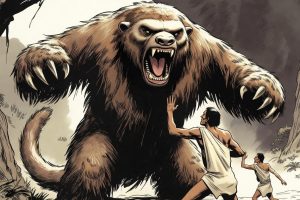
In reading 364-4 (16 February 1932), Cayce refers to “the invading animals” and “enormous animals.” He links the handling of these creatures to early developments in Atlantean society, including the beginning of certain sacrificial practices.
A related reference appears in reading 262-39, which describes a “Great Congress” held during the age of the destruction of the enormous animals. Summaries of the readings place this congress around 50,722 BC. The leader is identified as “Tim from Poseidia, Atlantis.” The event involved representatives from various groups and nations who gathered to address the problem of large, marauding beasts overrunning parts of the earth, including areas associated with Atlantis.
Secondary sources based on the Cayce material describe these as “hordes of huge beasts,” “giant members of the animal kingdom,” or animals that threatened human populations. Some accounts note that certain groups (associated with the Sons of Belial) attempted to destroy the animals using advanced or destructive methods, such as directed energy or rays from central plants. The animals were eventually reduced through a combination of these efforts and major natural changes, including shifts in the earth’s poles and climatic shifts.
These references appear in the broader context of early Atlantean development and the challenges faced by its inhabitants. They provide background for mentions of technology developed for safety and practical necessities during that period, as discussed in reading 364-6.
The people of Atlantis constantly experimented with obtaining energy from natural sources.
Following the final conference in 50,722 B.C., as they tried to rid their land of the dangerous large animals that were overrunning it, generation after generation of scientists worked intensely to devise weapons for defense against the beasts.
Toxic gases were one of their first attempts.
When the noxious fumes were ready, desperate Atlanteans optimistically used the wind to blow them into large caves where the dreaded animals lived. Only the young beasts died, and erratic breezes wafted the dreadful poisons toward unsuspecting human onlookers.
Simultaneously, the disturbed larger animals left their sheltered homes and, like a swarm of angry bees, furiously attacked anything or anyone within range.
For hundreds of years Atlanteans continued to search for means of combating the obnoxious animals.
They developed various types of explosives that were advantageous but also difficult to control.
Edgar Cayce describes powerful rods, similar to lasers, that skilled Atlantean technicians focused on the beasts from a central location.
The intense light killed some, but not enough to alleviate the problem. Lasers are an example of the many things in Cayce’s readings that seemed unlikely at the time he described them but later proved accurate.
Lasers were reinvented in the 1960s, thirty years after his references to them.
Continued experimentation eventually led to the development of nuclear power.
Seafaring merchants brought uranium to laboratories in Atlantis from mines adjacent to rivers leading to the ocean, such as the one in nearby Gabon, West Africa, which was mined extensively in antiquity.
Probably with considerable advice from their celestial visitors, scientists exposed the dangerous material to vast streams of energy from the heat of the sun and managed to split the atom. Before long, nuclear power was available.
It proved valuable for destroying large animals, but Edgar Cayce says its misuse soon stimulated earthquakes and intense volcanic eruptions, initiating the first major devastation of Atlantean civilization around 50,700 B.C.
Atlantis: Insights from a lost civilization

Gabon, a nation in West/Central Africa, is historically famous for the Oklo mine in the Haut-Ogooué Province. Discovered in the 1950s and operated from 1960 to 1999, these sites are the only known locations in the world where naturally occurring, prehistoric nuclear fission reactors operated over 2 billion years ago.
Scientific evidence for significant depopulation and extinction of large animals
There is substantial scientific evidence for significant depopulation and extinction of large animals (megafauna) during the Late Pleistocene, with a major wave of declines occurring around 50,000–40,000 years ago. This period aligns closely with the timeframe in the quote above (approximately 52,700 years before present, or ~50,700 BC).
Timing
The broader Quaternary (or Late Pleistocene) megafaunal extinction event spanned roughly 50,000 to 10,000 years ago.
A key early pulse occurred between about 52,000 and 40,000 years ago in several regions, including Australia (Sahul) and parts of Eurasia.
Studies identify a global breakpoint in megafauna population declines around 48,000–52,000 years ago.
Evidence
Radiocarbon and other dating methods show the last appearances or sharp reductions of many large species (e.g., giant ground sloths, certain elephant-like animals, large carnivores) cluster in this window, especially in Australia where extinctions were largely complete by ~50,000 years ago.
Genetic data from fossils reveal population bottlenecks and sharp drops in genetic diversity for species such as mammoths, horses, bison, and cave lions around 50,000–35,000 years ago in high-latitude and other regions.
Human arrival and expansion (Homo sapiens dispersal out of Africa and into Australia/Eurasia) coincide with these declines. In Australia, human presence is dated to at least 50,000–65,000 years ago, matching the extinction pulse.
One 2023 study in Nature Communications estimated that total megafauna abundance, biomass, and energy turnover decreased by 92–95% over the past 50,000 years, with declines becoming widespread across landmasses in the 32,000–76,000-year range and a clear acceleration near 48,000–52,000 years ago.
In Australia, ~82% of megafauna were lost between 50,000 and 40,000 years ago. In northern Eurasia, declines were staggered but began intensifying around this time. North and South American peaks came later (~13,000 years ago).
Causes
Scientists debate the drivers, but evidence points to a combination of factors:
Overhunting, habitat alteration (e.g., landscape burning), and competition are strongly supported, especially where human arrival timelines match extinction pulses. Some models suggest humans were the dominant driver globally.
Rapid fluctuations during Marine Isotope Stage 3 (including Dansgaard-Oeschger events) caused habitat shifts, vegetation changes, and stress on large herbivores and their predators.
Most researchers favor synergistic effects: climate made populations vulnerable, while human activities accelerated declines.


Comments are closed.