
Table of Contents
Overview of the Giza Plateau
The Giza Plateau is a site of immense architectural density. It contains numerous tombs, tunnels, shafts, and other structures, some of which remain unexplored. Surrounding the Great Pyramids are many mysterious features, such as vertical shafts descending over 12 meters (39.37 feet) into the earth. The site also includes notable structures like the Mortuary Temple and the Causeway of Menkaure.
The surrounding desert raises questions about the potential existence of ancient structures beneath the sands. Scholars speculate on how far back construction at Giza might extend, potentially preceding the Fourth Dynasty (circa 2600 BCE).
Early Dynastic Settlements
Evidence shows that ancient Egyptians thrived in a fertile, tropical region along the Nile, not in deserts. These primarily agricultural communities left little direct trace of their homes, as real estate along the river has been continuously occupied and rebuilt for millennia. However, tombs and burial sites in the western desert have mainly remained undisturbed.
Egyptian tombs were traditionally located west of the Nile, symbolizing the journey into the afterlife, as they associated the setting sun with death and rebirth. These practices were rooted in solar worship, particularly the veneration of Ra, the sun god.
Pre-Fourth Dynasty Structures at Giza
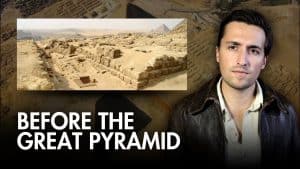
Efforts to uncover evidence of structures preceding the Great Pyramid have yielded insights. Archaeologists in 1904 uncovered a mastaba at Giza, believed to date to the First Dynasty (circa 3100 BCE). This tomb, constructed from mudbrick, displayed architectural features consistent with early dynastic styles.
A seal bearing the name of Pharaoh Djet provided evidence for the dating. The mastaba featured a burial chamber with dimensions matching those of the King’s Chamber in the Great Pyramid. Surrounding this central structure were approximately 55 smaller tombs, likely for artisans and officials associated with the primary tomb occupant.
Subsequent discoveries include mastabas attributed to the Second and Third Dynasties. For example, an excavation by Flinders Petrie documented another First Dynasty mastaba and the site known as Covington’s Tomb. Both were aligned southward of the Great Pyramid, with intricate features suggesting evolving architectural techniques.
The Sphinx and its Origins
The Great Sphinx of Giza, attributed to Pharaoh Khafre of the Fourth Dynasty, remains a subject of debate. Some scholars propose that the limestone outcrop forming its body predates Khafre’s reign. Evidence supporting this theory includes water erosion marks on the Sphinx enclosure, indicating exposure to significant rainfall in earlier, wetter periods of Egyptian history.
The exact timeline of the Sphinx’s construction is uncertain. It may have been a natural outcrop initially venerated and later shaped into a lion or a pharaoh’s likeness. However, determining the origins and modifications of this structure is complicated by the erosion and the lack of definitive records.
Insights into the Workers’ Village
Excavations south of the Giza Plateau have revealed remnants of settlements likely housing laborers who built the pyramids. A dump site near Menkaure’s Valley Temple contained artifacts dating from the First to Fourth Dynasties. These findings suggest a displacement of local communities during pyramid construction.
Legacy of Ancient Giza
Giza’s history spans thousands of years, marked by layers of construction and desert reclamation. While many structures from earlier periods are buried beneath the sands, discoveries of mastabas and other relics offer glimpses into Egypt’s formative dynasties.
The mysteries surrounding Giza, including the age and purpose of its monuments, continue to inspire exploration and speculation.
Comments are closed.