
Table of Contents
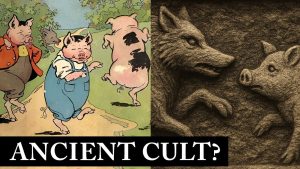
You think you know the story. Three pigs, three houses, one big bad wolf—a warning for children, a moral about hard work. Simple, harmless, familiar. But what if this innocent tale hides something much older and much darker? A story of winter, of sacrifice, of an ancient threat that always comes with the wind.
Because long before the pigs built houses of straw, sticks, and brick, they were offerings laid on stone altars. And the wolf was not just a predator. He was the one they feared would come if the sacrifice failed.
The Traditional Tale
Welcome back, Darklings.
Before we unearth the forgotten roots of the three little pigs, let’s return to the tale as it has been told for generations.
Once upon a time, there were three little pigs. Their mother sent them out into the world to seek their fortunes, and each built a house to protect himself from danger.
The first pig was carefree, light-hearted, and lazy. He built his house from straw—quick to gather, easy to stack, and done by midday. But when dusk fell, a shadow moved between the trees. It was the big bad wolf.
He called out from beyond the door: “Little pig, little pig, let me in.” The pig shivered with fear. “No, not by the hair on my chinny chin chin. You cannot come in.” “Then I’ll huff and I’ll puff and I’ll blow your house down.”
With one terrible breath, the wolf blew down the straw house and gobbled up the first little pig.
The second pig, wanting to play instead of work, had built his house from sticks. He had taken a little more care, and the house was a little stronger, but not strong enough.
Once more, the wolf cried out: “Little pig, little pig, let me in.” “No, not by the hair on my chinny chin chin. You cannot come in.” “Then I’ll huff and I’ll puff and I’ll blow your house down.” The sticks splintered and flew. And the second pig was devoured, too.
Only the third pig remained. He was patient, clever, and hardworking. He built his house from brick, even though it took him all day. And when the wolf came, he found walls that would not break and fall. He huffed. He puffed. But try as he might, the house stood firm.
Some versions end here, but others go further. The wolf tries to sneak in through the chimney, and the third pig sets a pot of boiling water on the fire. The wolf falls in and is cooked alive.
Today, the tale is usually softened. All three pigs scamper away to safety and survive. But in its older forms, it was cold, ruthless, and brutal.
Literary History
The version we know best was popularized in the late 19th century in Joseph Jacobs’ English Fairy Tales, but even Jacobs was borrowing.
Four years earlier, folklorist James Orchard Halliwell had included the three little pigs in the fifth edition of his Nursery Rhymes of England in 1886. And for the first time in print, the world saw the immortal lines: “Not by the hair of my chinny chin chin,” and “I’ll huff and I’ll puff and I’ll blow your house in.”
But Halliwell did not write the story. He was a collector of folk rhymes and tales, and earlier versions show it had already traveled far through oral tradition, part of a much older folk heritage from the British Isles.
One of the most curious comes from Dartmoor in 1853. Here the pigs are gone, replaced by three pixies and a cunning fox. But the bones of the tale remain: three dwellings of increasing strength, a relentless predator, and the triumph of the strongest.
And the trail does not end in England. In 1885, Thomas Crane recorded an Italian folk tale about three young goslings trying to outwit a wolf. Across Europe, India, America, and beyond, you find the same pattern: three siblings, three houses, one survivor.
When the same story appears in so many places, folklorists begin to suspect that this tale has roots that run far deeper than we think.
The Rule of Three in Storytelling
The Three Little Pigs follows a pattern seen again and again in storytelling: the rule of three. Three pigs, three houses, three chances. Just like Goldilocks and the three bears, the three Billy Goats Gruff, or the three trials faced by heroes in countless tales.
Across cultures, we find stories of three siblings given a task by fate or the divine. The first two fail through arrogance, laziness, or poor judgment. But the third succeeds through sacrifice, humility, or wisdom.
A clear example appears in the Russian fairy tale of The Firebird, where three brothers set out on a perilous quest. The two elder brothers falter by being distracted and lazy, but the youngest perseveres through hardship and is ultimately rewarded with success and glory.
But sometimes fairy tales are not just fanciful inventions. They are memories, stories passed by word of mouth for generations until we forget where they began.
In 2016, a study in the journal Royal Society Open Science used comparative methods to trace the ancestry of folktales and found that some may be over 5,000 years old.
Tales like Jack and the Beanstalk, The Smith and the Devil, and yes, stories with the three little pig structure may have been told in the Bronze Age, long before writing ever reached Europe.
And if that is true, then what we call a children’s story may have started as something far more serious, something sacred, something terrifying.
Connections to Ancient Myths
In ancient India, we find a powerful myth known as the Tripura. Three demon brothers each build a city: one of iron, one of silver, and one of gold. The cities are floating fortresses, invulnerable to the gods. And for a while, the demons are safe.
Like the pigs, these brothers believed their creations could withstand destruction. But fate had other plans. Eventually, the gods beg Shiva to intervene. He draws a single bow, looses a flaming arrow, and destroys all three cities at once. Not one survives.
The tale of Tripura, likely rooted in ancient Vedic tradition, was first written down over 2,000 years ago, but scholars believe it was told orally more than 3,000 years ago. It carries a chilling lesson: no structure, no matter how grand, can protect you from the divine. A warning that no one is ever beyond retribution.
We find similar echoes in Celtic mythology, where three proud brothers or sons of a king build separate fortresses only to be destroyed by magic, fate, or the elements.
But not every three-brother tale ends in ruin. In other ancient myths, the brothers are not hiding from destruction. They are building the world itself.
In Norse myth, the entire world is built by three brothers: Odin, Vili, and Ve. Sons of the primordial being Bor, they slay the giant Ymir, the embodiment of chaos. And from his remains, they construct the world: the sea from his blood, the sky from his skull, the mountains from his bones.
And there is another echo, older still. Reconstructed from ancient myth fragments is a tale told across Indo-European cultures. It begins with three brothers: Manu, Yemo, and Trito.
In this ancient myth, Manu sacrifices Yemo. From the slain brother’s body, the world is created—a cosmic act of creation through sacrifice. Later, Trito must prove himself by battling a monstrous serpent, a symbol of cosmic conflict between order and chaos.
And in certain reconstructions of the myth, especially those drawing from Iranian, Vedic, and Roman parallels, the guardian is not always a serpent. Sometimes it is a wolf-like creature or a monstrous beast linked to death, night, or destruction.
It is not the same tale, but the pattern is hauntingly familiar. In the three little pigs, two brothers perish, their houses destroyed, and the third, like Trito, faces a final test against a monstrous force—a ravenous wolf—and only one survives to carry the story forward.
The Role of Pigs in Ancient Rituals
But if this fairy tale began the same way, why are our brothers pigs?
In the ancient world, pigs were not just food; they were sacred. And the idea of three pigs has a strange connection to an ancient rite.
In Greece, during the secretive Thesmophoria rituals, pigs were sacrificed to Demeter and Persephone, goddesses of grain, fertility, and the underworld.
A pregnant sow was buried alive for Demeter. An uncut boar was offered to Persephone. And a suckling piglet given to Zeus Chthonios, a shadowy underworld form of Zeus tied to mystery rites.
These animals were left underground to rot. Then later, their remains were dug up, mixed with seed grain, and plowed back into the earth—a grotesque blend of death, decay, and rebirth believed to bless the harvest and appease the gods.
Unlike sheep or goats, seen as cleaner, more docile animals, the pig was something greater: louder, bloodier, harder to control. It rooted in the dirt, fattened quickly, and bled richly.
In many cultures, pigs were a heavier sacrifice—more valuable, more dramatic. It belonged to the realm of fertility and the underworld, ideal for rites that demanded death and promised rebirth.
Archaeological Evidence
Archaeological sites across Bronze and Iron Age Europe reveal real echoes of these ancient rites. At Göbekli Tepe in Germany, a ritual pit was unearthed containing the bones of a piglet, deliberately placed beside burnt grain, broken pottery, and human remains.
In Mycenaean Greece, similar pits held tiny piglets buried whole, offerings to chthonic deities tied to the underworld, harvest, and rebirth.
In Norse myth, a Yule boar was offered to Freyr, god of peace and plenty, during the winter solstice—a ritual marking the darkest time of year and the hope of returning light. It was death to bargain for life.
In each of these rites, the pig was an offering, a symbol, a bridge between the living and the divine. So perhaps pigs entered the tale not because they were funny, but because they were familiar—familiar as sacrifices and familiar as stand-ins for us.
In some Mediterranean traditions, pigs were seen as spiritual surrogates, animals offered in place of humans to appease the gods.
So when three pigs are sent into the world only to be consumed by the wolf, it may not be a silly fable. It may be a memory—a memory of ritual sacrifice, of death for the sake of life, of something or someone being given to the darkness so that others may live.
Symbolism of the Wolf
But what about the wolf? Wolves appear in the mythology and folklore of many cultures, often symbolizing both ferocity and protection, loyalty and destruction. In some traditions, they are divine messengers or even gods themselves.
In Norse mythology, the giant wolf Fenrir breaks free at the end of days, devouring the sun and plunging the world into darkness—the first act of Ragnarok. Among early Slavic peoples, the wolf was a threshold guardian, a beast that walked between the worlds of the living and the dead.
The wolf’s dual nature is found in these myths, embodying both the dangers and the strengths of the natural world. But the wolf in our story has one very particular trait. Listen again to the threat: “I’ll huff and I’ll puff and I’ll blow your house down.” It is not teeth; it is breath, wind.
Maybe it is because strong winds howl like wolves. Or maybe the wolf was never meant to be a creature at all. In prehistoric Britain and Europe, archaeologists have found strange signs of destruction. Entire wooden homes, still structurally sound, deliberately set on fire.
At Durrington Walls near Stonehenge, round houses were lived in for just one season, then burned—not by enemies, but by their own people. Some scholars believe these were ritual endings, a symbolic sacrifice of shelter to mark the turning of the year, a kind of controlled chaos to keep real chaos at bay.
And when we picture a wolf blowing down houses one after another, we might be seeing a dim echo of this idea: destruction as offering.
Connection to Winter and Survival
So the wolf in the story might not be a fairy tale villain. It might be the god of winter knocking at the door.
Winter required preparation, sacrifice, work. Across Europe and beyond, the winter solstice was both celebration and warning—a moment to feast, but also to fortify.
Animals were slaughtered, meat preserved, shelter prepared, offerings made to the gods, and always the question lingered: Will it be enough?
And maybe these ideas are reflected in the fairy tale we now know—a tale where the lazy are lost, where the clever survive, where winter comes, and those who prepare best live to tell the tale.
Teaser for Next Topic
But not all threats arrive as snarling wolves at the door. Sometimes they come from the shadows of a well, wearing the skin of something small, cold, and strange. And the true meaning of that tale is far older and far darker than anyone suspects. Click here to discover the ancient secret behind the Frog Prince.
See you in a future video.
Comments are closed.