
Table of Contents
For those of you who have been following this channel, you’re likely familiar with my stance on the accuracy of historical documents—not only the documents themselves but also their creators. It’s similar to the game of “telephone,” where information can be distorted over time. Back then, if someone wanted a fresh start, all they had to do was travel a few hundred kilometers and have the right documents, which could create an entirely new identity.
Take historical figures like Shakespeare, for example. It’s not so much the individuals themselves that were important, but rather the messages they conveyed. With that in mind, let’s talk about Hermes Trismegistus.
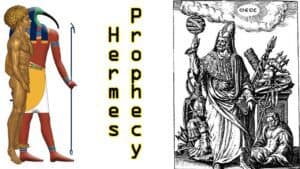
Hermes Trismegistus, if I’m pronouncing his name correctly, was both a Greek and Egyptian figure who had a significant influence on philosophy and, indirectly, on modern medicine. For instance, when you see the winged serpent symbol on medical staff insignias, that symbol is connected to Hermes. Ancient texts like the Kybalion and The Emerald Tablets of Thoth offer valuable perspectives on the world. While some concepts, like alchemy and turning lead into gold, might seem far-fetched, these works still provide unique insights into how we perceive life.
Today, we’re going to discuss a lament, or prophecy, from Hermes Trismegistus to his son Asclepius. It’s a rather bleak prediction about the future, but you might notice parallels between what Hermes described and the current state of society. Interestingly, this prophecy references a singular Creator or God, which stands out given the polytheistic context of ancient Egypt and Greece. Many world religions seem to overlap in various ways if we are open to seeing those connections.
The prophecy
Do you know, Asclepius, that Egypt is an image of the heavens, or to be more precise, in Egypt all the operations of the Powers that rule and work in heaven have been transferred to the earth below? No, it should rather be said that the whole cosmos dwells in this land as in a sanctuary. Yet, wise individuals must have knowledge of events before they come to pass. So, you must not be left ignorant of what I will now tell you.
There will come a time when Egyptians will have worshipped the gods in vain. All our holy worship will be found fruitless and pointless. The gods will abandon the earth and return to the heavens, and Egypt, once the home of religion, will be left desolate, bereft of the presence of its deities. Egypt will have nothing left but stories, which even her own children will not believe. The sacred words will remain etched in stone, but only the stones will tell of our piety.
On that day, people will grow weary of life and cease to wonder at the universe or hold it in reverence. Religion, the greatest of blessings, will be thought of as a burden, and people will scorn it. They will no longer admire the world around them, this magnificent creation of the Creator, and they will reject the diversity and harmony that inspire awe and veneration.
Darkness will be preferred to light, and death will be seen as more desirable than life. No one will look up to the heavens.
Good, spiritual people and seekers of truth will be deemed insane, while the wicked and the mad will be considered wise and brave. The belief in the soul’s immortality will be ridiculed, and people will mock the idea of spiritual truth.
In that age, the ancient deities will abandon humanity, leaving only malevolent spirits who will lead people into reckless crimes, wars, frauds, and all things contrary to the nature of the soul.
The earth will become unstable, the seas will no longer be navigable, and the stars will no longer follow their orbits. The fruits of the earth will wither, and the very air will sicken.
After this time of decay, the Creator of all things will intervene. He will restore order through his will, whether by water, fire, war, or pestilence.
In doing so, he will cleanse the world of evil and bring it back to its former glory. The cosmos will once again be revered and worshipped, and the Creator will be honored with unceasing hymns of praise.
This is the rebirth of the cosmos—a restoration of all that is good, brought about by the eternal will of God. His will has no beginning and no end, and it remains constant throughout time.
Comments are closed.