
Table of Contents
In one major Atlantis narrative, the nation’s sacred emblem is not a sun disk alone and not a simple Christian cross. It is a four-armed Cross kept as a victory standard.
What was the sacred symbol of Atlantis? In D. Bridgman-Metchim’s 1900 book Atlantis: The Book of the Angels, it is that four-armed Cross: the victorious standard of Emperor Tekthah, later feared and venerated in every Temple of the Sun.
I treat Bridgman-Metchim first because that is where this site’s symbol trail is stated most clearly. The book is a literary and visionary Atlantis narrative from 1900. It is not a dig report.
I then keep the book’s idolatry and sacrifice scene as plot. After that I mark Donnelly’s New World cross claims, and any OAHSPE or tree-of-life asides, as labeled secondary layers. Mixing those layers into one flat “Atlantis had this cross” claim is how a symbol page loses the visitor who only asked what the sacred symbol was.
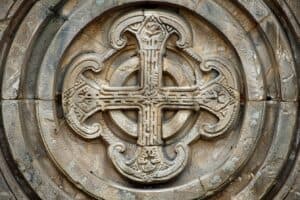
Tekthah’s four-armed cross
Bridgman-Metchim places the emblem inside a central temple tower. The same tower also holds a drum. The Cross is the nation’s victorious standard.
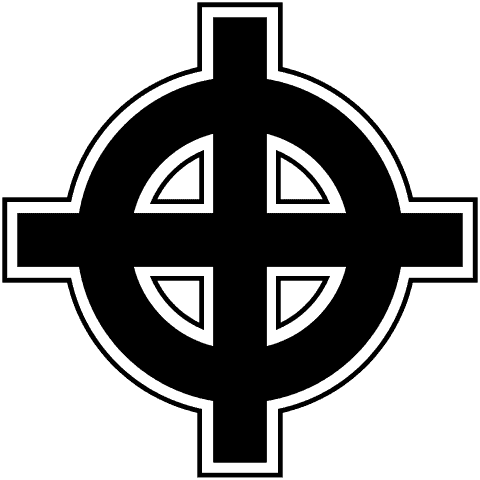
Within this tower was the drum and also within it was kept the victorious standard of the nation, the sacred symbol of victory — a Cross with four arms stretching horizontally, signifying the national prowess North, South, East and West — the old, rough rally-signal carried by the Emperor Tekthah from the North. Afterwards I knew that all the other cities had, in their Temple of the Sun, that same emblem, feared and venerated throughout the land and — Oh, confusion as I write! — worshipped as a god.
Source: D. Bridgman-Metchim, Atlantis: The Book of the Angels (London: Swan Sonnenschein, 1900).
What the passage states is concrete. The sacred symbol of victory is a Cross with four arms stretching horizontally. Those arms signify national prowess to the North, South, East, and West.
The Cross began as Tekthah’s rough rally-signal from the North. Later every city keeps the same emblem in its Temple of the Sun. The narrator already notes that it is feared, venerated, and worshipped as a god.
That last clause foreshadows the decline beat. I still keep it inside the novel’s voice.
A short related detail in the same book pairs the cross with the sun. A sceptre is shaped like the national standard, four-armed and cruciform, but surmounted by an orb of solid gold signifying the Sun. That pairing reinforces why Temple of the Sun placement matters on this trail.
On this site the temple context also sits at Temple of Zul, where Bridgman-Metchim’s Temple of Zul / Lord of Light houses the national four-armed cross. For the wider Temple of the Sun research habit I use on this site, see worship of the sun.
How I use this layer: as the clean phrase answer. In Bridgman-Metchim, the sacred symbol of Atlantis is Tekthah’s four-armed Cross. Comparative archaeology comes after that, labeled separately.
From victory standard to idolatry
Later in the same novel the victory standard becomes the object of a national crisis. Amaziel brings the Cross out of the central tower and lifts it toward the sky. The crowd’s roar mixes horror and approval.
Amaziel brought out from the central tower the sacred symbol of Atlantis, the four-armed Cross, that had led the nation under great Tekthah to its victorious empire, and with a shout lifted it towards the sky. A deafening roar of mingled import reached him. There was horror and frenzied approbation in that assent of a nation that their symbol should be sacrificed, all who perceived knowing and understanding that by such thing a nation signified its surrender to a Divinity whose power they did not comprehend, and which, their suddenly-strung consciences told them, was not the God of their fathers. This was Devil-worship…
Source: Bridgman-Metchim, Atlantis: The Book of the Angels (1900).
What the ceremony means inside the story is moral and spiritual decline. The nation assents that its own sacred symbol should be sacrificed. That assent marks surrender to a divinity they do not comprehend, and that their consciences say is not the God of their fathers. The narrator names it Devil-worship.
I keep this as literary plot. It is not archaeological proof that historical Atlanteans sacrificed a four-armed cross.
How I use the decline beat: as a fall motif that parallels other Atlantis destruction and deluge stories I already track, including the destruction of Atlantis described in the deluge legends. Parallel motifs help comparative reading. They do not upgrade fiction into dig fact.
Comparative trails
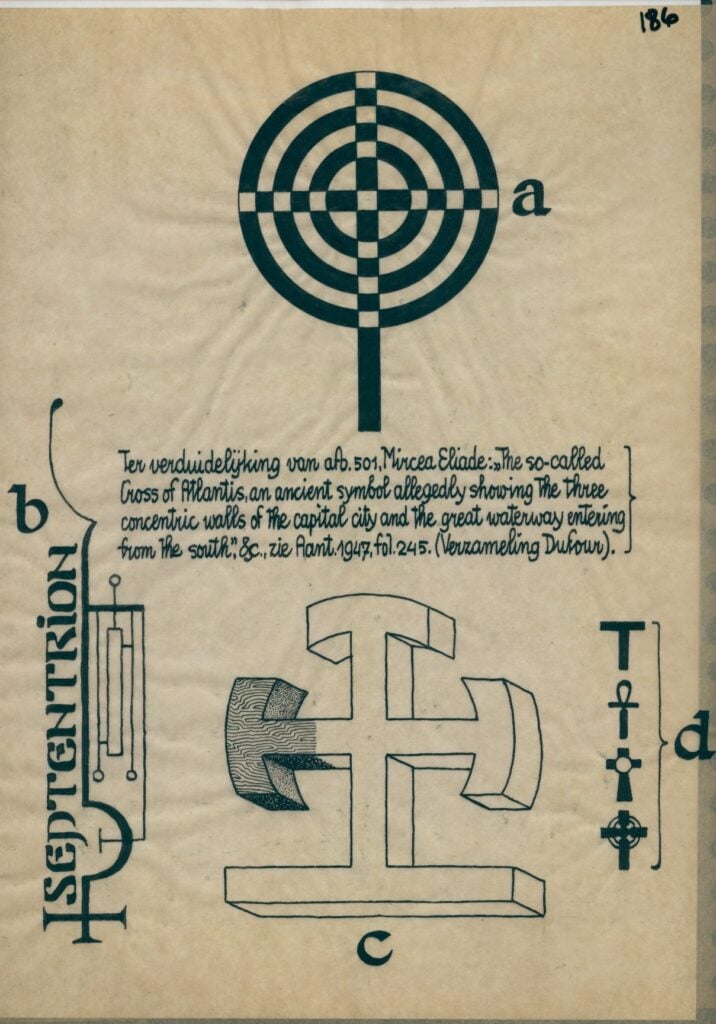
After Bridgman-Metchim, nineteenth-century diffusion writers placed cross signs in the New World beside Atlantis claims. Diffusion, here, means reading similar symbols as signs of contact or a common older center.
Ignatius Donnelly, in Atlantis: The Antediluvian World (1882), Part V, Chapter I, reports Toltec religion and cross use through Dêsirè Charnay’s Tula notes:
Dêsirè Charnay believes that he has found in the ruins of Tula the bones of swine, sheep, oxen, and horses, in a fossil state, indicating an immense antiquity. The Toltecs possessed a pure and simple religion, like that of Atlantis, as described by Plato, with the same sacrifices of fruits and flowers; they were farmers; they raised and wove cotton; they cultivated fruits; they used the sign of the Cross extensively; …
Source: Ignatius Donnelly, Atlantis: The Antediluvian World, Part V, Chapter I (Sacred Texts).
What Donnelly claims is likeness. Toltec religion is “like that of Atlantis, as described by Plato,” and the Toltecs used the sign of the Cross extensively. That is a nineteenth-century diffusion hypothesis. It is not proof that Bridgman-Metchim’s Tekthah standard is the same object as Mesoamerican crosses.
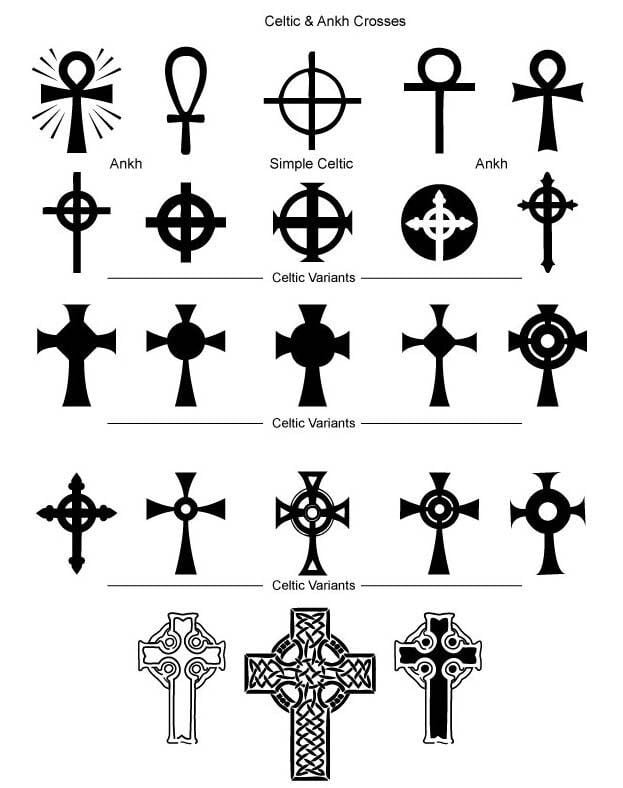
A related Donnelly layer sits in Part IV, Chapter V. There he ties the four rivers of paradise, running North, South, East, and West, to the origin of the cross sign among Atlantis-descended or Atlantis-influenced peoples. That directional reading soft-parallels Tekthah’s N/S/E/W prowess Cross. I keep it short and labeled on the pyramid, the cross, and the Garden of Eden.
OAHSPE and Selestor passages that describe cross-like or star-cross emblems are modern esoteric and channeling sources. I leave them as a short labeled aside. They are not Bridgman-Metchim, and they are not archaeology.
How I use the comparative layer: as secondary trails that explain why New World crosses appear near Atlantis pages. I do not flatten them into the Bridgman-Metchim answer.


How I use this in my research
The Bridgman-Metchim claim answers the search phrase cleanly. The sacred symbol in that 1900 Atlantis narrative is Tekthah’s four-armed Cross, the victory standard later kept in each Temple of the Sun.
The Amaziel sacrifice scene is the novel’s decline plot. I use it as a labeled fall motif beside other Atlantis destruction trails. I do not treat it as excavated ritual history.
Donnelly’s Tula and paradise-river cross claims are the diffusion research layer. They give a New World and four-directions frame. They do not prove that Tekthah’s Cross was dug at Tula.
Temple of the Sun placement ties this page to sun-worship research already on this site. Fiction stays fiction. Comparative claims stay labeled. That is why I keep the literary symbol answer early, and the archaeology-style equations after it.
This page matters to me as a symbol-identity page first. In Bridgman-Metchim, Atlantis’s sacred symbol is the four-armed Tekthah Cross. Idolatry is that book’s plot. Donnelly’s New World crosses are separate labeled interpretation. That is how I keep the what-question honest.


FAQ
What was the sacred symbol of Atlantis?
In Bridgman-Metchim’s Atlantis: The Book of the Angels (1900), it is the four-armed Cross, Tekthah’s victorious standard. That answer is literary. It is not an excavated object.
What did Tekthah’s cross mean?
It signified national prowess to the North, South, East, and West. It began as Tekthah’s rally-signal and later stood in every city’s Temple of the Sun as the sacred emblem of victory.
Is the four-armed cross of Atlantis historical?
No dig proves it. Bridgman-Metchim’s Cross is a 1900 novel’s Atlantis symbol. I keep fiction and archaeology in separate boxes.
How does it relate to other crosses?
Donnelly and related writers cite New World, Toltec, Tau, and paradise-river crosses as Atlantis diffusion claims. I treat those as labeled nineteenth-century hypotheses, not as proof that Tekthah’s standard is the same object.
How does this help Atlantis research?
The four-armed Cross plus Temple of the Sun placement gives a clear literary symbol trail. The idolatry plot gives a decline motif for comparative fall stories. Donnelly’s New World cross claims give labeled diffusion hooks. I use all three as source-critical research, not as dug proof of one Atlantis cross.
Related on this site
- Temple of Zul: Bridgman-Metchim temple context that houses the national four-armed cross.
- Worship of the sun: Temple of the Sun research, with fiction and comparative layers kept distinct.
- The destruction of Atlantis described in the deluge legends: Donnelly’s Atlantis fall and deluge spine beside the idolatry-decline motif.
- The pyramid, the cross, and the Garden of Eden: Donnelly’s four rivers N/S/E/W as a directional parallel to Tekthah’s Cross.


Comments are closed.