
Table of Contents
Long ago before Mother Earth existed, the Creator sat alone in darkness thinking, and with His thoughts He formed Mother Earth.
He covered the Earth with plants and trees, birds and animals, and many crawling insects, but He became lonely.
So, from the soil of the Earth he formed two companions, a man and a woman.
Beside the man he placed a bow and arrow. This was to show that the man was to be the protector and provider of food.
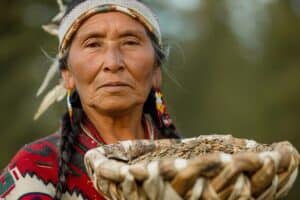
Beside the woman he placed a birch bark basket filled with seeds. The basket and seeds represented the natural resources given to the Ojibwe people.
The Creator also placed a book next to the woman.
Then the Creator blew life into the woman and the man. First he blew life into the woman, and when she arose, she picked up the birch bark basket full of seeds, but she did not pick up the book.
Her choice doesn’t mean that Ojibwe people are not educated, they just have a different way of learning.
When the Creator blew life into the man, the man picked up the bow and arrow and accepted his responsibility to protect and provide food.
Then the Creator said, “Take care of Mother earth, and she will take care of you.
Don’t get greedy.
Take only what you need, and remember to put down tobacco before you take from Mother Earth.”
This is how the Ojibwe people came to be.
Peter Jones on the Great Spirit
In The Lost Atlantis and Other Ethnographic Studies (1892) Daniel Wilson quotes Peter Jones (Kahkewaquonaby), an Ojibway adopted into the Mohawk nation, on Indian traditions of their own origin.
Keche-Manedoo
Jones says that the Great Spirit made all the nations, and that each nation with its own language is a second creation.
All the information I have been able to gain in relation to the question amounts to the following. Many, many winters ago the Great Spirit, Keche-Manedoo, created the Indians. Every nation speaking a different language is a second creation, but all were made by the same Supreme Being.
Peter Jones Kahkewaquonaby, quoted in Daniel Wilson, The Lost Atlantis and Other Ethnographic Studies (1892), chapter VI, p. 257

