
Table of Contents
The Oahspe Bible is a spiritual text first published in 1882. It was authored by John Ballou Newbrough, a New York dentist who was clairvoyant and clairaudient. He received the content through automatic writing, a process where he acted as a medium under the influence of divine forces. The text presents itself as a new revelation from Jehovah (the Creator) and angelic beings.
Osiris appears in Oahspe as a high-grade angel and sub-god under Anuhasaj (De’yus), the false Lord God. Anuhasaj appoints him to govern Arabin’ya (regions including the Middle East and Egypt) and parts of Guatama (Americas), along with other divisions like Parsi’e and Heleste (Book of Wars Against Jehovih, Chapters around VI–VIII and XI).
This occurs during the establishment of false god confederacies (~6,000 BCE in Oahspe’s cycle). Osiris starts loyal to De’yus but later asserts his own kingdom, using cunning to build independent power.
Characteristics of Osiris
Osiris is manipulative and strategic. He uses spiritual influence to deceive mortals and angels, presenting himself as a supreme deity while rejecting Jehovih (Book of Wars Against Jehovih, Chapters VII–VIII).
Unlike destructive approaches of other false gods, Osiris favors building idols, temples, and cultural systems to gain worship. He adopts the name Osiris to align with Egyptian beliefs, showing cultural adaptability. Oahspe describes him as cunning, ambitious, and self-serving, prioritizing personal glory over divine order.
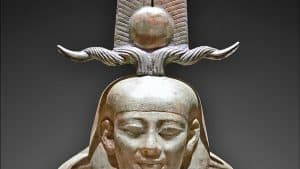
Osiris, a god of life, death, and resurrection
Osiris establishes a hadan (atmospheric) heaven in Arabin’ya, enslaving spirits and inspiring mortals to build temples and practice idolatry (~6,000–4,000 BCE, Book of Wars Against Jehovih, Chapter VIII).
He contributes to Egyptian spiritual traditions by promoting worship of himself as a god of life, death, and resurrection. Osiris creates or inspires false scriptures (like the Osirian Bible elements) and uses servants like Egupt to subdue regions.
He competes with Te-in (China/Jaffeth) and Sudga (India/Vind’yu) for dominance, leading to mortal wars and divisions (Book of Wars Against Jehovih, Chapter IX). Later, he breaks from De’yus, sets up his own kingdom, and fabricates myths to consolidate power (Chapters XXXVI, XLVII).
Downfall of Osiris
Osiris’s rule collapses during Cpenta-armij’s etherean invasion (~2,400 BCE, Book of Cpenta-armij, Chapter III). Her forces liberate enslaved spirits, overthrow hadan kingdoms, and cast Osiris and allies into hells, dense spiritual prisons for reflection and redemption. This ends the false gods’ era, with Osiris among those imprisoned (alongside Anuhasaj, Te-in, Sudga). Oahspe notes the hells hold millions, marking divine correction.
Osiris’s shape Egyptian idolatry and polytheism
Osiris’s actions shape Egyptian idolatry and polytheism, explaining distortions in ancient religions from a Faithist view. His influence opposes true prophets like Moses (~1,400 BCE), who restore Jehovih’s teachings (Book of Cpenta-armij, Chapter IV, and later books).
The downfall advances spiritual restoration, ending false god cycles and enabling progress toward Kosmon era. Osiris serves as an example of how ambition and deception corrupt heavenly and earthly order, requiring etherean intervention to maintain cosmic balance.


Comments are closed.