
Table of Contents
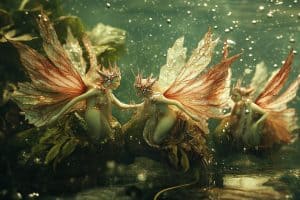
Nereids are beings often depicted as half-human, half-fish creatures. These figures are closely tied to the sea, beauty, and an aura of mystery and danger.
Pliny the Elder
In Natural History (Book IX), Pliny mentions aquatic humanoids, which some interpret as early references to mermaids.
- Pliny mentions “nereids” (sea nymphs) with human-like appearances, but he emphasizes that their bodies are partially fish-like.
- He describes creatures called “tritons”, which have human upper bodies and fish-like lower bodies.
- There is also a reference to “sea-men” seen in the waters near the island of Gaul. These beings reportedly resemble humans but inhabit the depths of the ocean.
Notable Accounts
- Sea-Nymph Sightings: Pliny recounts stories from sailors and locals who claimed to have seen nereids. They were described as beautiful but terrifying in appearance, with some accounts claiming their skin had scales.
- Captured Specimens: He notes that in some instances, humanoid sea creatures were allegedly caught and displayed, though Pliny expresses skepticism about the authenticity of such reports.
- Mythical Context: Pliny blends mythology with supposed eyewitness accounts, making it difficult to separate myth from what people of his time believed were real creatures.
Skeptical Commentary
Pliny’s writings often reflect a combination of curiosity and skepticism. He does not entirely endorse the existence of these beings but records what others have claimed to see.
Nereids: In Greek mythology, Nereids are sea nymphs, daughters of Nereus, the sea god. Unlike mermaids, they are usually benevolent and appear as companions of Poseidon, helping sailors in distress.
The Nereids are explicitly mentioned in works like Homer’s Iliad and Hesiod’s Theogony. They are depicted as helpful sea nymphs, often assisting gods and mortals.
Apollodorus’ Library and Ovid’s Metamorphoses also reference Nereids, detailing their association with Poseidon and their roles in Greek myths.
Nereids in Apollodorus’ Library and Ovid’s Metamorphoses:
The Library is a comprehensive compilation of Greek myths, attributed to Apollodorus. Nereids appear as significant figures, connected to various mythological events:
Lineage and Description:
Nereids are described as the fifty daughters of Nereus (the “Old Man of the Sea”) and Doris, an Oceanid.
They are benevolent sea deities, often depicted as protectors of sailors and companions to Poseidon.
Key Mentions:
Thetis, a prominent Nereid, is central to the story of Achilles. Zeus and Poseidon both pursued her romantically, but they withdrew when it was prophesied that her son would surpass his father in power.
Galatea, another Nereid, appears in the myth of Acis and Polyphemus. She rejects the Cyclops Polyphemus in favor of Acis, leading to a tragic outcome.
Amphitrite, the queen of the sea, was chosen by Poseidon to be his consort. Initially reluctant, Amphitrite was persuaded by a dolphin, whom Poseidon rewarded by placing it among the stars.
Nereids frequently assist heroes and gods. For example, Thetis helps Zeus and Hephaestus and provides magical items or advice to mortals like Achilles.
Ovid’s Metamorphoses
Ovid’s epic poem Metamorphoses is a rich source of Greco-Roman myths. Nereids feature in multiple episodes, emphasizing their divine beauty and connection to the sea.
Perseus and Andromeda (Book IV):
Andromeda, a mortal princess, is tied to a rock as a sacrifice to the sea monster Cetus. This punishment is linked to her mother Cassiopeia, who boasted that Andromeda was more beautiful than the Nereids.
Offended by this hubris, the Nereids appeal to Poseidon to punish Cassiopeia. Poseidon sends the sea monster to ravage the kingdom until Andromeda is offered as a sacrifice. Perseus saves her, slaying the monster and marrying Andromeda.
Acis and Galatea (Book XIII):
Galatea, a Nereid, falls in love with the shepherd Acis. However, the Cyclops Polyphemus, also in love with Galatea, becomes enraged by her preference for Acis.
In a fit of jealousy, Polyphemus kills Acis by crushing him with a rock. Galatea transforms Acis into a river deity, preserving his memory.
Transformation Themes:
Nereids often appear in stories involving transformation, a recurring theme in Metamorphoses. For example, their interactions with gods and mortals frequently lead to metamorphoses as acts of vengeance or preservation.
Association with Poseidon
Nereids are closely tied to Poseidon as his attendants or allies. They personify the calm and nurturing aspects of the sea, contrasting with its chaotic and destructive powers.
Amphitrite’s marriage to Poseidon symbolizes the union of the sea’s sovereignty and its natural beauty.


Comments are closed.