
Table of Contents
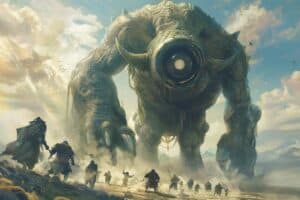
The Cyclopes are remembered for one eye, but in the oldest Greek stories what really matters about them is their hands. They are smiths and builders, strong enough to forge the thunderbolt and, so later Greeks believed, to stack stones no ordinary people could lift. That second idea has travelled further than the myth itself, because walls of huge fitted blocks are still called Cyclopean, on both sides of the Atlantic. This page gathers both.
Children of Uranus and Gaia
On A genealogy of the gods Gaia and Uranus produce the Titans, the Cyclopes and the Hecatoncheires, and Uranus imprisons the Cyclopes and the Hundred-Handers in Tartarus, which angers Gaia. Uranus – The primordial Age tells the same story at length and has the imprisoned Cyclopes freed as allies. In The Kings of Atlantis become the Gods of the Greeks Ignatius Donnelly makes Uranus the parent of three races, the Titans, the Hekatoncheires and the Kyklopes.
Smiths of the thunderbolt
On The Olympian Gods the freed Cyclopes give Zeus his thunderbolt, Poseidon his trident and Hades his helmet of invisibility for the war against the Titans. Mines quotes Hesiod’s Theogony on it:
"And next he brought forth the Cyclopes, who gave Zeus the thunder and fashioned for him the lightning bolt."
Hesiod, Theogony
Mines also links them with underground workshops in volcanic places such as Lemnos and Etna.
Homer’s cave dwellers
In the Laws by Plato, translated by Benjamin Jowett, the dialogue uses Homer’s Cyclopes as the picture of the oldest patriarchal government:
'They have neither councils nor judgments, but they dwell in hollow caves on the tops of high mountains, and every one gives law to his wife and children, and they do not busy themselves about one another.'
Homer, quoted by Plato, Laws, translated by Benjamin Jowett
On Nereids are beings often depicted as half-human, half-fish creatures the Cyclops Polyphemus loves the sea nymph Galatea and turns violent when she prefers Acis.
Cyclopean walls
On Built by Ancient Civilisations? the term Cyclopean is explained as coming from the later Greek belief that only the mythical Cyclopes could have moved such enormous stones. On The Peruvian Colony Donnelly sets Cyclopean walls in Greece beside Inca masonry in Peru, and on Atlantis, Edda und Bibel (1925) Hermann Wieland sees the same plan in the cyclopean buildings of Mycenae and Central America. On Basque mythology – Atlantis connection? the Cyclopes stand in a wider pattern of crediting old walls to giants. On PT 11: Researches Into The Lost History of America the Cyclopean buildings of Western Europe, from the towers of Sardinia to the Talyots of the Balearic Islands, are traced to builders from the Americas.
Other readings
On The History of Atlantis (1926) Lewis Spence equates the Cro-Magnon people with the Aurignacians and with the Cyclopes. On Nimrod read as Saturn and a master mason Nimrod is called king of the tower-building Cyclopes.
Related pages
- Uranus – The primordial Age
- A genealogy of the gods
- The Olympian Gods
- Giants worldwide
- Mines
- Laws by Plato
- The Peruvian Colony
- Built by Ancient Civilisations?
For every page I tagged with cyclopes, see the cyclopes tag archive.

