
Table of Contents
- Introduction
- Central America and the Ruined Cities
- Source Text:
- Topics Discussed:
- Chapter 22: The Evacuation of the Cities of Central America and the Flight of the Gods
- Themes Explored:
- Historical Correlations:
- Notable Artifacts and Interpretations
- Copán and Palenque Images:
- Mythological Connections:
- Conclusion
Introduction
The video continues a series of readings from the 1884 book Researches into the Lost Histories of America by W. S. Blacket. This is the tenth installment, covering Chapter 21 and parts of Chapter 22, focusing on Central American ruins, mythology, and migrations.
Central America and the Ruined Cities
Source Text:
The discussion references Researches into the Lost Histories of America, specifically Chapter 21, which compares artifacts and ruins from Central America with European, Asian, and African mythology.
Topics Discussed:
- Artifacts and Ruins: Detailed descriptions of sculptural finds in Copán and Palenque, such as the Pusa and Diana of Ephesus figures, which are compared to Asiatic idols and European deities.
- The Old and New Worlds: The text argues that America, referred to as the “true old world,” was the origin of certain myths and artifacts rather than being influenced by external civilizations.
- Comparisons with Other Regions: Central American monuments and hieroglyphics are contrasted with Egyptian and Assyrian designs, emphasizing shared elements and questioning the direction of influence.
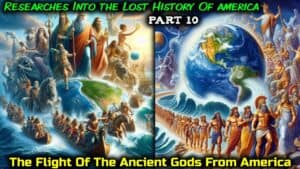
Chapter 22: The Evacuation of the Cities of Central America and the Flight of the Gods
Themes Explored:
- Mythological Evacuations: The chapter describes a great dispersion of gods and peoples from Central America, connecting myths like those of Atlas, Europa, and Bacchus to migrations from the Americas to Europe, Asia, and Africa.
- Neptune and the Caribbean: Neptune’s association with the Atlantic Isle and myths such as the entrance to Hades being located in the Caribbean reinforce the narrative of America’s foundational role in mythology.
- Migrations and Civilization: The gods’ “flight” symbolizes real migrations, suggesting ancient Americans introduced advanced sciences, architecture, and religion to other parts of the world.
Historical Correlations:
- Atlas and Atlantis: The book places the palace of Atlas in Central America and argues for the migration of its people to North Africa.
- Phoenician Influence: Europa’s myth is tied to Phoenician origins, with implications of transatlantic crossings.
- Cultural Foundations: The narrative credits Central American civilizations with the initial development of astronomy and urban planning, later disseminated globally.
Notable Artifacts and Interpretations
Copán and Palenque Images:
- Stone Carvings: Human figures surrounded by detailed carvings, interpreted as mythological or divine representations, are compared to Asian idols and European gods.
- The Palenque Cross: Found in Central America, this artifact challenges traditional assumptions about the origins of Christian and Asiatic cross symbols.
Mythological Connections:
- Cerberus and the Caribbean: The myth of Cerberus is linked to the Caribbean, with the “entrance to Hades” localized near the Gulf of Mexico.
- Bacchus and Neptune: Bacchus, often associated with wine and revelry, is identified with ancient Jaguar imagery in Central American ruins. Neptune’s mythology is tied to Atlantic crossings.
Conclusion
The video underscores the argument that Central America served as the cradle of early civilization and mythological development. The book suggests that migrations from America influenced cultures across the Atlantic and Pacific, challenging traditional views of history and geography.
Comments are closed.