
Table of Contents
- The Conventional Timeline of Ancient Egypt
- The Nubian Egg: A 7,000-Year-Old Artifact
- Examination of the Depictions:
- Circular Rings on the Egg and Atlantis
- Rediscovered Ancient Cedar Wood
- Possible Explanations for the Wood’s Age:
- Evidence of Rainwater Erosion on the Great Sphinx
- Points of Contention:
- Climatic Changes and Ancient Egypt
- Conclusion
The Conventional Timeline of Ancient Egypt
- The Great Pyramid of Giza is traditionally dated to approximately 4,500 years ago, around 2500 BCE.
- Modern historians often use terms like “suggest” to indicate uncertainty regarding the pyramid’s construction date.
The Nubian Egg: A 7,000-Year-Old Artifact
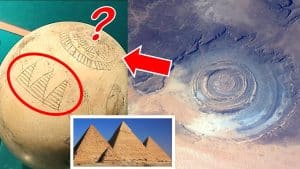
- A decorated ostrich egg was discovered in a 7,000-year-old tomb in the Nubian Desert, Sudan.
- The egg depicts shapes resembling three pyramids, though experts have classified them as mountains.
Examination of the Depictions:
- Analysis of Mountains:
- Nearby mountain ranges in Sudan, such as the Dariba Caldera, Tatil Mountains, and Altaka Mountains, do not match the angular shapes depicted on the egg.
- Comparisons with the steep Nubian pyramids reveal closer similarities in shape, but these were constructed thousands of years after the artifact’s creation.
- Lines Through the Shapes:
- Lines visible within the shapes resemble the layers of stepped pyramids, making the mountain theory less plausible.
- Zigzag Features:
- A zigzag pattern adjacent to the pyramids could represent the Nile River.
- The depiction aligns geographically with the relative location of the Giza pyramids and the Nile River.
- Additional Drawings:
- The opposite side of the egg shows similar pyramid shapes with a new zigzag feature, potentially representing the Fayoum Oasis south of Giza.
Circular Rings on the Egg and Atlantis
- Circular markings at the top of the egg resemble the described structure of Atlantis: three rings of water and two of land.
- The legend of Atlantis originates from Egyptian traditions, as relayed by the ancient Greek philosopher Plato.
Rediscovered Ancient Cedar Wood
- Pieces of cedar wood were removed from the Great Pyramid in 1872 and rediscovered in 2020 after being misplaced for over a century.
- Carbon dating revealed the wood was between 514 and 781 years older than the Great Pyramid’s traditional construction date.
Possible Explanations for the Wood’s Age:
- The wood might have been centuries old when incorporated into the pyramid.
- It could have been chosen for symbolic reasons to honor Egypt’s history.
- The tree itself may have been ancient when cut down, as cedar trees can live up to 1,000 years.
Evidence of Rainwater Erosion on the Great Sphinx
- Significant rainwater erosion is visible on the limestone bedrock surrounding the Sphinx.
- Egypt’s last significant rainfall occurred approximately 9,000 years ago.
- Geologists argue that this erosion suggests the Sphinx could be much older than 4,200 years.
Points of Contention:
- The Sphinx lacks documentation or carvings indicating its construction date.
- Its face was recarved at some point, but the original identity remains uncertain.
Climatic Changes and Ancient Egypt
- Studies show that the Sahara Desert transitioned from a tropical environment to a desert approximately 4,500 years ago.
- The construction of the pyramids may have coincided with a greener Sahara environment, which supports theories of an older Egyptian civilization.
Conclusion
The evidence suggests that ancient Egypt’s history may extend thousands of years beyond conventional timelines. Artifacts like the Nubian egg, the rediscovered cedar wood, and geological evidence from the Great Sphinx challenge traditional narratives and merit further exploration.
Comments are closed.