
Table of Contents
Ancient Egyptian Solar Boat
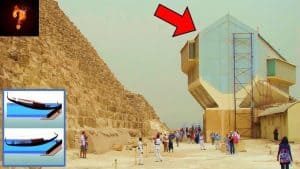
Artifacts of great significance have been recovered from Egypt over the years, including intact tombs containing valuable items intended for use by Pharaohs in the afterlife. Among the less-highlighted discoveries is the Khufu ship, found at the base of the Great Pyramid. This ancient Egyptian vessel, over 4,000 years old, was sealed beneath multi-ton limestone blocks.
The Khufu ship is associated with King Khufu (Cheops), the second Pharaoh of Egypt’s Fourth Dynasty. The vessel, measuring 44 meters (144.36 feet) in length and 6 meters (19.69 feet) in width, is regarded as one of the oldest and most well-preserved ships from antiquity. It was reconstructed over several years by the Egyptian Department of Antiquities, led by Chief Restorer Ahmed Youssef Mustafa.
This ship is thought to have been a solar barge, used for rituals involving the sun god Ra. Despite showing signs of use, its primary purpose may have been to transport the king in the afterlife or for other ceremonial purposes.
Discovery and Preservation
The ship was first uncovered in 1954 by archaeologist Kamal el-Malak, who had conducted extensive research in the area. The ship was found disassembled into 1,224 pieces, laid out systematically beneath the pyramid. Its reconstruction relied on ancient shipbuilding methods studied from tomb carvings, wooden models, and contemporary Nile boatyards.
Today, the Khufu ship is housed in the Giza Solar Boat Museum, where it has been preserved since 1985. The museum employs advanced preservation technologies to maintain this historic artifact.
Theories of Flight and Function
The ship’s design has sparked speculation due to its unique characteristics. Built from Lebanon cedar and using the shell-first construction technique, it lacked a keel and featured flat-bottomed planks bound together with grass ropes.
Some researchers have proposed unconventional theories, such as the ship being capable of flight. These hypotheses are inspired by its designation as a “solar boat” and references to ancient texts describing advanced technologies. However, others suggest it was a funerary barge or a pilgrimage vessel.
Connection to Pyramid Construction
The Khufu ship’s discovery adds to theories about ancient Egyptian engineering. Some propose that similar vessels could have played a role in the transportation and placement of massive stones used in pyramid construction. This includes the possibility of utilizing Nile floods for logistical purposes.
Cracks in weight-bearing blocks within the Grand Gallery of the Great Pyramid suggest additional stress, possibly from counterweights or other unknown mechanisms. The Khufu ship’s features, such as ease of disassembly and repair, could support such theories.
Broader Implications
The discovery of the Khufu ship highlights the technological and ceremonial sophistication of ancient Egypt. It also raises questions about the extent of their capabilities, including the possibility of advanced knowledge that predates modern technological achievements.
Theories surrounding the ship reflect broader investigations into ancient civilizations and their potential mastery of engineering, transportation, and even aeronautics.
Related Discoveries
Additional findings across the globe, such as mysterious metals and advanced artifacts, continue to challenge modern understandings of ancient history. Objects such as orichalcum, a legendary alloy linked to Atlantis, and descriptions of flying machines in ancient Indian texts like the Mahabharata and Ramayana, suggest the existence of advanced prehistoric civilizations.
These accounts, while speculative, provide insights into technologies and cultures that might have existed long before recorded history.
Comments are closed.