
Table of Contents
Troy is a city that a poem kept alive. For centuries most readers treated it as Homer’s invention, a stage for Achilles and Hector. Then a merchant with a copy of the Iliad dug into a mound in northwest Turkey and found burned walls and gold. On this site Troy turns up again and again, and not only as a battlefield. It appears as a colony, a lineage, a maze and a place where a vase was said to name Atlantis. This page gathers those threads.
The war in the poems
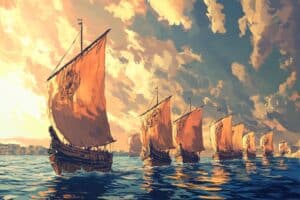
The Catalogue of Ships gives Book 2 of Homer’s Iliad, where Zeus sends a false dream to Agamemnon:
Tell him to get the Achaeans instantly under arms, for he shall take Troy.
Homer, Iliad, Book 2
Astynome follows one captive of that war, the daughter of a priest of Apollo, whose father’s prayer brings a plague on the Greek camp. On Minoan Civilization: Colony of Atlantis Sarpedon, a son of Zeus, fights at Troy as a Trojan ally and is slain by Patroclus.
Mount Ida and the judgment of Paris
The war starts on a mountain. Mount Ida (Troad) tells how Hera, Athena and Aphrodite asked Paris, a prince of Troy, to judge which of them was the fairest, and how his choice of Aphrodite led to the abduction of Helen. The same page covers Ganymede, the Trojan prince taken up by Zeus, and Aeneas, who escaped the burning city. On Venus Aeneas becomes the son of Venus and the father of the Roman people. For the goddess who lost that contest and her part in the war, see Hera.
Schliemann’s dig and a vase from Atlantis
On How I found the lost Atlantis, the source of all civilization Paul Schliemann presents papers he says his grandfather left behind. One of them starts at Troy:
"When in 1873, I made the excavation of the ruins of Troy at Hissarlik and discovered in the Second City the famous 'Treasure of Priam,' I found among that treasure a peculiar bronze vase, of great size.
Heinrich Schliemann, as given by Paul Schliemann
The paper goes on to say the vase carried the words “From the King Chronos of Atlantis.” Of all the Troy material I found, this is the most direct link to Atlantis. The video Thoth, Knossos, Troy, and the Copper Scroll tells the dig as a hunt for fame and gold, with a burned layer, a larger sixth city and a diary that experts distrust.
Troy as an Atlantean colony
Ignatius Donnelly reads Troy as a daughter city of Atlantis. On The Question of Complexion he writes:
(the walls of Troy, we shall see, were built by Poseidon; that is to say, Troy was an Atlantean colony)
Ignatius Donnelly, Atlantis: The Antediluvian World (1882)

On The Peruvian Colony Donnelly sets the owl-headed idols and vases Schliemann found at Troy beside vases from Peru with the same kind of face. On The Origin of Our Alphabet he compares signs from deep in the ruins of Troy with Phoenician and Ethiopian letters, and on The Oldest Son of Noah he points to the cow-headed idols of Troy. In Atlantis Reconstructed Troy, Egypt and Greece are pictured warring against the parent race.
Lineages that run through Troy
On Pt 23 – History or Myth: Kronos or As the Phoenicians Call Him Israel Dardanus, a son of Zerah of Judah, is credited with founding Troy, and Trojan lines are traced into Greece and the British Isles. On The Noble Lineage of Jesus Christ the Aryan migration story passes through Babylon and Troy before it reaches Europe. In The Oera Linda Book Reviewed Ulysses brings jewels from Troy to Texland.
Troy Towns and Troy as Atlantis
Labyrinths explains that in Scandinavia the old stone mazes are called Troy Towns, or Trojeborgar. The same page notes that Eberhard Zangger linked the labyrinth symbol to Troy, which he had earlier identified as Atlantis. On The antiquity of some of our great inventions the heroes returning from Troy are said to have sailed around Africa long before the voyage of Neco.
Related pages
- The Catalogue of Ships
- Mount Ida (Troad)
- Astynome
- How I found the lost Atlantis, the source of all civilization
- The Question of Complexion
- The Peruvian Colony
- Labyrinths
- Poseidon
For every page I tagged with troy, see the troy tag archive.

