
Table of Contents
- Domestication of Goats and the Discovery of the Dead Sea Scrolls
- The Dead Sea Scrolls
- Origin and Attribution
- The Star of David and Aryan Influences
- Zoroastrianism and Messianic Lineages
- The Knights Templar and the Holy Grail
- Migration of Lineages and Genetic Markers
- Connections to Babylon and Aryan Cultures
- The Davidic and Odinic Lineages
- Esoteric Knowledge and the Role of Secret Societies
- Scientific and Cultural Evidence
- Conclusion
Domestication of Goats and the Discovery of the Dead Sea Scrolls
Goats, among the oldest domesticated animals, played a significant role in the Neolithic agricultural revolution due to their adaptability and utility in providing meat, milk, and fiber. In late 1946 or early 1947, young Bedouin shepherds near the ancient settlement of Qumran, on the northwest shore of the Dead Sea (modern-day West Bank), stumbled upon a cave containing large clay jars with leather and papyrus scrolls. These texts, later identified as the Dead Sea Scrolls, date back over 2,000 years. Further excavations in the area unearthed tens of thousands of additional fragments from nearby caves.
The Dead Sea Scrolls
The Dead Sea Scrolls are among the most significant archaeological finds of the modern era. Written between the 3rd century BCE and the 2nd century CE, they include the earliest known copies of biblical texts and other ancient writings, offering insights into the culture and beliefs of first-century Palestine and Israel.
Origin and Attribution
Scholars debate the scrolls’ origin. A prevailing theory suggests they were authored by the Essenes, a devout Jewish sect that practiced asceticism and lived in Qumran until the settlement was destroyed by Roman forces around 70 CE.
The Star of David and Aryan Influences
The Star of David, now a symbol of Judaism, was historically used in Islamic and other cultures, including ancient Aryan civilizations. Symbols such as the pentagram and swastika also have shared origins in Aryan cultures across regions like India, Tibet, and Phoenicia. This connection underscores the cross-cultural exchanges of ancient iconography.
Zoroastrianism and Messianic Lineages
Zoroastrianism, an ancient Iranian religion, introduced the concept of a savior figure known as Saoshyant. This belief parallels Jewish and Christian messianic traditions, envisioning a final confrontation between good and evil. Similarities between these narratives have influenced European mysticism and esoteric practices, mainly through the dissemination of ideas by groups like the Knights Templar.
The Knights Templar and the Holy Grail
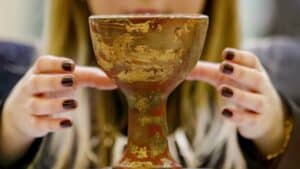
Established in 1118, the Knights Templar was a Christian military order that engaged in crusades, established early banking systems and incorporated esoteric practices. Their use of symbols like the Seal of Solomon and their association with the Holy Grail reflects a blend of mysticism and bloodline lore. The Grail is often interpreted as a metaphor for sacred bloodlines, including those tracing back to biblical figures like Jesus and ancient European dynasties.
Migration of Lineages and Genetic Markers
Genetic and historical evidence supports the migration of ancient lineages from Mesopotamia to Europe, including the purported descent of Nordic kings from Odin. The CCR5-Delta32 mutation, linked to immunity against certain diseases and lactose tolerance, are examples of traits tracing back to these migrations. This genetic legacy is prominent in Northern Europe and Scandinavia.
Connections to Babylon and Aryan Cultures
The Aryan migration narrative includes settlements in regions such as Babylon and Troy before moving into Europe. Aryan influences shaped civilizations across Mesopotamia, with their cultural and technological advancements perceived as divine by local populations.
The Davidic and Odinic Lineages
Claims of descent from the Davidic line of Jesus and the Odinic line of Norse mythology highlight the intersection of religious and royal genealogies. Figures like Mary Magdalene and Mary of Bethany are central to this narrative, with apocryphal texts suggesting familial connections to Jesus.
Esoteric Knowledge and the Role of Secret Societies
Organizations such as the Knights Templar, Rosicrucians, and Freemasons have preserved and propagated knowledge of these lineages and their mystical implications. These groups view bloodlines as central to understanding ancient wisdom and power structures.
Scientific and Cultural Evidence
Archaeological and genetic studies support elements of these historical narratives. The spread of symbols, technologies, and genetic markers like the CCR5-Delta32 mutation corroborates the migration and influence of ancient Aryan and Semitic lineages across regions.
Conclusion
Studying ancient lineages, their migrations, and their influence on religious and cultural developments provides a lens to understand the complex interplay of history, myth, and science. Aspects of these narratives remain contentious but continue to inspire scholarly and popular interest.
Comments are closed.