
Table of Contents
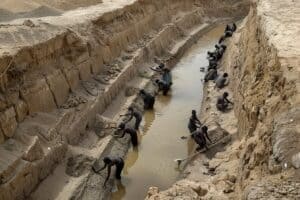
Before Memphis could be built, the river had to be moved. That is how the Greek historians tell it: the first king of Egypt dug a new bed for the Nile, dried out the old one and put his city on the ground the water left behind. Memphis then stayed the seat of kings, the home of Ptah and the place where priests met for thousands of years, and the very word Egypt grew out of one of its temples. This page gathers what the site has on it.
Menes moves the Nile
The founding is on Account of Menes. Herodotus describes it in the second book of his Histories:
"This king was the first to establish the city of Memphis, making use of the mud and earth that the river deposits in its floods. And after he had dammed off the river from the town, he first founded in the place where it used to run, and which is now the lake of Moeris, the temple of Hephaestus" .
Herodotus, Histories, Book 2, 2.99
Diodorus Siculus gives Menes a wider role, as the king who taught Egypt to live in cities:
"Menes, the first king, having established himself in the royal power, instructed the people in the worship of the gods and in the practice of living together in cities, and he founded Memphis, the first and most ancient of the cities of Egypt".
Diodorus Siculus, Bibliotheca historica, Book 1, Chapter 45
On The Egyptian Colony Ignatius Donnelly counts the monstrous embankments that turned the Nile among the works of Egyptian greatness he traces back to Atlantis. On Menes – Adam, from Paschal Beverly Randolph’s Pre-Adamite Man, Menes founds Memphis as part of an Egyptian past far longer than the biblical count.
Ptah and the name Egypt
The temple Herodotus calls the temple of Hephaestus belonged to Ptah, the creator and craftsman whose main cult center was Memphis. The holy trinities lists the Memphis Triad of Ptah, Sekhmet and Nefertem. The temple’s Egyptian name, Hwt-ka-Ptah, passed through the Greek Aigyptos into the English word Egypt, as Etymology of Egypt and What Is Khem? explain.
Kings and priests at Memphis
Menes’ son built the palace. On Athothis, king of the First Dynasty Athothis is credited with the palace at Memphis and with practising medicine, and Manetho’s King Lists keeps the same tradition. Much later the priests still gathered there. On What the Rosetta Stone says the decree is issued by priests meeting at Memphis, not at Alexandria, who grant the young Ptolemy statues, festivals and a place beside the gods.
Memphis in the occult histories
In Submerged Atlantis Restored, Menes descends from the people of Abusir, which is said to have become part of the later city of Memphis. In Sacred Mysteries among the Mayas and the Quiches, Augustus Le Plongeon quotes a high priest of Memphis, through Samuel Birch:
"That he knew the arrangements of the Earth, and those of Heliopolis and Memphis; that he had penetrated the mysteries of every sanctuary
Augustus Le Plongeon, Sacred Mysteries among the Mayas and the Quiches
Related pages
- Account of Menes
- Ptah
- The Egyptian Colony
- Athothis, king of the First Dynasty
- Etymology of Egypt
- Manetho’s King Lists
- What the Rosetta Stone says
- Menes – Adam
For every page I tagged with memphis, see the memphis tag archive.

