

Table of Contents
- The tree in the garden
- Siduri on the life that cannot be found
- The flood hero who did not die
- Uta-Napishtim and his wife shall be equal to the gods
- The drink of the gods
- China and the elixir
- The fountain of youth
- The plant of youth in the Epic of Gilgamesh
- The serpent snatches the plant
- The immortal soul
- Plato on the immortal soul
- The true and immortal being
- The eldest of all things which are born
- Related pages
The search for a life without end shows up on this site in a surprising number of places. Genesis guards a tree so that man cannot eat from it. A flood hero in Babylon is taken away and never dies. Gods and demons churn an ocean to win a drink. And a Chinese emperor sends ships across the sea to find an elixir.
Across those sources two ideas keep running side by side. One is a body that does not die, or that lives for thousands of years. The other is a soul that survives the body. I follow both.
The tree in the garden
The Bible names the danger directly:
And the LORD God said, Behold, the man is become as one of us, to know good and evil: and now, lest he put forth his hand, and take also of the tree of life, and eat, and live for ever:
Genesis 3:22 (KJV)
On The forbidden fruit I compare the fruit of Eden with the Peach of Longevity, the golden apples and ambrosia. On Genesis contains a history of Atlantis Ignatius Donnelly sets the same verse next to the Quiche legend of gods who feared they had made men too perfect. And on Sumer: The First Known Civilization Jim Marrs reads it in paleo-contact terms:
The extreme life spans of the more pure-blooded Anunnaki rulers made them appear as immortal.
Jim Marrs
Siduri on the life that cannot be found
In The Epic of Gilgamish, in Thompson’s 1928 wording, the wine-maker Siduri meets Gilgamish on his search and tells him that the life he wants is not for mortals:
“Gilgamish, why runnest thou, (inasmuch as) the life which thou seekest,
Thou canst not find? (For) the gods, in their (first) creation of mortals,
Death allotted to man, (but) life they retain’d in their keeping.”
R. Campbell Thompson, The Epic of Gilgamish, Tablet X, Luzac and Co., London, 1928, p. 46
The flood hero who did not die
The Babylonian flood hero escaped death altogether. George Smith wrote in 1873:
Now, the Babylonians believed in the existence of a patriarch named Sisit, the Xisuthrus of the Greeks, who was supposed to have been translated and to have attained to immortality without death.
George Smith
See The Chaldean Account of the Deluge and Utnapishtim, Ziusudra, and Noah. Gilgamesh goes looking for the same secret and does not get it. On Did Genesis copy the Gilgamesh flood the lesson of the epic is put simply:
the only immortality one can hope to achieve is to make a name for yourself
InspiringPhilosophy, Genesis and the Gilgamesh flood, at 2:06
Uta-Napishtim and his wife shall be equal to the gods
Thompson’s Tablet XI, however, gives the flood hero the gift that Gilgamish does not receive. In that wording Enlil blesses Uta-Napishtim and his wife after the Deluge:
‘Uta-Napishtim hath hitherto only been mortal,
Now, indeed, Uta-Napishtim and (also) his wife shall be equal
Like to us gods; in the distance afar at the mouth of the rivers
Uta-Napishtim shall dwell.’
R. Campbell Thompson, The Epic of Gilgamish, Tablet XI, Luzac and Co., London, 1928, p. 53
The drink of the gods
India tells of a drink won from the sea. W. S. Blacket quotes the story:
the Gods and the demons (the vast serpent Vasuky serving as a rope), churn the Ocean, to recover the Amrita or beverage of Immortality.
W. S. Blacket, Researches into the Lost Histories of America
See Researches into the Lost Histories of America and The creation story in Tibetan Buddhism, which has its own version of the churning. Matías de Stefano links the same drink to the philosopher’s stone:
But when it becomes a stone when it's the philosopher's stone, that amrita, that golden liquid becomes an apple.
Matías de Stefano, Golden Apple and the Broken Bloodline, at 4:01

See Golden Apple and the Broken Bloodline. In a longer talk with Aubrey Marcus, on Matias de Stefano on cycles and the philosopher’s stone, he treats the stone not as a substance at all but as an inner state, the coherence of thought, feeling and action inside a person. Not every immortality is a gift, though. On Sadhguru on the curse of Ashwatthama:
Krishna did not curse him with death he said I curse you with immortality
Sadhguru, Sadhguru on Ashwatthama, at 1:56
China and the elixir
In China the immortals are a whole class of beings. See The Eight Immortals, where Li Tieguai carries a gourd with an elixir. On Moon Chang’e becomes the moon goddess after she drinks the Elixir of Immortality. On The myth of a sinking city Emperor Qin Shi Huang, obsessed with the elixir of life, searches for the island of Yingzhou. And on Ningyo the flesh of a fish with a human face grants immortality or a very long life.
The fountain of youth
The search reached the Americas as well. Lewis Spence writes:
When the first Spanish expedition reached Florida in a quest for the Fountain of Perpetual Youth, the Elixir of Life, they encountered a band of Indians searching in these regions for the self-same thing !
Lewis Spence, The Problem of Atlantis
See The Problem of Atlantis. On The Occult Sciences in Atlantis Spence also notes that Vincent de Beauvais made Noah acquainted with the Elixir of Life. And on The Immortal Count of St Germain I follow the man who was said to have found it.
A modern channeled source is more modest. On Longevity and Living in the Now, Bashar answers a question about very long lives by saying such longevity is unlikely in this lifetime, though living longer than average is possible, depending on technology and personal circumstances.
In a Sedona session a visitor reminds Bashar that he once spoke of people on Earth who are 200, 400 and even 1,000 years old. He confirms it and says such people have a rare calm and depth (at 35:33).
Yes, they are few and far between but they exist.
Bashar

The plant of youth in the Epic of Gilgamesh
When eternal life itself is refused him, Thompson’s Uta-Napishtim still tells Gilgamish of a plant in the ocean that can restore youth. In the 1928 wording:
There is a plant like a thorn with its root (?) ‘deep down in the ocean’,
Like unto those of the briar (in sooth) its prickles will scratch ‘thee’,
(Yet) if thy hand reach this plant, ‘thou’lt surely find life (everlasting)’.
R. Campbell Thompson, The Epic of Gilgamish, Tablet XI, Luzac and Co., London, 1928, p. 55
The serpent snatches the plant
Gilgamish takes the plant, in Thompson’s account, and then loses it while he is bathing. A serpent smells it and carries it off:
Gilgamish spied out a pool of cool water, (and) therein descending
Bathed in the water. (But here was) a serpent who snuff’d the plant’s fragrance,
Darted he up ‘from the water (?)’, and snatch’d the plant, uttering malison
As he drew back.
R. Campbell Thompson, The Epic of Gilgamish, Tablet XI, Luzac and Co., London, 1928, p. 56
The immortal soul
The second idea is older than any elixir. On Mummification the practice rests on a belief in the immortality of the soul and the resurrection of the body. Manly P. Hall reads the Book of the Dead the same way:
this Union bestows immortality upon the personality which then becomes an incarnation of the God
Manly P. Hall, Manly P. Hall on the Book of the Dead, at 46:19
See Manly P. Hall on the Book of the Dead and Phoenix, the bird of death and rebirth.
Plato on the immortal soul
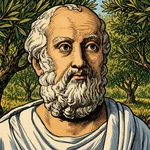
In Book XII of The Laws, in Benjamin Jowett’s translation, the Athenian stranger returns to the soul as the true and immortal being of each person, and as a first principle of worship.
The true and immortal being
He says the soul is in all respects superior to the body, that what makes each of us what we are is only the soul, and that this immortal being goes on her way to other Gods to give an account.
Now we must believe the legislator when he tells us that the soul is in all respects superior to the body, and that even in life what makes each one of us to be what we are is only the soul; and that the body follows us about in the likeness of each of us, and therefore, when we are dead, the bodies of the dead are quite rightly said to be our shades or images; for the true and immortal being of each one of us which is called the soul goes on her way to other Gods, before them to give an account--which is an inspiring hope to the good, but very terrible to the bad, as the laws of our fathers tell us; and they also say that not much can be done in the way of helping a man after he is dead.
Plato, The Laws, Book XII, 959a-b (Jowett)
The eldest of all things which are born
No man, he says, can be a true worshipper of the Gods who does not know that the soul is the eldest of all things which are born, and is immortal and rules over all bodies.
ATHENIAN: No man can be a true worshipper of the Gods who does not know these two principles--that the soul is the eldest of all things which are born, and is immortal and rules over all bodies; moreover, as I have now said several times, he who has not contemplated the mind of nature which is said to exist in the stars, and gone through the previous training, and seen the connexion of music with these things, and harmonized them all with laws and institutions, is not able to give a reason of such things as have a reason.
Plato, The Laws, Book XII, 966d-967b (Jowett)
Related pages
- The forbidden fruit
- The Eight Immortals
- The Immortal Count of St Germain
- Utnapishtim, Ziusudra, and Noah
- Ningyo
- Phoenix
- Mummification
- After death
For every page I tagged with immortality, see the Immortality tag archive.

