
Table of Contents
Greenland keeps turning up in my Atlantis research, though never as the main subject. For the Theosophists it was a promontory facing Atlantis where its earliest races settled. For Chan Thomas it was an ice cap that would one day turn tropical, and for climate researchers its ice cores record the catastrophes I write about. These are the pages where I followed it.
Rmoahals and Tlavatli
W. Scott-Elliot placed Greenland at the northern edge of the Atlantean world. On The Story of Atlantis – focus on the occult investigation of Atlantis and its sub-races he describes how the first sub-race, the Rmoahals, was pushed north:
Harried on their southern borders and driven further north by the Tlavatli warriors, they began to overflow to the neighbouring land to the east, and to the still nearer promontory of Greenland.
W. Scott-Elliot, The Story of Atlantis

The Tlavatli Race follows the second sub-race, the people who drove them there, on its own migration north towards the coast opposite Greenland. Arthur E. Powell repeats the account on The Solar System – Atlantis:
This sub-race arose on an island off the west coast of Atlantis; thence it spread across the continent, gradually tending northwards to the coast facing Greenland. They were of a red-brown colour, powerful and hardy, but not quite so tall as the Rmoahals, whom they drove further north.
Arthur E. Powell, The Solar System

Hyperborea in the north
Other sources put an older civilization in the far north. On Mission Rahma I cover Sixto Paz Wells’s account of a Hyperborean humanity, an alien race that settled in northern Europe and Greenland and founded Hyperborea with its capital Thule. Before Atlantis: Antarctic, Hyperborean, Lemurian and Atlantean humanity sets that race in the Mesozoic, tall and fair, and has them leave before the asteroid impact that ended the dinosaurs. In the video Savak, the ancient ant people, Sonja Grace says Europe, Greenland and North America were once connected and that people migrated across these lands.
Ice cores and catastrophe
Greenland’s ice is also a record. The Dual Cataclysm That Ended a Civilization and The earth to spin off balance both point to the nanodiamonds and ash in Greenland ice cores at the start of the Younger Dryas, about 12,800 years ago. Events leading to the final destruction of Atlantis mentions a drop of 7 to 10°C in local temperatures in the same data. Events around 3,100 BCE linked to a meteor impact? uses a sulphate spike in Greenland ice around 3150 BC, and Could the Taurid Meteor Shower Have Caused the Great Flood? lists the Hiawatha Crater under the Greenland ice as a possible impact site.
A tropical Greenland
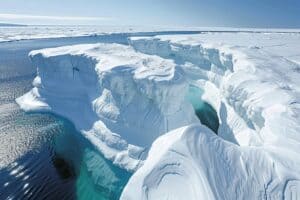
Chan Thomas imagined the reverse. In The Adam and Eve Story he describes the earth’s crust shifting so that Greenland and Antarctica rotate into the Torrid Zone, their ice caps melting into great floods, until both emerge covered in tropical foliage.
The first man of Greenland
‘A woman is created from a part of a man’ – stories collects creation stories from around the world. The Greenland version names the first man Kallak, who came out of the earth. His wife came from his thumb, and she brought death into the world so that their descendants would have room.
Leslie on the Kasmancees in Greenland
J. Ben Leslie set out a detailed history of Atlantis in Submerged Atlantis Restored (1911). He presents it as information given by pre-historic spirits, and he cites almost no other sources. He describes people from the north of Atlantis who, in his account, ended up in Greenland and Labrador.
At the time of the convulsion that separated Greenland from British America, remnants of the Kasmancees of the northern portion of Teltzie Ket, of Atlantis, who had migrated and settled in that district of country now submerged by the waters of the North Atlantic Ocean, south of Greenland, and east of Labrador, were left on both southern Greenland, and eastern Labrador.
J. Ben Leslie, Submerged Atlantis Restored (1911), Teltzie LVII, p. 788
Bailly on Atlantis in the northern sea
In Letter XXIII of Lettres sur l’Atlantide de Platon et sur l’ancienne histoire de l’Asie (London and Paris, 1779), Jean-Sylvain Bailly reads Plutarch’s island of Ogygia as Atlantis, and he places it to the north of Europe. He then asks whether the lost island was swallowed by the sea, or only closed and defended by ice.
Ogygia to the north of Europe
You know, Sir, that in all the countries of our hemisphere the summer sunset is toward the north; here then is the position of the island of Ogygia, or Atlantis, well determined to the north of Europe.
Jean-Sylvain Bailly, Lettres sur l'Atlantide de Platon et sur l'ancienne histoire de l'Asie (London and Paris, 1779), Letter XXIII, p. 383, translated from the French
Closed by the ices
One may have believed that the island of Atlantis was swallowed up, or lost in the sea, only because men had ceased to go there, because the accumulated ices frightened the navigators, little bold in the beginnings. Atlantis is perhaps only closed by the ices, and defended by them; but I confine myself to following Plutarch, I show as he does the islands of the northern sea.
Jean-Sylvain Bailly, Lettres sur l'Atlantide de Platon et sur l'ancienne histoire de l'Asie (London and Paris, 1779), Letter XXIII, p. 385, translated from the French
Related pages
- The Story of Atlantis – focus on the occult investigation of Atlantis and its sub-races
- The Tlavatli Race
- The Solar System – Atlantis
- Mission Rahma
- Before Atlantis: Antarctic, Hyperborean, Lemurian and Atlantean humanity
- The Dual Cataclysm That Ended a Civilization
- Events leading to the final destruction of Atlantis
- The Adam and Eve Story
For every page I tagged with Greenland, see the Greenland tag archive.

