
Table of Contents
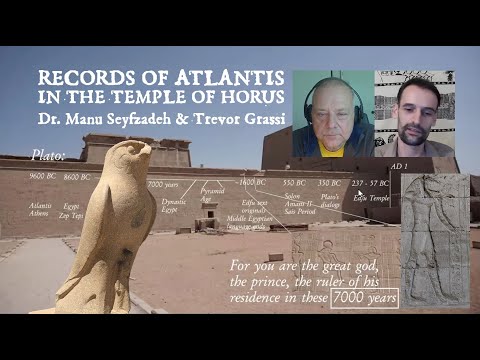
On Trevor Grassi’s channel, Dr. Manu Seyfzadeh argues that the building inscriptions at the temple of Horus in Edfu keep an Egyptian pattern behind Plato’s account of a lost island power. The carved temple is late, but he says the mythic passages use an older stage of the language, so they were not composed to impress Greek visitors. In his reading an earlier world cycle is drowned, and a resurrection story follows in which written creation words, not a purely spoken tale, remake what was lost. He treats the temple plan as a copy of the sky. A linguistic ancestor of the name Atlantis, he says, stands on those walls, and Solon, inside Plato’s dialogue, turned Egyptian names back into Greek. A span of seven thousand years in the inscription is lined up with Plato’s date for Egypt’s beginning after the war with Athens. Seyfzadeh starts from the Egyptian wording and only afterward compares Edgar Cayce, without treating every Cayce detail as settled. Flood memory and the claim that Greek ideas of harmony have Egyptian roots stay inside that comparison.
Key points
- Seyfzadeh reads the Edfu mythic texts as older than the Ptolemaic temple because of their language.
- An earlier cycle is drowned, and creation words that were written down are used to rebuild it.
- The temple is described as a copy of the heavens, matching the shape of Plato’s creation story.
- He claims a forerunner of the name Atlantis is present on the wall, with Solon recasting Egyptian names into Greek.
- A seven thousand year figure is aligned with Plato’s date for Egypt beginning after the war with Athens.
- Egyptian wording comes first in his method, and Edgar Cayce is only a later comparison, not the proof.
Short quotes
The middle kingdom Egyptians spoke a language called middle Egyptian which is almost like old Egyptian.
Manu Seyfzadeh, Seyfzadeh on the Edfu texts and Atlantis
He uses the older stage of the language to argue that the myth is not a late composition. Watch at 9:47
And so somehow something happens to that original cycle and it ends up being destroyed, flooded.
Manu Seyfzadeh, Seyfzadeh on the Edfu texts and Atlantis
The first world age in his reading ends in a flood before a new creation begins. Watch at 24:53
The temple itself is is an image of the universe as above so below.
Manu Seyfzadeh, Seyfzadeh on the Edfu texts and Atlantis
He takes the building as a model of the heavens set on the ground. Watch at 30:57
He's saying that Solon translated the names that he heard in Egypt back into the into the Greek original.
Manu Seyfzadeh, Seyfzadeh on the Edfu texts and Atlantis
Plato’s Greek names, in this account, are Solon’s translations of Egyptian ones. Watch at 53:34
No, the word Atlantis, its predecessor is there on the wall of Edfu people.
Manu Seyfzadeh, Seyfzadeh on the Edfu texts and Atlantis
He tells listeners that an older form of the famous name is carved at Edfu. Watch at 1:00:18
I'm just saying is that I look at this whole thing from the text of the Egyptians first and foremost.
Manu Seyfzadeh, Seyfzadeh on the Edfu texts and Atlantis
He says the Egyptian inscription, not later psychics, is where his argument starts. Watch at 1:40:00
Video by Trevor Grassi. Watch on YouTube.