
Table of Contents
- Origin of Our Lady of Aparecida (1717)
- Suppression of Indigenous and African Religions
- Persecution of African Spiritual Practices
- Resilient spiritual traditions
- Colonial Context
- Guaratinguetá and the Paraíba Valley
- African Enslaved Population
- Indigenous Peoples and Relations
- Religious Enforcement
- Overlay of African Water Deities
- The story of Princess Isabel (~150 years later)
- The Ewe people’s rituals for Mami Wata
- A young boy saved from drowning
- The Constituições Primeiras do Arcebispado da Bahia (1707)
- 1. Prohibition of Non-Catholic Religious Practices
- 2. Mandatory Christian Instruction
- 3. Control over Images and Unauthorized Rituals
The origin of Our Lady of Aparecida in Brazil is deeply intertwined with the colonial imposition of Catholicism and the suppression of Indigenous and African spiritual practices. The Catholic Church, in collaboration with the Portuguese colonial administration, systematically dismantled native religious systems through forced conversions, destruction of sacred objects, and persecution of spiritual leaders.
Origin of Our Lady of Aparecida (1717)
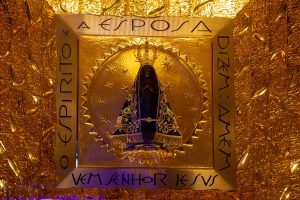
The story of Our Lady of Aparecida, Brazil’s patroness, is rooted in the 1717 discovery of a small, dark clay statue of the Virgin Mary by three fishermen in the Paraíba River near Guaratinguetá, São Paulo. This statue, named Nossa Senhora da Conceição Aparecida, is associated with numerous miracles.
After retrieving the head, they experienced an abundant catch, which was interpreted as a miracle. The statue, known as Nossa Senhora da Conceição Aparecida, gained widespread veneration, particularly among Afro-Brazilians due to its dark complexion and association with miraculous events due to its close association with their deity Mami Wata.
Suppression of Indigenous and African Religions
The Catholic Church enforced forced conversions, mandating baptism and Christian instruction for Indigenous peoples and African slaves. Sacred sites and objects of native religions were destroyed, and traditional ceremonies were banned. Spiritual leaders, such as Indigenous shamans (pajés), were targeted for elimination, as their influence was seen as a threat to Christianization efforts.
The Constituições Primeiras do Arcebispado da Bahia (1707) imposed strict penalties, including death, for those practicing or promoting non-Christian beliefs.
They were issued under Archbishop Sebastião Monteiro da Vide and applied throughout Brazil as the central religious authority of the time. These constitutions reflected the fusion of Church and colonial power and enforced strict discipline on the population, especially Indigenous peoples and African slaves.
For example Title LXXIV, Canon 1312 states that anyone who practiced or promoted rituals considered “superstitions” or “witchcraft” would be punished with major excommunication and handed over to the civil authorities for sentencing. Punishments include imprisonment, whipping, or even execution in cases of repeated offenses or “grave scandal.”
Persecution of African Spiritual Practices
African religious expressions, including dances and rituals associated with deities like Mami Wata, were often equated with witchcraft and punished severely.
Practitioners of Afro-Brazilian religions such as Candomblé and Umbanda faced legal restrictions; until 1976, they required police permission to hold public ceremonies.
Despite persecution, enslaved Africans preserved their spiritual traditions by syncretizing their deities with Catholic saints, allowing clandestine worship under the guise of Christian practices.
Resilient spiritual traditions
The veneration of Our Lady of Aparecida, symbolizes a complex intersection of imposed Catholicism and the resilient spiritual traditions of Brazil’s Indigenous and African populations.
The situation around the Paraíba River near Guaratinguetá, São Paulo, in 1717 was shaped by the dynamics of Portuguese colonization, the expansion of the plantation economy, and the violent imposition of Catholicism on Indigenous and African populations.
Colonial Context
In 1717, Brazil was a colony of Portugal. The region of São Paulo was part of the Captaincy of São Vicente, one of the earliest Portuguese settlements.
The Portuguese Crown had granted large tracts of land to settlers through the sesmaria system, which facilitated the creation of plantations and settlements. Indigenous people were often displaced from their lands without legal recognition. Enslaved Africans were used as the primary labor force on sesmaria lands, especially in sugarcane plantations, cattle ranches, and later in coffee zones.
Guaratinguetá and the Paraíba Valley
Guaratinguetá was a small but growing village in the Paraíba Valley, located between Rio de Janeiro and São Paulo. The Paraíba River served as a key transport and resource route, vital for fishing, agriculture, and regional trade. The valley became strategically important for its access to inland areas and for supporting mining expeditions toward Minas Gerais, which was entering its gold boom.

African Enslaved Population
Africans were brought mainly from West Central Africa (e.g., Kongo, Angola) and West Africa (e.g., Yoruba, Ewe-Fon, Akan regions). They carried with them rich spiritual traditions, including the veneration of water deities such as Mami Wata.
The Transatlantic slave trade was at its height; Brazil was the largest destination for African slaves, receiving nearly 5 million over three centuries.
Indigenous Peoples and Relations
The area around Guaratinguetá had been inhabited by Tupi-speaking peoples, including the Guarani and Guaianá. These communities faced violence, forced conversion, and displacement by colonists and missionaries.
Portuguese bandeirantes (slave raiders and explorers from São Paulo) captured Indigenous people to enslave them and to support the colonization of interior Brazil.
Many Indigenous people were absorbed into aldeias (Catholic mission villages), where they were pressured to abandon their languages and spiritual traditions.
Religious Enforcement
Catholic priests, especially Jesuits, established missions in the region. They baptized and indoctrinated Indigenous and enslaved Africans, while systematically repressing their spiritual practices.
Overlay of African Water Deities
Mami Wata, is a water spirit revered in various African and diaspora cultures. She is often depicted as a beautiful, dark-skinned woman with long hair and sometimes a fishtail, embodying both human and aquatic qualities. Her name, derived from “mother” or “mommy” and “water,” reflects her role as a maternal, protective figure associated with the sea, rivers, and fertility.
In Yoruba mythology, Mami Wata is one of the principal deities in the pantheon, alongside other water deities like Oshun, the goddess of love and rivers, and Olokun, the god of the sea.
The figure of Our Lady of Aparecida absorbed attributes resonant with African water spirits like Mami Wata—both associated with water, healing, fertility, and protection. This identification allowed African-descended communities to continue venerating Mami Wata’s spiritual power under the socially accepted guise of Catholic devotion.
Oral histories and ethnographic studies record how ceremonies, dances, and healing rituals linked to Mami Wata continued within Afro-Brazilian communities, often timed with Catholic festivals dedicated to Our Lady of Aparecida. This blending preserved African spiritual frameworks hidden in Catholic symbols and language.
By linking Mami Wata’s attributes with the Virgin Mary, enslaved and marginalized communities asserted their spiritual identity and claimed divine protection within a hostile colonial system.
The story of Princess Isabel (~150 years later)
Princess Isabel, daughter of Emperor Dom Pedro II, is closely associated with Our Lady of Aparecida. According to tradition, Isabel faced difficulties conceiving a child with her husband, Conde d’Eu. She made a promise to Our Lady of Aparecida, vowing to offer a crown and mantle if her prayers for a child were answered. Her prayers were fulfilled, and in gratitude, she donated a gold crown adorned with diamonds and rubies, along with a richly embroidered blue mantle, to the statue in 1888. This act was part of a larger vow made during her visits to the basilica in 1868 and 1888. The crown, reportedly a replica of one she would have worn as empress, was used in the statue’s canonical coronation in 1904, authorized by Pope Pius X, declaring Our Lady of Aparecida the Queen of Brazil.
Beyond her personal miracle of childbirth, Isabel is famous for signing the Lei Áurea in 1888, abolishing slavery in Brazil, which earned her both admiration and enemies among powerful landowners. Her devotion to Aparecida, including her offerings, was seen as a spiritual acknowledgment of the Virgin’s intercession in her life and Brazil’s history.
The Ewe people’s rituals for Mami Wata
The Ewe people’s rituals for Mami Wata, as a divine queen, are elaborate expressions of devotion, designed to honor her opulence and maintain harmony with her aquatic realm. Through offerings like perfume, alcohol, coins, mirrors, and fine cloth, and through rhythmic drumming, dance, and chanting by rivers or the sea, devotees invoke her presence and seek her favor. These ceremonies, rooted in Ewe Vodun, reflect a blend of indigenous beliefs, coastal trade influences, and female empowerment, reinforcing Mami Wata’s regal status and her role as a powerful intermediary.
A young boy saved from drowning
Another miracle often cited involves a young boy, not a prince, who was saved from drowning in the Paraíba River. During a strong current, the boy fell from a boat and couldn’t swim. His father prayed to Our Lady of Aparecida, and the river miraculously calmed, allowing the boy to float safely until rescued, without swallowing any water. This is one of the first seven miracles attributed to her intercession.
Across West Africa, Mami Wata is often depicted as rescuing individuals from drowning, particularly those who have shown her devotion. For example, fishermen who regularly offer libations (e.g., alcohol or coins) to her before setting out to sea may be spared from storms or accidents. In some stories, individuals who fall into turbulent waters and call upon Mami Wata are miraculously saved, either by being guided to shore or by the sudden calming of the waters.
Among the Fon (close neighbors of the Ewe in Benin), Mami Wata (or related water deities like Yemoja in Yoruba tradition) is credited with saving devotees from drowning. For instance, a Fon fisherman who nearly drowned during a storm might claim that Mami Wata appeared as a beautiful woman or mermaid, guiding him to safety after he prayed to her.
The Constituições Primeiras do Arcebispado da Bahia (1707)
The Constituições Primeiras do Arcebispado da Bahia (1707) were the first ecclesiastical constitution of the Catholic Church in colonial Brazil. They were issued under Archbishop Sebastião Monteiro da Vide and applied throughout Brazil as the central religious authority of the time. These constitutions reflected the fusion of Church and colonial power and enforced strict discipline on the population, especially Indigenous peoples and African slaves.
1. Prohibition of Non-Catholic Religious Practices
Title LXXIV, Canon 1312 states that anyone who practiced or promoted rituals considered “superstitions” or “witchcraft” would be punished with major excommunication and handed over to the civil authorities for sentencing. Punishments could include imprisonment, whipping, or even execution in cases of repeated offenses or “grave scandal.” Source
2. Mandatory Christian Instruction
Title II required that parents, teachers, masters, and slave owners ensure that children, students, servants, and enslaved people received Catholic instruction (catechism). Failure to comply was considered a grave sin, subject to spiritual penalties, and in repeated or serious cases, to civil punishment as well. Source
3. Control over Images and Unauthorized Rituals
Title XVII, Clause 699 forbade the use of any image or symbol in churches, chapels, or oratories without prior approval from Church authorities. Any unauthorized religious imagery or ritual—especially those influenced by Indigenous or African traditions—had to be destroyed. The individuals responsible were punished and their acts declared illegal and offensive to the faith. Source


Comments are closed.