
Table of Contents
- Introduction
- Etymology and Origins
- Morgan’s Role in Arthurian Legend
- Early Texts – A Benevolent Healer (Geoffrey of Monmouth, 12th Century)
- The Medieval Transformation – The Sorceress and Temptress
- The Femme Fatale and Villain (Late Medieval & Renaissance)
- 4. Morgan’s Connection to Avalon
- Morgan’s Magical Abilities
- Morgan and Other Mythological Figures
- The Modern Morgan – Reinterpretations
- Conclusion – Who Was the “Real” Morgan le Fay?
Introduction
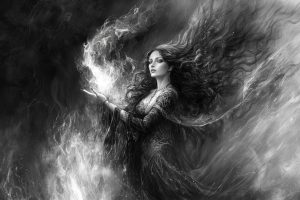
Morgan le Fay is one of the most complex figures in Arthurian legend. She appears as a powerful sorceress, healer, shape-shifter, and sometimes a nemesis to King Arthur. Her portrayal changes significantly across medieval literature, ranging from a benevolent faery queen to a vengeful antagonist.
Morgan’s name and origins suggest links to Celtic mythology, possibly evolving from ancient goddesses or priestesses of Avalon. Over time, she was influenced by Christian and patriarchal narratives, which often turned her into a villainous witch.
Etymology and Origins
- The name “Morgan” is likely derived from Old Welsh or Breton, meaning “born of the sea”, linking her to water deities.
- “le Fay” (French: la fée) means “the fairy”, reinforcing her supernatural nature.
- Some scholars connect her to the Morrígan, the Irish war and fate goddess, who also has shape-shifting abilities and a connection to kingship and death.
- In early texts, Morgan is portrayed positively as a wise healer and enchantress, but later medieval authors—especially influenced by Christianity—turned her into a dangerous temptress or enemy of Arthur.
Morgan’s Role in Arthurian Legend
Morgan le Fay’s storyline changes depending on the source. Below are the major phases of her character development:
Early Texts – A Benevolent Healer (Geoffrey of Monmouth, 12th Century)
- First appears in Geoffrey of Monmouth’s Vita Merlini (c. 1150).
- She is one of nine sisters who rule over Avalon, a mystical island.
- She is described as a healer and shape-shifter, skilled in herbal medicine and magic.
- Arthur is taken to Avalon after his final battle at Camlann, where Morgan tries to heal him.
- In this version, Morgan is not an antagonist but a guardian figure.
The Medieval Transformation – The Sorceress and Temptress
Later medieval writers, especially in French and English romances, made Morgan more antagonistic:
- In Chrétien de Troyes’ Erec et Enide (c. 1170), she is a jealous and vengeful sorceress.
- In Thomas Malory’s Le Morte d’Arthur (1485), she becomes one of Arthur’s greatest enemies.
Key changes in these versions:
- She becomes a rival of Arthur’s wife, Guinevere.
- She is often depicted as seductive, manipulating knights for her own purposes.
- She attempts to steal Excalibur and sabotage Arthur’s kingdom.
- She is frequently associated with dark magic and treachery.
Why did this shift happen?
- The increasing Christianization of Europe cast powerful pagan women in a negative light.
- Morgan’s independent power was seen as a threat to patriarchal order.
- She was made into a temptress in contrast to the virtuous Guinevere.
The Femme Fatale and Villain (Late Medieval & Renaissance)
By the 15th century, Morgan le Fay had become:
- A seductress, luring knights away from their quests.
- A sorceress, using dark magic against Arthur and his allies.
- A manipulator, orchestrating the downfall of Camelot.
- A rival to Merlin, sometimes replacing him as the primary magician of the legend.
She often plays a role in Arthur’s downfall, either by helping his enemies or leading him to betrayal and destruction.
4. Morgan’s Connection to Avalon
- Avalon is a mystical island, often described as the place where Arthur was taken after his mortal wound.
- In some versions, Morgan is the ruler of Avalon and a protector of Arthur’s spirit.
- This duality (villain vs. healer) shows how medieval writers struggled with her character—was she an enemy, or was she simply misunderstood?
Morgan’s Magical Abilities
Morgan le Fay’s powers include:
- Healing: In early stories, she is a master of herbal medicine and natural magic.
- Shape-shifting: She can transform herself and others (e.g., disguising herself to trick Arthur’s knights).
- Flying: Some accounts mention her flying through the air or over the sea.
- Illusions and enchantments: She can create visions, trap knights in magical prisons, or cause men to fall in love with her.
- Weather manipulation: Some versions connect her to storms and sea magic, linking her back to Celtic deities.
Morgan and Other Mythological Figures
Morgan le Fay is often compared to other mythological female figures, suggesting older origins:
| Figure | Comparison to Morgan le Fay |
|---|---|
| Morrígan (Irish) | Shares the name Mór-Rígan ("Great Queen"), is a shape-shifter, associated with fate, war, and kingship. |
| Mari (Basque) | Both are powerful female figures controlling nature, sometimes seen as dangerous but not evil. |
| Circe (Greek) | Both are sorceresses who manipulate men and practice transformation magic. |
| Lilith (Jewish folklore) | Both are demonized female figures representing independence and rebellion. |
| Fairy Queens (Celtic lore) | Morgan le Fay is called la fée (the fairy), linking her to faery enchantresses like the Sidhe (Aos Sí). |
The Modern Morgan – Reinterpretations
Morgan le Fay has been reclaimed in modern literature and media:
- Feminist Reinterpretations: Modern writers view her as a powerful woman resisting patriarchal oppression.
- Avalon as a Feminine Utopia: Some works, like Marion Zimmer Bradley’s The Mists of Avalon (1983), depict Morgan as a priestess of an older, matriarchal religion resisting Christianity.
- Superhero & Pop Culture Adaptations:
- In DC Comics, Morgan is a major magical villain in the world of Batman and Wonder Woman.
- In Marvel Comics, she is a sorceress and adversary of Doctor Strange.
- In films and TV, she is sometimes depicted as a tragic anti-heroine rather than a pure villain.
Conclusion – Who Was the “Real” Morgan le Fay?
- Was she a goddess turned into a villain? → Likely, as she shares traits with older Celtic goddesses.
- Was she a historical figure? → Some believe she was based on real-life Druidic priestesses.
- Was she truly evil? → Originally, no. Later medieval authors rewrote her story to fit Christian ideals.
Morgan le Fay remains one of the most mysterious and powerful figures in European mythology, embodying magic, transformation, and the clash between old and new beliefs.


Comments are closed.