
Table of Contents
This section looks at the Iron Age inscriptions from Kuntillet Ajrud and what they reveal about Yahwistic worship during the 9th–8th centuries BCE.
This period, often called Iron Age II, marks a time when the Israelite kingdoms of Judah and Israel established their cultural and religious identities amidst a complex Near Eastern landscape.
The Kuntillet Ajrud findings offer a rare snapshot of how Yahweh was revered and how his worship intersected with local practices.
The Site: Kuntillet Ajrud
Kuntillet Ajrud is a remote desert site in the northeastern Sinai Peninsula, excavated in the 1970s by archaeologist Ze’ev Meshel. Dated to around 800 BCE, it’s interpreted as either a fortified caravanserai (a roadside stop for traders) or a small religious outpost. What makes it extraordinary are the inscriptions and drawings found on plaster walls and large storage jars (pithoi), written in ancient Hebrew script. These artifacts mention “Yahweh” explicitly, providing some of the earliest non-biblical evidence of his worship.
The Inscriptions
Two key phrases stand out: “Yahweh of Samaria” and “Yahweh of Teman.”

These are typically part of blessings, like “I bless you by Yahweh of Samaria and by his Asherah” or “by Yahweh of Teman and his Asherah.” Here’s what they suggest:
- Regional Variations of Yahweh
- Yahweh of Samaria: Samaria was the capital of the northern kingdom of Israel. Naming Yahweh this way implies he was tied to specific locales, much like how other Near Eastern gods (e.g., Baal of Ugarit) were linked to cities or regions. This could reflect a decentralized cult where Yahweh was seen as a protector of particular places, not yet a fully universal deity.
- Yahweh of Teman: Teman, meaning “south,” likely refers to a region in Edom or southern Judah. This aligns with older biblical poetic texts (e.g., Habakkuk 3:3, “God came from Teman”) that associate Yahweh with southern origins. It hints that his worship may have spread northward from desert regions, adapting as it went.
- Asherah as Consort
The mention of “his Asherah” is explosive because it suggests Yahweh had a female counterpart. Asherah was a well-known Canaanite goddess, often linked to fertility and motherhood, worshipped across the Near East. In these inscriptions, “his Asherah” could mean:- A literal goddess, implying Yahwistic worship included a divine pair, not unlike El and Athirat in Canaanite religion.
- A cult object, like a wooden pole or symbol representing Asherah, used in worship (some scholars lean toward this to avoid implying polytheism). Either way, it challenges the later biblical push for strict monotheism, showing that 9th–8th century Israelites weren’t shy about blending traditions.
- The Drawings
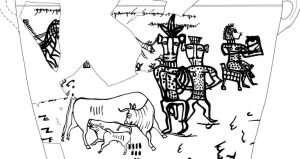
Accompanying the inscriptions are sketches on the pithoi, including two humanoid figures (often debated as Yahweh and Asherah) and a cow-and-calf image, possibly tied to fertility motifs. One figure, sometimes called “Bes-like” due to its resemblance to the Egyptian dwarf god Bes, adds another layer of cultural mixing. These visuals suggest worship at Kuntillet Ajrud was eclectic, drawing from Israelite, Canaanite, and even Egyptian influences.
What It Means for Yahwistic Worship
By the 9th–8th centuries BCE, the kingdoms of Israel and Judah were navigating their identities post-Solomon’s united monarchy (if it existed as described). The Kuntillet Ajrud evidence points to a Yahwistic cult that was:
- Localized: Yahweh wasn’t a one-size-fits-all god yet. “Of Samaria” and “of Teman” show regional flavors, possibly reflecting political or tribal loyalties.
- Syncretic: The Asherah connection and diverse iconography suggest Israelites were comfortable integrating Canaanite elements. This tracks with biblical complaints about “high places” and idol worship (e.g., 2 Kings 17), hinting that the monotheistic ideal of later Judaism wasn’t fully baked.
- Growing: The site’s location along trade routes implies Yahweh’s cult was spreading, carried by travelers or settlers, adapting to new contexts.
Context in the Iron Age
This period saw Israel and Judah as small players amid bigger powers like Assyria. The 8th century BCE, in particular, was tumultuous—Israel fell to Assyria in 722 BCE, shortly after Kuntillet Ajrud’s heyday. The inscriptions might reflect a time when Yahwistic worship was still flexible, before Judah’s later reforms under kings like Hezekiah or Josiah pushed for centralized, Yahweh-only worship in Jerusalem (e.g., Deuteronomy 12).
Scholarly Debate
- Monotheism vs. Henotheism: Were these worshippers monotheists who saw Asherah as a symbol, or henotheists who accepted multiple gods but prioritized Yahweh? The inscriptions don’t settle it, but they lean toward the latter.
- Asherah’s Role: Some argue “his Asherah” is just a ritual object, not a goddess, to preserve a monotheistic lens. Others say the evidence points to a divine couple, later scrubbed from official theology.
- Purpose of the Site: Was it a lay worship spot for travelers or a state-sponsored outpost? Its isolation favors the former, but the sophistication of the finds suggests some official backing.
The Bigger Picture
Kuntillet Ajrud shows Yahwistic worship in a raw, transitional phase—less polished than the Bible’s portrayal, more rooted in the gritty realities of Iron Age life. It’s a cult gaining traction, flavored by its Canaanite neighbors, and not yet the exclusive faith of later Judaism. The “Yahweh of Samaria” and “Yahweh of Teman” duo, paired with Asherah, paints a picture of a deity still finding his footing in a crowded divine landscape.


Comments are closed.