
Table of Contents
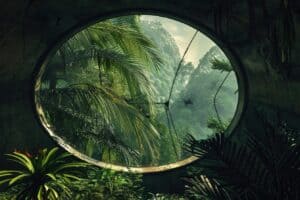
The dome-shaped colony is the home that “Lacerta” describes in the Lacerta Files. These are two interview transcripts published online by a Swede who signs as Ole K. He says he met a female reptilian being in a remote house in southern Sweden, first on 16 December 1999 and again in April 2000, through a friend he names only as E.F. Ole K. calls the account true, but the colony has never been found or confirmed. The details below are what the second transcript claims.
Depth, age and size
Lacerta refuses to say where her colony is, only that it is a smaller settlement somewhere east of the meeting place. In her account it is a natural cave about (14,108 feet) down. Her people settled it some 3,000 years ago and reshaped its roof into a low dome built partly into the rock. The floor is oval, about two and a half kilometres across, and the roof rises to about (722 feet) at its peak. Roughly 900 of her kind live there.
The central column
Under the highest point of the roof stands a pale grey cylinder, the first building raised in any colony. It holds up the honeycomb frame of the roof, and it is the tallest and oldest structure in the dome. It has a special name and a religious role. It also runs the climate and the lighting, and the air shafts and light systems pass through it. Five large light sources, which she says draw on gravity, give the colony ultraviolet light and warmth.
Buildings and rings
The other buildings are round, dome-like and much lower, between (9.8 to 65.6 feet) high. They stand in oval rings around the column, and their colour changes from ring to ring. North of the column a wide, flat round building about (820 feet) across breaks the pattern. It holds brightly lit rooms where residents warm their blood under strong ultraviolet light, together with a clinic and a meeting room. Lacerta’s group, which she calls her “family” in quotation marks, lives in the fourth ring out.
Animal pens lie outside the outer ring, because her species must eat meat. Gardens there grow plants and mushrooms, and underground springs supply hot and cold water. A fusion power plant on the edge of the colony feeds the buildings and the artificial suns.
Shafts and tunnels
The colony has three air shafts and two elevators. One elevator climbs to a cave near the surface. The other reaches a small hangar, hidden behind a rock face, that usually holds three of the cylindrical craft described elsewhere in the interviews. A tunnel leads to a larger main colony about (311 miles) to the southeast.
The wider network
In the first transcript Lacerta says her people live in caverns between (6,562 to 26,247 feet) deep, linked by hidden tunnels to the surface. She names major sites beyond the Arctic and the Antarctic, in Inner Asia, and in North America and Australia. One main colony in Inner Asia, over (15.5 miles) across, needs nine supporting columns instead of one. For more on claims of this kind, see underground cities.
Entrances and signs
She would not reveal any entrance. She did say that she had come up through one about (186 miles) north of the meeting place, near a large lake. Her advice to anyone exploring a narrow cave or old shaft is to watch for walls that grow smoother with depth, warm air rising from below, or the sound of air rushing through a shaft. Behind a grey metal door in a smooth wall there may be a round room with ventilation and elevators.
Two symbols mark her people’s places. The more ancient one, now rarely used, shows a blue serpent with four white wings on a black ground. The more common one is a dragon curled into a circle around seven white stars. Lacerta adds a warning: not every underground site belongs to her kind, and some tunnels are run by other, sometimes hostile, races.

