
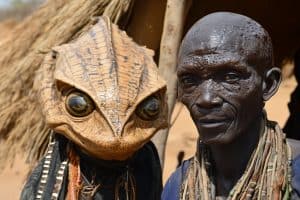
In the cosmology of the Dogon people, Amma and Yurugu are central figures representing creation and chaos. Their myth encapsulates the universe’s origins, humanity’s creation, and the balance between order and disorder. Below is a detailed account of these mythological entities:
Amma: The Creator God
Amma is the supreme deity and the central figure in Dogon cosmology, embodying the force of creation and the universal order.
1. Role in Creation
- Amma is described as an omnipotent, androgynous being who existed before the universe.
- Creation began when Amma shaped the cosmos from primordial chaos. He molded the earth (symbolized as a female figure) and fertilized it with the power of his divine word and essence.
2. The Creation of the World
- Amma’s first attempt at creation was disrupted by disorder, but subsequent acts brought balance to the universe:
- He spun the cosmos like a potter shaping clay.
- The stars, sun, moon, and earth were formed as part of his divine plan.
3. The Birth of the Nommos
- As part of the creation process, Amma created the Nommos, amphibious beings who were sent to bring order and knowledge to the universe.
- The Nommos are Amma’s messengers and intermediaries between the divine and the earthly.
4. Symbolism
- Amma is often represented by the celestial sphere or as a creative force inherent in all life.
- He is associated with the egg of the world, which symbolizes the totality of existence and the beginning of time.
5. Amma’s Laws
- Amma established the moral and spiritual laws that govern human behavior and the natural order.
- His influence extends into the rituals and spiritual practices of the Dogon people.
Yurugu: The Chaotic Rebel
Yurugu, also known as the Pale Fox, represents disorder, imperfection, and the destructive forces of chaos.
1. Role in Creation
- Yurugu was born during Amma’s act of creation but rebelled against the divine order.
- He is often described as an incomplete or imperfect being, symbolizing imbalance and disharmony.
2. The Myth of Rebellion
- Yurugu attempted to create the world independently, stealing parts of Amma’s creation to form his own flawed universe.
- His rebellious act led to imperfection and the introduction of chaos into the world.
- The Dogon attribute the fragmented and dualistic nature of existence to Yurugu’s failed attempt at creation.
3. Symbolism
- Yurugu is associated with the Pale Fox, a creature in Dogon mythology that symbolizes mischief, disorder, and imbalance.
- He is depicted as a restless, wandering figure who searches for completeness but can never achieve it.
4. Connection to Humanity
- Yurugu’s actions serve as a cautionary tale about the dangers of hubris and disobedience to divine laws.
- He represents the flawed nature of humanity and the struggle between good and evil.
5. Cosmological Impact
- The disruption caused by Yurugu required Amma to send the Nommos to restore order and harmony to the universe.
- The Dogon believe that Yurugu’s influence persists in the world, manifesting as imperfections in human behavior and the environment.
Amma and Yurugu in Balance
- The dynamic between Amma (order) and Yurugu (chaos) reflects the Dogon understanding of the dualistic nature of existence.
- The creation myth emphasizes the importance of maintaining harmony and following divine laws to counteract the destructive forces symbolized by Yurugu.


Comments are closed.