
Table of Contents
Zoroaster, or Zarathustra, is a prophet I keep meeting at the edges of other subjects: the Persian god of light, the great cycles of time, the Oahspe chronology and even a family in the Anna material. These are the pages where he appears.
A family that followed his teachings
In the Anna material, Myriam of Tyana describes her family on Myriam of Tyana:
My immediate family is considered affluent and well-educated. We do not keep slaves and we abhor sacrifice of any kind. Many of us, including my father, ascribe to the teachings of Zoroaster, in addition to the writings within the Torah and other mystical oral traditions passed down from Moses, the Egyptian alchemists and the Greek philosophers.
Myriam of Tyana, in Claire Heartsong, Anna, the Voice of the Magdalenes

Ahura Mazda and the Avesta
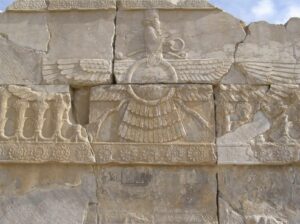
On Zoroastrianism: Ahura Mazda I write that the title Ahura Mazda was given by Zoroaster, who proclaimed him the uncreated spirit, wholly wise and benevolent, creator and upholder of Asha. On Ormazd represents the ultimate source of all goodness, wisdom, and light I note that the Avesta contains hymns and teachings attributed to Zoroaster. In Initiates of the Flame (1922) the summary of Manly P. Hall’s book notes that among the followers of Zoroaster, fire was worshipped as a manifestation of Ormuzd.
Dating the prophet
On Yima and the Vara I note that Zoroaster is traditionally dated somewhere between 1500 and 1000 BCE, with scholarly estimates varying widely. On Cyclical Time in Ancient Legends Paschal Beverly Randolph lists the Persian cycle of the followers of Zoroaster as 12,000 years.
Zarathustra in Oahspe
On Zarathustra (Mortal Prophet) the Oahspe Bible makes Zarathustra a mortal prophet chosen by Jehovih to restore monotheistic worship, while an Unknown Etherean God oversees his cycle in the heavens. On The Book of Saphah Oahspe counts three thousand one hundred years from Brahma and Abraham back to Zarathustra.
Donnelly on Persian fire worship
Ignatius Donnelly, the Minnesota politician who wrote Atlantis: The Antediluvian World, followed it in 1883 with Ragnarok: The Age of Fire and Gravel. He read the Persian serpent Azhidahaka as the comet and traced Persian fire worship to the Age of Darkness that, in his account, followed it.
The Persian fire-worship is based on the primeval recognition of the value of light and fire, growing out of this Age of Darkness and winter.
Ignatius Donnelly, Ragnarok: The Age of Fire and Gravel (1883), part III, chapter VI, p. 171

Zarathustra in the Aquarian Gospel
In The Aquarian Gospel (1908), a text presented as taken from the Akashic Records, Dowling has Elihu of Zoan tell Mary and Elizabeth this account of Zarathustra:
In course of time a lofty soul, whom men called Zarathustra, came in flesh. He saw the causeless Spirit, high and lifted up; he saw the weakness of all man appointed gods. He spoke and all of Persia heard; and when he said, One God, one people and one shrine, the altars of the idols fell, and Persia was redeemed.
Dowling, The Aquarian Gospel (1908), 10:20-22
Roisel on the date of Zoroaster
In the chapter on the Magi in Études anté-historiques (1874), Roisel gathers the ancient datings of Zoroaster. Aristotle and Eudoxus, in the authorities he cites, place him six thousand years before their own time.
Aristotle and Eudoxus make Zoroaster live six thousand years before their time. Hermippus, Diogenes Laerce, Hermodorus, and Plutarch place him five thousand years before the Trojan war; and, according to them, this legislator of Persia was not the first.
Roisel, Études anté-historiques (1874), chapitre II, Les Mages, p. 113, translated from the French
Related pages
- Myriam of Tyana
- Zoroastrianism: Ahura Mazda
- Ormazd represents the ultimate source of all goodness, wisdom, and light
- Initiates of the Flame (1922)
- Yima and the Vara
- Cyclical Time in Ancient Legends
- Zarathustra (Mortal Prophet)
- The Book of Saphah
For every page I tagged with Zoroaster, see the Zoroaster tag archive.

