
Table of Contents
Indra is the king of the gods in the Vedas: the god of storms, rain and war, who rides a white elephant and throws the thunderbolt. He turns up on this site in very different places, from Donnelly’s Atlantis to the Rigveda, Chan Thomas and the Norse and Greek comparisons. These are the pages where I wrote about him.
King of the gods
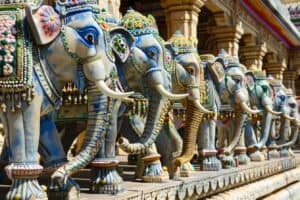
Principal deities of Hinduism describes Indra as the ruler of the heavens and the god of storms and war, often shown riding the white elephant Airavata and holding the thunderbolt, the vajra. In 12 Adityas in Hindu Mythology he is one of the twelve sons of Aditi, linked with rain and thunderstorms. The Rigveda Samhita names him first in the pantheon its hymns praise, before Agni and Varuna. World Elephant covers the Ashtadiggajas, the eight elephants that guard the zones of the universe in Hindu cosmology.
The serpent and the Ten Kings
Indra is a fighter. The Serpent tells how the great serpent Vrita was overcome by Indra after a desperate struggle. Ancient wars covers the Battle of the Ten Kings in Mandala 7 of the Rig Veda, where King Sudas of the Bharata, with the sage Vasistha and the divine help of Indra, defeated a coalition of ten kings on the Parushni River.
On The Bastra, a tool capable of drilling into rock, producing effects similar to vaporization I look at a Yajurveda passage that asks for a sacred implement to fall like the bolt of Indra and split stone from stone, and I ask whether it describes a tool that harnessed something like lightning.
King of Meru
Ignatius Donnelly connected Indra to Atlantis. On The Aryan Colonies from Atlantis he reads Indra as an ancient king who was later deified:
Here we see that the great god Indra, chief god of the Hindoos, was formerly king of Meru, and that Deva-Nahusha (De(va)nushas--De-onyshas) had also been king of Meru; and we must remember that Theopompus tell us that the island of Atlantis was inhabited by the "Meropes;" and Lenormant as reached the conclusion that the first people of the ancient world were "the men of Mero."
Ignatius Donnelly, Atlantis: The Antediluvian World

On Genesis contains a history of Atlantis Donnelly goes further and calls William Tell a survival of the sun-god Apollo, Indra, who was worshipped on the altars of Atlantis.
The parable of the palace
The Adam and Eve Story by Chan Thomas retells a Hindu parable. After Indra defeats the Titan who held the waters captive, he orders the architect Visvakarman to build him an ever greater palace. A young Brahman, a messenger of Vishnu, tells him that countless Indras came before him, each rising and vanishing with the cycles of the world. Thomas places the story, from the Brahmavaivarta Purana, right before the Egyptian priest’s words to Solon about the many destructions of mankind.
Comparisons
Zeus: Poseidon’s older brother compares the two thunderbolt-throwing kings of the gods. Thor (Etherean God) compares the Oahspe’s Thor with Indra and with the Norse Thor, and concludes that Indra’s polytheistic setting makes him a less precise fit.
Related pages
- Principal deities of Hinduism
- 12 Adityas in Hindu Mythology
- The Rigveda Samhita
- The Aryan Colonies from Atlantis
- Genesis contains a history of Atlantis
- The Serpent
- Ancient wars
- The Adam and Eve Story
- Zeus: Poseidon’s older brother
For every page I tagged with Indra, see the Indra tag archive.

