
Table of Contents
The last ice age sits underneath most of the questions I follow: how much land lay where the sea is now, which animals vanished and when, and who was living through it.
Ice, sea and memory
Last Glacial Maximum holds the numbers that frame the rest. The sea rose from about 20,000 to 7,000 years ago, and in three bursts called Meltwater Pulses 1a, 1b and 1c it rose by several metres within a few centuries. The same page collects the Aboriginal stories of a coast “where the Great Barrier Reef now stands”. One Yidindji story has Fitzroy Island joined to the mainland, which would place its origin between about 10,000 and 13,000 years ago.
The cold snap and the animals
Younger Dryas: The Last Cold Snap and the Fall of Atlantis covers the return of the cold around 12,900 years ago, the impact hypothesis and the dates the Atlantis sources give. Mammoths: Ice Age Giants and Their Sudden End follows the animals through that period. Did a Massive Solar Flare Cause the Pleistocene Megafauna Extinction? sets out Paul LaViolette’s 2011 paper, which reads a 65% rise in carbon-14 as the sign of a solar proton event. It is one explanation among several, next to human hunting, climate change and a comet.
Hancock and the lost ice age society
Graham Hancock argues that an advanced society lived through the ice age and was drowned by the rising sea. Graham Hancock on ice age maps and drowned coasts and Graham Hancock on ice age sailors and old maps make his case from the lost shorelines and the old charts. Hancock on an ice age homeland is where he admits the limit of that case:
I don't know where this civilization started or where it was based.
Graham Hancock, An ice age homeland

Go underwater
On PGX Ideas, Hancock puts the land drowned at the end of the ice age at 27 million square kilometres, about the size of Europe and China together. He says archaeology has barely looked there (at 44:10).
Do explore those 27 million square kilometers that were flooded at the end of the ice age. Really explore the Sahara desert. Really explore the Amazon. And then come back and tell me there was no lost civilization.
Graham Hancock
The hunters
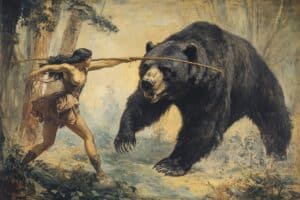
The Cosmic Hunt Myth – 40,000 years old follows the story of hunters chasing a great animal across the sky, a myth that John White traces back about 40,000 years by comparing versions from different peoples. History Fuzz and a carved ice age shelter follows a film team through rock shelters on the Bogotá savanna, where butchered ice age animals are dated to about 12,900 to 11,700 years ago and the team argues the carvings are deliberate. It is their case from surveys without excavation, not a dig report. These two pages remind me that the people in the numbers above had stories of their own.
Donnelly’s Age of Fire and Gravel
Ignatius Donnelly, the Minnesota politician who wrote Atlantis: The Antediluvian World, followed it in 1883 with Ragnarok: The Age of Fire and Gravel. In his account the clay and gravel of the Drift did not come from ice sheets but fell from a comet that struck the earth, and the cold came after the heat. He held that people already lived in the warm world before it.
We shall see hereafter that man, possibly civilized man, dwelt in this fair and glorious world—this world that knew no frost, no cold, no ice, no snow; that he had dwelt in it for thousands of years; that he witnessed the appalling and sudden calamity which fell upon it; and that he has preserved the memory of this catastrophe to the present day, in a multitude of myths and legends scattered all over the face of the habitable earth.
Ignatius Donnelly, Ragnarok: The Age of Fire and Gravel (1883), part I, chapter VII, p. 45

Related pages
- Last Glacial Maximum
- Younger Dryas: The Last Cold Snap and the Fall of Atlantis
- Mammoths: Ice Age Giants and Their Sudden End
- Did a Massive Solar Flare Cause the Pleistocene Megafauna Extinction?
- Graham Hancock on ice age maps and drowned coasts
- Graham Hancock on ice age sailors and old maps
- Hancock on an ice age homeland
- The Cosmic Hunt Myth – 40,000 years old
- History Fuzz and a carved ice age shelter
For every page I tagged with Last Glacial Maximum, see the Last Glacial Maximum tag archive.

