
Table of Contents
Paul A. LaViolette published a research paper in 2011 in the journal Radiocarbon. The title is “Evidence for a Solar Flare Cause of the Pleistocene Mass Extinction.” The paper argues that a massive solar proton event caused the extinction of many large mammals at the start of the Younger Dryas period about 12,900 years ago.
Did a Massive Solar Flare Cause the Pleistocene Megafauna Extinction?
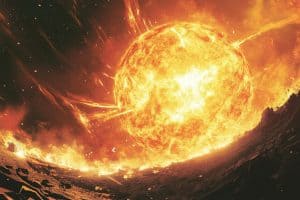
LaViolette proposes that a super-sized solar proton event (SPE), or several such events, occurred around 12,837 calibrated years before present. This event delivered high radiation to Earth’s surface and contributed to the abrupt end of Pleistocene megafauna, especially in North America. The theory uses data from sediment records, ice cores, and radiation estimates. It differs from other explanations like human hunting, climate shifts, or comet impacts.
Main Evidence from Radiocarbon Records
The Cariaco Basin sediment core from Venezuela shows a sharp increase in atmospheric radiocarbon (^14^C). A 65% rise in excess ^14^C occurred over 200 years at the Younger Dryas onset. Key spurts happened at dates like 12,973, 12,904, 12,837, and 12,639 cal yr BP. The largest spurt at 12,837 ± 10 cal yr BP showed a 20% ^14^C rise in about 8 years.
These spurts align with multiples of the 22-year Hale solar cycle. This pattern points to solar activity, linked to coronal mass ejections and super-sized SPEs. Lunar rock studies show solar cosmic-ray intensity was 15–50 times higher than today between 16,000 and 12,000 years ago.
Evidence from Greenland Ice Cores
The GISP2 ice core shows a ^10^Be peak that matches the 12,837 cal yr BP ^14^C spurt. ^10^Be forms from cosmic-ray interactions in the atmosphere. This supports an SPE rather than geomagnetic causes.
An acidity spike at 1708.65 m depth aligns with this date. It includes high nitrate (NO₃⁻) and ammonium (NH₄⁺) levels. High nitrate indicates cosmic-ray ionization. High ammonium points to global wildfires. Nitrate depletion in the layer suggests ozone destruction and prolonged UV exposure.
Radiation Dose and Lethal Effects
LaViolette compares the event to the 1956 SPE, which caused a 0.16% ^14^C increase with a fluence of 10^9 protons/cm². The ancient event’s 20% ^14^C rise suggests a fluence of about 1.3 × 10^11 protons/cm², or 125 times stronger.
For a hard-spectrum SPE, this could deliver 3–6 Sieverts or more of radiation at ground level over about 50 hours. This dose exceeds lethal levels for large mammals (LD-100: 3–8 Sv). A temporary magnetospheric collapse could increase the dose.
Such strong events are plausible, as superflares occur on sun-like stars at 10² to 10^7 times modern flare strength.
Timing and Link to Extinctions
The 12,837 cal yr BP event matches the Rancholabrean termination around 12,883 ± 60 cal yr BP and the end of Clovis culture (12,880–12,840 cal yr BP). It falls in the early Younger Dryas (12,950–12,750 cal yr BP).
The “black mat” layer, often linked to megafauna remains, dates younger and may reflect later changes after the SPE.
Additional Impacts
High ammonium levels indicate widespread wildfires, which reduced food for herbivores. A rapid warming followed, shown by oxygen isotope changes.
The SPE may have collapsed the magnetosphere, releasing cosmic dust from Earth’s orbit. This explains sporadic nanodiamonds and other markers in sediments, unlike uniform comet impact evidence.
Comparison to Other Theories
- Overkill by humans does not explain extinctions in Europe, Siberia, or bird losses.
- Climate cycles in the Pleistocene did not cause similar mass extinctions.
- Comet impact lacks a crater, shows weak nitrate signals, and has debated extraterrestrial markers that may come from cosmic dust.
Conclusion and Test Suggestions
LaViolette concludes that the SPE at 12,837 cal yr BP, with fluence ~1.3 × 10^11 protons/cm², caused lethal radiation, ozone loss, wildfires, and dust release. This led to megafauna extinction. Multiple events may have added effects.
He recommends testing by analyzing the GISP2 1708.65-m layer for ^10^Be spikes and platinum group elements to confirm cosmic-ray influx and dust collapse.
The paper combines radiocarbon, beryllium-10, ice chemistry, and solar physics data. It explains the abrupt extinction and other anomalies better than some alternatives in the author’s view. It stresses the Sun’s possible role in Earth’s biological history. This remains a debated hypothesis in paleoclimate and extinction research.


Comments are closed.