
Table of Contents
The Assyrians appear on well over a hundred pages of this site, but nearly always as a side note. They are the empire that threatens Judah, the people whose tablets hold a flood story, the makers of a tree symbol nobody can explain. Put together, those side notes tell a story of their own.
Most of what we know about them came out of the ground in the nineteenth century. That is also when the Atlantis writers started to use them, so the two stories grew up side by side. I follow both.
Nineveh and the tablets
Genesis has Nimrod build the first Assyrian cities. On The origin of Nimrod I give the text:
From that land, he went to Assyria, where he built Nineveh, Rehoboth Ir, Calah, and Resen, which is between Nineveh and Calah—which is the great city.
Genesis 10:11-12 (NIV)
The real Nineveh held the library of Ashurbanipal. On Hea/Ea, Lord of the Earth I follow the god Ea through the Nineveh tablets, where he advises the flood hero. Those tablets reached London, and George Smith read the flood story in them. See The Chaldean Account of the Deluge and The Deluge of the Chaldeans.
The sacred tree
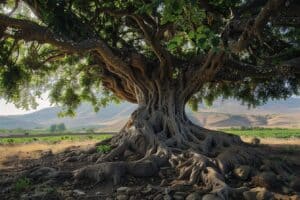
The most discussed Assyrian symbol is a stylized tree. On Mariana Giovino, The Assyrian Sacred Tree I go through her 2007 study, and the book itself is at The Assyrian Sacred Tree.
Unfortunately no Assyrian text discovered to date discusses the nature or purpose of this treelike thing.
Mariana Giovino, The Assyrian Sacred Tree (2007), p. 1
A second interpretation, first proposed in 1888 and much the most popular of the three, maintains that the Assyrian 'tree' is a symbol of a real tree.
Mariana Giovino, The Assyrian Sacred Tree (2007), p. 2
I also link the tree to the Asherah poles of Canaan on Asherah connection with tree worship.
The winged circle
Augustus Le Plongeon saw the same royal symbols in Yucatan and in Assyria:
In Assyria the symbol of the winged serpent was replaced by that of the winged circle, emblem of Asshur, the supreme deity of the Assyrians; and this symbol is seldom found in the sculptures except in immediate connection with the monarch.
Augustus Le Plongeon
See Sacred Mysteries among the Mayas and the Quiches. Ignatius Donnelly adds the Assyrian Du-Zu to his list of dying and rising gods on Ragnarok: The Age of Fire and Gravel.
An Atlantean ancestress
In Selestor’s Men of Atlantis the Assyrians descend from a woman who escaped the sinking island:
And she—the beautiful, the fond, the happy at the last, bore sons and daughters to her loved lord, and did become ancestress of that great race which called Assyria home.
Selestor's Men of Atlantis
See Selestor’s Men of Atlantis.
The empire and the prophets
In the Bible, Assyria is the great power of the eighth century BCE. On Prophets I look at the prophets who spoke when Assyria was rising. On King Hezekiah’s religious reforms the pressure of Sargon II and Sennacherib pushes Judah to unite around one temple. Egypt remembered the same king:
"In his reign, Sennacherib king of the Arabians and Assyrians marched a great army against Egypt".
Herodotus, Histories, Book 2, 2.141
See Account of Sethos. And on Jonah the prophet is sent to warn Nineveh, the capital of the empire, and the whole city repents.
Odd finds
One more object keeps coming back. On Out-of-Place Artifacts I list the Nimrud lens, a piece of ground rock crystal from an Assyrian palace, about 3,000 years old.
Iamblichus on the Assyrian records
Proclus cites Iamblichus on the age of the Assyrian records in The Commentaries of Proclus on the Timaeus of Plato (Thomas Taylor’s translation, 1820). In that account the Assyrians kept memorials of 270,000 years, and Proclus says the much praised antiquity of the Greeks cannot compare with them.
But the Assyrians, says Iamblichus, have not only preserved the memorials of seven and twenty myriads of years, as Hipparchus says they have, but likewise of the whole apocatastases and periods of the seven rulers of the world.
Iamblichus, quoted in Proclus, The Commentaries of Proclus on the Timaeus of Plato, trans. Thomas Taylor (1820), vol. 1, book I, p. 84
Xenophon at Larissa and Mespila
In Book III of H. G. Dakyns’s 1890 translation of Xenophon’s Anabasis, the Ten Thousand, marching in safety after a fight, reach the Tigris and come upon two large deserted cities. Dakyns’s notes place Larissa on the site of Nimrud, commonly taken as the south-west corner of Nineveh, and Mespila opposite Mosul, as the north-west portion of that city. Xenophon himself names the places Larissa and Mespila, and says the Medes once dwelt in them.
Larissa on the Tigris
He describes Larissa as a deserted city of clay-bricks on a stone basis, once inhabited by the Medes, with walls (7.62 meters) broad and (30.5 meters) high.
Here they came upon a large deserted city, the name of which was Larissa: a place inhabited by the Medes in days of old; the breadth of its walls was (7.62 meters), and the height of them a hundred, and the circuit of the whole two parasangs.
Xenophon, Anabasis, trans. H. G. Dakyns, in The Works of Xenophon, vol. I, Macmillan and Co., London and New York, 1890, Book III, Chapter IV, p. 164
The walls of Mespila
From Larissa they came to Mespila, another deserted place. Xenophon gives the measure of its basement of polished stone full of shells, and of the brick wall reared upon it.
The basement was made of polished stone full of shells ; (15.2 meters) was the breadth of it, and (15.2 meters) the height ; and on this basement was reared a wall of brick, the breadth whereof was (15.2 meters) and the height thereof four hundred ; and the circuit of the wall was six parasangs.
Xenophon, Anabasis, trans. H. G. Dakyns, in The Works of Xenophon, vol. I, Macmillan and Co., London and New York, 1890, Book III, Chapter IV, p. 165
Related pages
- Babylon
- The origin of Nimrod
- Mariana Giovino, The Assyrian Sacred Tree
- Hea/Ea
- Jonah
- Akitu Festival in Mesopotamia
- Sumer: The First Known Civilization
- The Akkadians
For every page I tagged with Assyrian, see the Assyrian tag archive.

