
Table of Contents
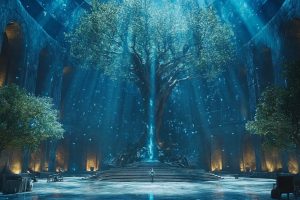
Asgard is the home of the Norse gods, the fortress of the Æsir above Midgard. It keeps turning up in my research in two ways: in the Norse myths themselves, and in Ignatius Donnelly’s argument that the Norse Olympus was a memory of Atlantis. These are the pages where I wrote about it.
The fortress of the gods
On Groups of Elohim appear to have taken distinct roles, sometimes even competing in purpose I cite the Prose Edda, where Odin and his brothers build a fortress in the middle of the world called Asgard, home of the gods and their families. I read that as a base that was both on the ground and high in the sky.
The Æsir who live there are Odin, Thor, Frigg and their kin. Æsir-Vanir War: Conflict Sparked by Gullveig and Power Struggles covers their war with the Vanir, and Vanir gods represent the more peaceful and nurturing aspects of existence tells how Njörðr, Freyr and Freyja came to live in Asgard after the truce.
Stories set in Asgard
In Þór and Hrungnir the giant Hrungnir loses a horse race against Odin’s Sleipnir, ends up in Asgard, gets drunk and becomes abusive, which leads to his duel with Thor. On The forbidden fruit I retell how Loki lured Idunn and her apples of youth out of Asgard, and had to fly her back as a falcon. Ancient wars lists Thor’s battles with frost and fire giants to protect Asgard and Midgard.
Asgard as Atlantis
Ignatius Donnelly read the Norse gods as remembered kings of Atlantis. On The God Odi, Woden, or Wotan he writes:
He dwelt with the twelve Æsir, or gods, upon Asgard, the Norse Olympus, which arose out of Midgard, a land half-way between the regions of frost and fire (to wit, in a temperate climate). The Scandinavian Olympus was probably Atlantis.
Ignatius Donnelly, Atlantis: The Antediluvian World

He even traced the twelve jurors of a modern court back to the twelve gods. On The Kings of Atlantis become the Gods of the Greeks:
Diligent investigation may yet reveal that the number of a modern jury, twelve, is a survival of the ancient council of Asgard.
Ignatius Donnelly, Atlantis: The Antediluvian World
On Is Wotan the Same as Odin? I keep Asgard as Atlantis labeled as Donnelly’s interpretation, not archaeology. Atlantis: a name recorded by hundreds of cultures puts Asgard in a long list of names given to Atlantis, and in Hollow Earth Theory Dan Xuisoko notes that Agartha sounds close to Asgard, which the Vikings placed beyond the ice.
Ragnarok in Donnelly’s account
Ignatius Donnelly, the Minnesota politician who wrote Atlantis: The Antediluvian World, followed it in 1883 with Ragnarok: The Age of Fire and Gravel. He gave a chapter to the Norse Ragnarok and read it as a memory of a comet that had already struck the earth, not as a prophecy.
A rain of dust
Donnelly sets out two readings of the name Ragnarok and prefers the one that fits his theory of clay falling from the sky.
According to Professor Anderson's etymology of the word, it means "the darkness of the gods"; from regin, gods, and rökr, darkness; but it may, more properly, be derived from the Icelandic, Danish, and Swedish regn, a rain, and rök, smoke, or dust; and it may mean the rain of dust, for the clay came first as dust; it is described in some Indian legends as ashes.
Ignatius Donnelly, Ragnarok: The Age of Fire and Gravel (1883), part III, chapter IV, p. 141
Lif and Lifthraser
The Elder Edda says that Lif and Lifthraser lie hidden in Hodmimer’s holt and that the races descend from them. Donnelly reads this as history.
This statement, "From them are the races descended," shows that this is not prophecy, but history; it refers to the past, not to the future; it describes not a Day of Judgment to come, but one that has already fallen on the human family.
Ignatius Donnelly, Ragnarok: The Age of Fire and Gravel (1883), part III, chapter IV, p. 150
The plain of Ida
After Ragnarok the surviving gods meet on the plain of Ida, where Asgard stood. Donnelly reads this as the remnant of mankind gathering again.
All this means that the fragments and remnants of humanity reassemble on the plain of Ida—the plain of Vigrid—where the battle was fought. They possess the works of the old civilization, represented by Thor's hammer; and the day and night once more return after the long midnight blackness.
Ignatius Donnelly, Ragnarok: The Age of Fire and Gravel (1883), part III, chapter IV, p. 151
Related pages
- Groups of Elohim appear to have taken distinct roles, sometimes even competing in purpose
- Æsir-Vanir War: Conflict Sparked by Gullveig and Power Struggles
- Þór and Hrungnir
- The forbidden fruit
- The God Odi, Woden, or Wotan
- Is Wotan the Same as Odin?
- The Kings of Atlantis become the Gods of the Greeks
- Hollow Earth Theory
For every page I tagged with Asgard, see the Asgard tag archive.

