
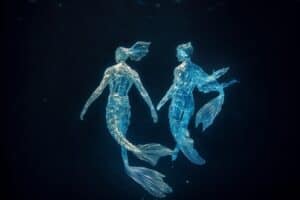
The veneration of the water spirit known as “Water Mama” or “Watramama” in Dutch Guiana (present-day Suriname) during the 1740s is documented in colonial records.
An anonymous colonist described enslaved Africans reporting encounters with this spirit, who instructed them to abstain from work on certain days and to perform rituals involving offerings, such as the blood of a white hen. Noncompliance was believed to result in harm or death to their family members .(academia.edu)
In suriname, on the other hand, the first mention of watramama was made in the 1740s by an anonyÍnous writer:
It sometimes happens that oneor the otherof the black slaves eitherimagines truthfully, or out ofrascality pretends to haveseen andheard an apparition or ghost which they call waíer mama, which ghost would have ordered themnot to work on such or such a day,but to spend it as a holy day for offering with the blood of a white hen, to sprinkle this or that at the water-side and moreof that monkey-business, adding in such cases that if they do not obey this order,shortly Watermama will make their child or husband etc. die or harm them otherwise.
During the 1770sthe colonial authoritiesin suriname for the first time issued a law against “the watermama and similar slave dances,” which were considered to have “dangerous effects” on the slaves.
In that same period, the later govemor Nepveu noted that the Papa, Nago, Arada and other slaves who commonly are brought here under the name of Fida [Ouidah] slaves, have introduced certain devilish practiccs into their dancing, which they have transposed to all other slaves; whena certain rhythm is played […] they are possessed by their god, which is generally called Watramama.
These practices were part of broader spiritual traditions among enslaved Africans. Rituals included dancing and entering trance-like states, which were interpreted as possession by the spirit. In the 1770s, colonial authorities, perceiving these practices as subversive, outlawed them. Governor J. Nepveu noted that enslaved individuals from regions such as Papa (Ouidah), Nago, and Arada introduced these rituals, which then spread among other enslaved populations .(academia.edu)
The belief in Watramama persisted into the 19th century, eventually becoming integrated into the Surinamese Winti religion. This syncretic religion combined elements from various African spiritual systems and was practiced despite periods of prohibition .(en-academic.com)
Similar water spirit beliefs existed in other parts of the Caribbean. In British Guiana, for example, the “Minje Mama” dance was a communal ritual aimed at healing and identifying sources of misfortune. These rituals often involved spirit possession and were central to the spiritual lives of enslaved and free African-descended populations .(researchgate.net, ebin.pub)
Hans had a second task: to find the ‘bad thing which was there to destroy children’. To uncover the wrong-doer, everyone who gathered participated in ceremonial singing and dancing. Hans sang his ‘country song’ and was joined by the others who sang its ‘chorus’. Hans then sang ‘the dance called Water mamma dans’ while everyone danced, some eventually falling into convulsions as if possessed. link
According to January, those gathered ‘became as if crazy, some thr[o]w[ing] themselves in the mud [while] others jumped’. Hans and another man (apparently under the latter’s orders) ‘flogged’ the ‘most turbulent’ with ‘wild canes’ and bamboo that seemed to have been gathered for that purpose.
He also put ‘guinea pepper in their eyes which he [had] chewed’. A circle formed, and Venus – after dancing within it – accused Frederick of being the poisoner, the ‘bad man on the estate’; she saw this ‘from the water that ha[d] been sprinkled over [her] face and eyes’. She then led the crowd to Frederick’s house to find the ‘poison’. Once there, Hans directed a child (Gabriel) to stand over a hole in the floor (which the others had dug), holding a pot of water; he covered her head and the pot with a piece of cloth.
Pompandour removed the cloth, revealing blood, ‘negro hair’, nail clippings, a snake’s head, and ‘other things’ in the pot. Hans told those gathered that ‘the stuff in the horn was the bad thing which destroyed the children, but it would do so no longer’
Ritualistic dances, such as the water mamma dance were banned, and offenders faced the death penalty.
The trial and conviction of Hans and Willem both represent the legal attempts to eradicate these ‘African’ practices as do a series of less notorious convictions against such practices.
The seriousness of Willem’s offence earned an awful and solemn punishment. The place of his crime, the mango tree from which Madalon had been suspended and flogged, was chosen as the spot where it would be expiated.
Here it was that Primo, Mey, Kees and Corydon (his ‘accomplices’) were flogged. Head driver Primo and second driver Mey each received 300 lashes and were branded and sentenced to be ‘worked in chains for a year’. Driver Kees and Corydon received 100 lashes. And here it was that Willem – following an address by Reverend Austin and an ‘earnest prayer’ by John Wray – was hanged and ‘launched into an awful eternity’. His head was cut from his body and impaled on a pole on the estate, ‘there to remain until destroyed by the elements, or birds of prey, and the body to be interred under the aforesaid Mango tree’. The local political and military authorities had gathered to assure themselves that justice was done: the governor, the fiscal, and the members of the Court, the militia, and a ‘great number of white people’ watched Willem’s execution. So did some 400 or 500 slaves.
The punishment inflicted on Willem and Hans implied that the European authorities held the two men primarily responsible for the obeah rituals.
The figure of Mami Wata, associated with water spirits, is prevalent across West and Central Africa and the African diaspora. While the name “Mami Wata” was not documented in West African sources during the 18th century, the concept of water spirits with similar attributes was widespread.


Comments are closed.