
Table of Contents
Introduction
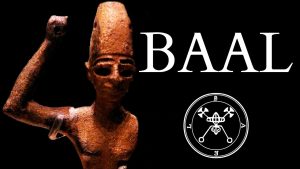
The video explores the history and mythology of Baal, a storm deity from the ancient Near East. It examines Baal’s transformation from a revered god to a demon in later religious traditions. The narrative includes Baal’s role in ancient Canaanite religion, his rivalries with other deities, and the eventual demonization of Baal in Christian and Islamic traditions.
Baal’s Origins and Rise
- Early Identity:
Baal’s precursor, known as Hadad (also Haddu or Rammanu in Akkadian), was initially a minor storm deity in Mesopotamian mythology. As this deity migrated westward to Canaan around the third millennium BCE, he became central to the region’s theological framework. - Geographical Context:
Unlike Mesopotamia and Egypt, where irrigation relied on rivers, agriculture in Canaan depended on unpredictable winter rains brought by Mediterranean storms. This reliance elevated the storm deity’s importance. - Baal’s Transformation:
By 1800–1500 BCE, Hadad had evolved into Baal-Hadad, eventually known simply as Baal (“Lord”), signifying his dominance over nature and his emergence as a kingly god.
The Baal Cycle
- Discovery of Texts:
The Baal Cycle was discovered in 1928 at the Bronze Age city of Ugarit. The six clay tablets, dated to the 14th–13th centuries BCE, provide the most comprehensive account of Baal’s mythology. - Key Myths:
- Conflict with Yam (Sea):
Baal’s primary adversary is Yam, the personification of the sea, representing chaos. With the help of his sister Anat and the divine craftsman Kothar-wa-Khasis, Baal defeats Yam using magical weapons. - Establishment of Kingship:
After defeating Yam, Baal constructs a palace on Mount Zaphon (modern Jebel Aqra), solidifying his role as king of the gods. - Conflict with Mot (Death):
Baal battles Mot, the personification of death. Though Baal is initially defeated and descends into the underworld, he is eventually revived, symbolizing the cyclical nature of fertility and the agricultural seasons.
- Conflict with Yam (Sea):
Baal and Yahweh
- Early Rivalry:
By the late Bronze Age and early Iron Age (ca. 1000 BCE), the Israelite god Yahweh emerged as a tribal deity. The similarities between Baal and Yahweh, both storm gods, created theological competition in the region. - Biblical Narratives:
The Hebrew Bible frequently references Baal, often in opposition to Yahweh. For example, the Elijah narrative in 1 Kings 18 depicts a dramatic contest between Yahweh and Baal’s prophets. - Cultural Assimilation:
Elements of Baal’s mythology were adapted into Yahweh worship. For instance, Psalm 29, with its storm imagery, is believed by scholars to have originally been a hymn to Baal.
Demonization of Baal
- Transition to a Demon:
During the rise of Christianity and in later Jewish apocalyptic literature, Baal was transformed into a demonic figure. This demonization reflected a broader theological shift, positioning Yahweh as the supreme deity and relegating Baal to an adversarial role. - Beelzebub and Western Demonology:
- In Christian tradition, Baal became Beelzebub (“Lord of the Flies”) and was described as a prince of demons.
- Texts like the Testament of Solomon and the Goetia of the Lesser Key of Solomon portray Baal as a high-ranking demon, often commanding legions of lesser spirits.
Baal’s Legacy
- Cultural Impact:
Despite his demonization, Baal’s mythology has influenced various religious and literary traditions. His narrative reflects broader themes of conflict, order, chaos, and renewal that were central to ancient Near Eastern cosmologies. - Modern Scholarship:
- The Baal Cycle remains a vital resource for understanding Canaanite religion and its influence on neighboring cultures.
- Works such as Stories from Ancient Canaan and Yahweh and the Gods of Canaan provide detailed analyses of Baal’s mythology and its theological significance.
Conclusion
Baal’s journey from a powerful storm deity to a demonized figure encapsulates the shifts in religious and cultural paradigms over millennia. The rediscovery of the Baal Cycle allows modern audiences to appreciate his role in the ancient world and his enduring influence on religious thought.
Comments are closed.