
Table of Contents
- Introduction to the Red Pyramid
- Design and Construction Features
- Entrance and Accessibility
- Exploration of the Interior Chambers
- First Chamber
- Second Chamber
- Final Synthesis Chamber
- The Hypothesis: A Chemical Manufacturing Site
- Overview of the Chemical Theory
- Architectural Precision and Anomalies
- External Features and Casing Stones
- Alternate Theories and Speculations
- Conclusion
Introduction to the Red Pyramid
The video explores the Red Pyramid located in Dahshur, Egypt, constructed during the reign of Pharaoh Sneferu around 2600 BCE. The pyramid is the third-largest in Egypt, following the Great Pyramid and Khafre’s Pyramid in Giza. Originally covered in white Tura limestone, the pyramid’s name derives from the reddish hue of its core stones.
Design and Construction Features
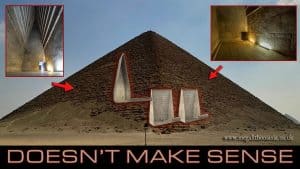
- The Red Pyramid has an unusual angle of 43°, differing from the 51–52° angle of the Great Pyramid.
- Three chambers comprise the interior:
- Two lower chambers connected by a passage.
- A third, higher “corbelled roof” chamber accessed via a staircase.
- The pyramid is thought to have been a precursor to the Great Pyramid, showcasing similar construction techniques.
Entrance and Accessibility
Visitors must ascend the pyramid’s side to enter and then descend into the chambers via narrow corridors. The corridors are designed with massive blocks and corbelled ceilings, emphasizing precise craftsmanship.
Exploration of the Interior Chambers
First Chamber
- The first chamber is accessed via a shallow corridor. It features a corbelled ceiling and finely cut blocks.
- The chamber contains a filled-in hole in its western wall, potentially linked to ancient chemical processes.
Second Chamber
- The second chamber mirrors the first but is positioned slightly deeper within the pyramid.
- Staining on the southern wall suggests the movement of gases between chambers.
Final Synthesis Chamber
- The third chamber, located at a higher level, is the largest of the three. It features removed flooring, exposing large foundational blocks.
- This chamber has historically emitted a strong ammonia odor, earning the pyramid the local nickname “the Bat Pyramid.”
- The chamber exhibits evidence of heavy stone removal and possible chemical residue.
The Hypothesis: A Chemical Manufacturing Site
Overview of the Chemical Theory
Jeffrey Drum’s theory posits that the Red Pyramid was a chemical plant designed to produce aqueous ammonia. Key elements of the hypothesis include:
- Water and Gas Manipulation:
- Lower chambers were filled with water to create isolated reaction spaces.
- Methane gas was introduced, and rising water levels compressed the gas into the upper vaults.
- Chemical Reactions:
- In the first chamber, methane reacted with steam to produce hydrogen and carbon monoxide.
- In the second chamber, these gases combined with air to form hydrogen, nitrogen, and carbon dioxide.
- In the third chamber, hydrogen and nitrogen reacted to produce ammonia gas, which dissolved into water.
- Evidence Supporting the Theory:
- Staining patterns inside the chambers align with gas flow and chemical reactions.
- The pyramid’s chamber arrangement mimics modern industrial processes, such as the Haber process for ammonia production.
Architectural Precision and Anomalies
- The blocks within the pyramid are highly precise, with minimal gaps between them.
- The construction methods suggest advanced engineering, including techniques for manipulating massive stones.
- Some theorists propose that megalithic mounds predated the pyramid’s construction, contributing to the foundation.
External Features and Casing Stones
- Remnants of the original white casing stones are visible near the base, with some showing polygonal joins.
- Much of the casing stone was repurposed for building projects in Cairo.
- The capstone (pyramidion) was reconstructed from fragments and now resides near the site.
Alternate Theories and Speculations
- John Anthony West and others propose that the Red Pyramid may have been built atop a pre-existing mound, symbolizing the “mound of creation.”
- Speculations about hidden chambers within the pyramid persist, supported by recent technological surveys.
Conclusion
The exploration of the Red Pyramid raises questions about its original purpose. While traditionally considered a tomb, emerging theories suggest it served as a functional structure, possibly for chemical manufacturing. This aligns with broader ideas about ancient Egypt’s focus on fertility and abundance.
For further research, viewers are encouraged to explore the work of Jeffrey Drum and related studies on ancient chemical processes.
Comments are closed.