
Table of Contents
Introduction
The video explores the history and design of the Bent Pyramid of Dahshur, an ancient Egyptian monument commissioned by Pharaoh Sneferu. The discussion challenges common misconceptions that label the pyramid as a failure and instead presents evidence of its innovative construction and purpose.
The Bent Pyramid’s Unique Shape
The Bent Pyramid is known for its two-angled slope, leading to speculation that it was a compromised or failed structure. This structure is considered the first large pyramid built with smooth sides instead of stepped terraces. The common argument against the design relies on a Historian’s Fallacy—the assumption that ancient builders had access to the same knowledge available today.
The context indicates that the pyramid’s builders did not have later structures, such as the Red Pyramid, as a reference. Thus, the Bent Pyramid’s design cannot be judged as a compromise or failure based on later developments.
Pharaoh Sneferu also commissioned the Red Pyramid nearby, which Egyptologists have historically assumed replaced the Bent Pyramid due to inadequacies. This assumption has influenced the interpretation of every aspect of the Bent Pyramid’s design.
Claims of Failure
Critics of the Bent Pyramid, including archaeologists and Egyptologists, have described it as a failed monument. For example, Kenneth Feder referred to it as a “monstrosity,” and television features have perpetuated the narrative of its supposed structural issues. However, the video asserts that such claims are based on outdated interpretations rather than evidence.
The Upper Chamber
The Bent Pyramid’s Upper Chamber shows signs of erosion, leading to assumptions of structural failure during construction. However, there is no substantial evidence to support this claim. The chamber contains no large fractures like those seen in the Great Pyramid’s King’s Chamber or the Red Pyramid’s passages. Instead, minor flaking of corbels is observed.
The condition of the chamber is attributed to variations in limestone quality and weathering over millennia, as well as possible alterations made during later periods. Engineer Peter James, who studied Old Kingdom pyramids, dismissed claims that the Bent Pyramid’s corbel designs were structurally inadequate.
Subsidence and Foundation Stability
Italian researchers Maragioglio and Rinaldi proposed in 1964 that the pyramid’s foundation subsided, based on a 30-centimeter dislocation in its descending corridor. This theory suggested that a girdle of stone was added during construction to stabilize the structure. However, no visible evidence of subsidence exists on the pyramid’s exterior.
Engineer Peter James confirmed that the Bent Pyramid shows no signs of foundational movement. The story of subsidence and structural instability appears to be speculative, lacking support from any physical study of the pyramid’s foundation.
Casing Stones and Patches
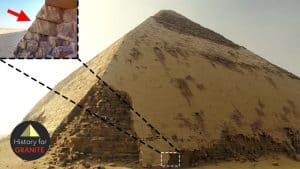
The Bent Pyramid retains much of its original casing stones, offering insights into its construction. The pyramid exhibits thousands of patches, which have been interpreted by some researchers as evidence of cracks forming during construction. However, the video presents evidence that these patches likely resulted from thermal expansion over centuries rather than construction flaws.
The patches are categorized into two types:
- Small Patches: Found near corners or edges, addressing localized vulnerabilities.
- Large Patches: Deeper repairs that often align with natural bedding planes in the limestone.
The distribution of large patches is concentrated in the middle courses of the pyramid and does not align with vertical fissures that would indicate subsidence. The patterns suggest maintenance rather than emergency structural repairs.
Thermal Expansion and Damage
Thermal expansion is identified as the likely cause of damage to the pyramid’s casing stones. The temperature fluctuations between day and night gradually push stones outward, particularly toward the pyramid’s corners. This process, documented by engineers, occurs over millennia and explains the damaged sections seen today.
A lidar scan conducted in 2014 revealed that the pyramid’s middle sections bulge outward slightly, consistent with thermal expansion. These findings debunk claims that the damage was due to instability during construction.
Comparisons to the Red Pyramid
The Red Pyramid, also attributed to Sneferu, has often been cited as an evolution or improvement upon the Bent Pyramid. This argument primarily hinges on the alignment of the pyramids’ casing stones. The Bent Pyramid’s casing stones are inclined inward, while the surviving casing stones of the Red Pyramid are laid horizontally.
Historical observations, such as those by James Dawkins in 1750, indicate that the Red Pyramid originally had some casing stones that were also inclined inward. This evidence undermines the assumption that the Red Pyramid represented a new architectural direction.
The Bent Pyramid’s larger and deeper casing stones suggest it was designed to support its steeper angle. These differences likely reflect variations in construction methods rather than an evolutionary sequence of design.
Sequence of Construction
There is no definitive evidence to establish the order in which Sneferu’s pyramids were constructed. Graffiti on casing stones provides limited dating information, but the overlap in timelines suggests that the Bent Pyramid, Red Pyramid, and possibly the Meidum Pyramid may have been constructed simultaneously or in overlapping phases.
The notion that the Red Pyramid was built to replace the Bent Pyramid is challenged by the absence of evidence for structural failure in the Bent Pyramid and the similarities in their construction techniques.
Importance of Preservation
The Bent Pyramid remains one of the best-preserved pyramids in Egypt, offering unique insights into ancient construction techniques. However, the narrative of failure has negatively influenced its preservation and appreciation.
Structures deemed unsuccessful, such as the unfinished pyramid at Zawyet El Aryan, often face neglect. The video emphasizes the importance of reexamining such narratives to ensure the preservation of historical monuments.
Conclusion
The Bent Pyramid was not a failed experiment but a significant achievement in ancient Egyptian engineering. Its design, construction, and maintenance reflect the ingenuity of its builders. The narrative of failure, perpetuated by outdated interpretations, has hindered a full understanding of its purpose and significance.
The video calls for continued research into the Bent Pyramid and other ancient structures, highlighting the need to preserve physical evidence and challenge assumptions that may limit historical understanding.
Viewers are encouraged to explore history with curiosity and a willingness to question established narratives.
Comments are closed.