
Table of Contents
The Discovery in Kosovo
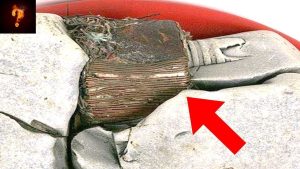
A device described as an ancient transformer was discovered in the Šar Planina mountain range in Kosovo by photographer and researcher Ismet Smiley. This artifact, which contains a stone coil, copper wires, and a unique ancient insulator, is estimated to be over 20,000 years old.
Features of the artifact include:
- Four symmetrically located openings speculated to have been entry points for wires.
- Mysterious convex bands fused into the stone.
The artifact raises questions regarding its purpose, its creators, and its actual age. Suggestions point to its possible use in harnessing energy and connections to an advanced ancient civilization.
Despite these intriguing aspects, concerns have been raised over the potential for the artifact to be lost or dismissed in academic circles.
The Nampa Figurine
Discovered in 1889 near Nampa, Idaho, a small figurine was found at a depth of 90 meters (295.28 feet) during a well-digging operation. Its features include:
- A bulbous head with faint facial features.
- Broad shoulders, short arms, and long legs.
- Geometric markings indicating clothing patterns or jewelry.
The figurine was authenticated by Professor Albert A. Wright in 1979 and dated to the Pliocene Epoch, approximately 2 million years ago. Its discovery challenges conventional timelines of human history, suggesting the existence of an advanced civilization.
The Nangjing Belt
A belt ornament containing 85% pure aluminum was found in a tomb in Nanjing, China, dated to 1,700 years ago. Analysis revealed that the belt’s composition required high temperatures, challenging known technological capabilities of the era.
Despite initial interest, the artifact disappeared from public view, and its authenticity continues to be questioned by academics who argue against the required metallurgical processes for aluminum production at the time.
Artifacts in the Great Pyramid
Bronze, wood, and other fragments discovered in a shaft of the Great Pyramid in Giza suggest technological capabilities beyond the tools traditionally attributed to the builders. A piece of cedar wood, rediscovered in a collection in Scotland, was carbon-dated to 3341–3094 BCE, predating the pyramid’s construction.
Out-of-Place Artifacts (OOPArts)
Numerous unexplained artifacts challenge mainstream historical timelines:
- The Sakara Vases: Stone vases showcasing advanced lathe work with thin edges and intricate shapes.
- The Trilobed Disc: Demonstrates precision machining capabilities.
- Greek Artifacts: Items from the Greek island of Samos, including a bronze piece speculated to depict an ancient submarine.
These artifacts suggest the existence of lost technologies and civilizations.
Conclusion
These discoveries challenge the accepted narrative of human history. The advanced techniques and materials evident in the artifacts imply the existence of civilizations with technological capabilities far surpassing those traditionally acknowledged.
As investigations continue, the debate surrounding these artifacts underscores the importance of preserving and studying such relics to uncover humanity’s true history.
Comments are closed.