
Table of Contents
Introduction
The speaker begins at the site of the largest version of the Ten Commandments, which is carved into a mountainside. This location serves as a backdrop to explore differences between the original Hebrew version of the Ten Commandments and their modern English interpretation.
The Name “Ten Commandments”
The original Hebrew name for this list is Aseret HaDibrot, which translates to “the Ten Words” or “the Ten Sayings.” This title is more neutral than “Ten Commandments.” Ancient Greek and Latin traditions also referred to them as “Ten Words” or “Ten Verses,” a convention preserved until the 1500s by translators such as William Tyndale. The modern name “Ten Commandments” is a relatively recent adaptation.
The Structure of the Hebrew List
In the Hebrew tradition, not all items in the list are commandments. The first item is a declaration: “I am the Lord your God, who brought you out of Egypt.” This is followed by the prohibition against worshipping other gods and making idols, which are combined into a single item. This contrasts with the modern English list, where “You shall have no other gods before me” is the first commandment.
Translation Variations
Prohibition of Theft
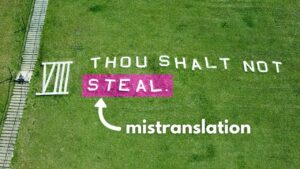
The English version typically interprets the commandment as “You shall not steal,” focusing on theft of personal property. However, traditional Hebrew interpretations understand this as a prohibition against kidnapping, emphasizing the violation of personal boundaries rather than property crime.
Prohibition of Killing
The King James Version translates this as “You shall not kill.” However, more recent English translations use “You shall not murder.” In Hebrew, the verb “ratzach” refers specifically to unethical killing, such as murder, rather than all forms of killing. This includes manslaughter, which was considered unethical in ancient Jewish culture.
Differences in Presentation
In Western art, the Ten Commandments are often depicted as two stone tablets with five commandments on each. Jewish tradition suggests a different presentation. The tablets were likely duplicates, consistent with ancient Mesopotamian practices of creating identical copies of agreements for each party involved.
Exodus 32 mentions that the tablets had writing on both the front and the back. Some Jewish mystical texts, such as the Zohar, propose that the writing penetrated through the stone, with corresponding commandments on the front and back. For example, “I am the Lord your God” aligns with “You shall not kill.” This arrangement suggests a deeper relationship between recognizing divine existence and ethical behavior.
Pairing of Commandments
Jewish tradition interprets the commandments as being paired across the two tablets:
- 1 and 6: Relationship between acknowledging God and ethical treatment of others.
- 2 and 7, 3 and 8, 4 and 9, 5 and 10: Additional paired relationships explore connections between religious obligations and social ethics.
Conclusion
The differences between the Hebrew and modern English versions raise questions about whether the same document is being referenced in contemporary interpretations. The speaker concludes by suggesting that these variations reflect broader cultural and theological differences. A follow-up video may explore the paired relationships in more detail.
Comments are closed.