
Table of Contents
Overview
The video explores five lesser-known ancient monuments across various regions, analyzing their construction, historical significance, and potential functions.
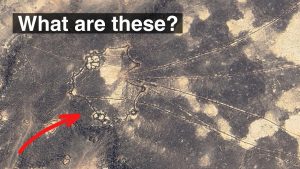
Desert Kites – Middle East
Location
These structures are primarily found in the Middle East, especially in Jordan, with examples extending from West Africa to Kazakhstan.
Discovery
- First identified during a 1914 archaeological survey of the Negev Desert led by Leonard Woolley and Thomas Edward Lawrence.
- Initially misunderstood as walls of unknown purpose.
- Aerial observations in the 1920s revealed their kite-like shape, leading to the term “desert kites.”
Description and Function
- Composed of low rock walls, often less than 1 m high, forming long, narrowing corridors leading to pits.
- Likely used as hunting traps for gazelles and other animals.
- Animals would follow the walls into narrowing paths and fall into pits.
- Radiocarbon dating suggests usage dating back 7,000–10,000 years.
Historical and Cultural Context
- Comparable to other ancient hunting methods, such as buffalo jumps in North America.
- Associated with early Neolithic communities, potentially contributing to animal domestication practices in the region.
Dolmen of Menga – Spain
Location
Located in Andalusia, southern Spain.
Construction
- Built during the Neolithic period using massive stone slabs.
- Features an interior space supported by three columns, a unique architectural innovation for the time.
- The largest capstone weighs approximately 150 tons and was transported about 1 km from the quarry.
Alignment and Function
- Oriented toward a prominent mountain, La Peña de los Enamorados.
- Functions as a burial site and a solar calendar, with its interior aligning with the summer solstice.
- Contains a deep well at its rear, the significance of which remains uncertain.
Discovery
First opened in the 19th century, revealing hundreds of burials inside.
Deer Stones – Mongolia
Location
Scattered across the Eurasian Steppe, primarily in Mongolia.
Description
- Granite pillars decorated with engravings of deer and other motifs.
- Typically include depictions of belts and earrings, indicating they represent human figures.
Dating and Function
- Dated to the Late Bronze Age, between 1300 and 700 BCE.
- Likely associated with elite burials, with faces always oriented east toward the rising sun.
- Still used in modern shamanic and Buddhist rituals, demonstrating cultural continuity.
Stone Spheres – Costa Rica
Location
Found in the Diquís Delta on Costa Rica’s Pacific coast.
Description
- Made from volcanic rock and range in size from small to several meters in diameter.
- Often placed prominently within settlements.
Dating and Theories
- Associated with the Chiriquí Period (800–1550 CE), though some may be older.
- Hypothesized to symbolize celestial bodies or represent elite display.
Challenges
- Many are buried due to flooding in the region, complicating studies.
Plain of Jars – Laos
Location
Central Laos, with 93 identified sites across an area of 10,000 km².
Description
- Stone jars, ranging from 1 to 3 m tall, are scattered across hills and plains.
- Only one jar is decorated, and many are presumed to have had lids made of perishable materials.
Function and Dating
- Believed to have been connected to burial practices, serving as temporary storage for human remains.
- Dating suggests they were constructed around 3,000–4,000 years ago.
Modern Challenges
- Excavations are hampered by unexploded ordnance left from the Vietnam War, making the area hazardous.
Comments are closed.