Table of Contents
Vatea in Cook Islands Mythology
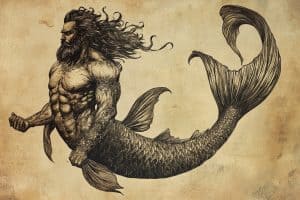
In the mythology of the Cook Islands, Vatea, also known as Avatea, holds a central role as a creator god. Vatea is a unique and dual-natured deity, depicted with one half of his body as human and the other half as a fish. This duality reflects a connection between the realms of land and sea, symbolizing the harmonious balance of these two essential aspects of life in Polynesian culture.
Role and Significance
Cosmic Creator
Vatea is recognized as one of the primordial beings in Cook Islands cosmology. He is often associated with the creation of the world and the progenitor of gods and humans. His actions are central to the formation of the universe, emphasizing his status as a life-giver.
Symbol of Duality
The portrayal of Vatea as half-human and half-fish is symbolic of the interconnectedness of the natural world. The human half represents life on land, while the fish half signifies the ocean’s critical role in sustaining life. This dual representation reflects the Cook Islanders’ deep respect for their environment and its resources.
Mythical Parentage
Vatea is sometimes described as the father of important deities and ancestors, further emphasizing his role as a figure of creation and continuity. His lineage often connects to various myths that explain the origins of life and the social structures of the islands.
In Cook Islands mythology, Vatea (also known as Avatea) and his wife, Papa, are considered the progenitors of several significant deities and ancestral figures. Their lineage includes:
- Tangaroa
God of the sea, Tangaroa is one of the twin sons of Vatea and Papa. - Rongo
God of agriculture and war, Rongo is the twin brother of Tangaroa. - Tavake
Daughter of Rongo, Tavake is part of the divine lineage stemming from Vatea and Papa. - Rangi
Grandson of Vatea and Papa, Rangi is known for lifting the island of Mangaia from the underworld and becoming its first king. - Mokoiro
Another grandson, Mokoiro is among the early settlers and ancestors of the Nga Ariki tribe. - Akatauira
Also a grandchild of Vatea and Papa, Akatauira is part of the foundational lineage of Mangaia’s inhabitants.
These figures play pivotal roles in the myths that explain the origins of life and societal structures in the Cook Islands.
Mythological Context
Vatea’s imagery and myths are part of the broader Polynesian mythological tradition, which frequently features gods and demigods with transformative or dual characteristics. These narratives serve as both spiritual teachings and practical guides, reflecting the values and challenges of island life.
Churchward on Atea
In 1933 James Churchward published The Sacred Symbols of Mu. In his account a Polynesian cosmogony names Atea as light. He treats the marriage of these gods as a way of speaking about the Cosmic Forces. The quotations are short excerpts for review and study.
Atea and Atauana
He quotes a Polynesian account in which dawn is born from a struggle, then Atea marries Atauana and they create earth, animals and man.
From all this struggle was Atauana (dawn) born. Atea (light) married Atauana (dawn) and they created earth, animals and man.
James Churchward, The Sacred Symbols of Mu (1933), chapter VIII, p. 237
Jarves on Wakea and Papa
Vatea in the Cook Islands and Wakea in Hawaii are related names in Polynesian tradition. In Chapter II of History of the Hawaiian Islands, Jarves writes that Wakea, born to the first man and woman, married the daughter of Kukalaniehu, and that this couple became the progenitors of the whole Hawaiian race. He then records traditions of Papa, who in his account is the mother of the islands.
Papa and the kalo plant
Jarves also finds in the story of Papa an idea of the soul passing from body to body.
Papa was believed to be the mother of the islands, and to have created the kalo plant, by planting a deformed child, from which it grew. In the history of Papa is found the eastern idea of transmigration of souls, as she is said to have inhabited different bodies by passing from one to another.
James Jackson Jarves, History of the Hawaiian Islands, Chapter II, p. 16.