
Table of Contents
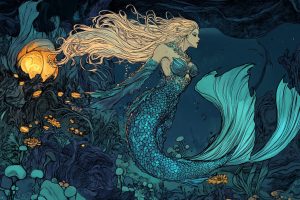
Melusine is a legendary figure deeply rooted in European folklore, particularly in French and German traditions. She is often depicted as a mermaid-like creature with two tails, distinguishing her from other mermaids and water spirits.
Origins and Mythology
The name Melusine is derived from medieval folklore, with possible links to the Breton or Celtic mythologies.
She is often portrayed as a water spirit or a faerie tied to rivers, springs, and wells.
In the most famous version of her tale, Melusine marries a mortal man, Raymond of Poitou, under the condition that he never sees her on Saturdays.
On Saturdays, Melusine transforms into her true form, a serpent or fish-tailed creature.
When Raymond breaks his promise and spies on her bathing, her secret is revealed, and she leaves him, flying away as a dragon or spirit.
Melusine is often interpreted as a symbol of duality: human and otherworldly, love and betrayal, beauty and mystery.
Her tale is associated with themes of fidelity, identity, and the consequences of broken promises.
Depictions in Art and Culture
Two-Tailed Iconography
The image of Melusine with two tails has been linked to heraldry and commercial logos, most famously appearing in the Starbucks logo.
Her dual tails represent her unique form and connection to water mythology.
The story of Melusine gained prominence in the medieval romance “Roman de Mélusine,” written by Jean d’Arras in the late 14th century.
Historical and Mythological Context
Connection to Water Deities
Melusine shares traits with other water spirits, such as nymphs, selkies, and sirens, emphasizing her connection to natural water sources.
Cultural Influence
Her legend often reflects medieval anxieties about women’s power, autonomy, and hidden identities. It also mirrors local traditions of sacred springs and the protective spirits believed to inhabit them.


Comments are closed.