
Table of Contents
- How much of Göbekli Tepe has been dug?
- Was Göbekli Tepe buried on purpose?
- The official reasons for digging slowly
- Why critics think the pace is a choice
- What happened next: trees, walkways and a new roof
- The olive trees
- Roads, walkways and steel
- Karahan Tepe gets a roof too
- Why dig the sister sites and not the mother site?
- The burial question again
- The official answer
- What is at stake under the hill
- Where I land
Göbekli Tepe is the oldest known monumental site on Earth. It sits on a hill near Şanlıurfa in southeastern Turkey. The first stone circles were raised around 9600 BCE.
I kept going back to one number. After thirty years of digging, most of the hill is still closed. On this page I put what the excavators say next to what their critics say.
How much of Göbekli Tepe has been dug?
Klaus Schmidt of the German Archaeological Institute (DAI) led the dig from 1995 until his death in 2014. He told Smithsonian Magazine that the work covered “less than 5 percent of the site” (Smithsonian).
In the same article he said at least 16 more rings lay buried across the 22-acre hill.
The DAI later mapped the mound with geophysics. Geophysics means instruments that look under the ground without digging, such as radar and magnetic surveys. The surveys ran in 2003, 2006, 2007 and 2012.
The DAI’s summary is short. In its words, “a minimum of 20 enclosures seem to exist inside the mound” (DAI).
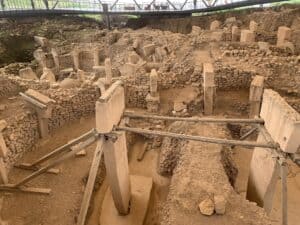
An enclosure is one of the round or oval stone buildings. Each one has two tall T-shaped pillars in the middle and a ring wall with more pillars around them.
So the map is already there. The archaeologists know roughly where the buildings are. They have opened only a handful.
Was Göbekli Tepe buried on purpose?
The second question is how the buildings got buried at all. When Schmidt opened the first enclosures, they were full of rubble, flint, animal bone and some human bone.
Schmidt read this as a deliberate act. In his view the builders filled each enclosure on purpose when they stopped using it. That idea is called backfilling. It made the site famous. A people who bury their own temple must have had a reason.
For alternative researchers that reason matters. If the builders buried the site on purpose around the end of the Ice Age, they may have been protecting something. Graham Hancock goes further. In a talk I keep on this site he says it plainly.
Göbekli Tepe is a hall of records.
Graham Hancock, An ice age homeland
You can watch that part on Hancock on an ice age homeland.
The team that took over after Schmidt now says the opposite. In 2020 Moritz Kinzel, Lee Clare and Devrim Sönmez published “Built on Rock” in Istanbuler Mitteilungen 70 (DOI).
They write that the intentional burial idea “now appears increasingly unlikely”. In their reading the buildings filled up through slope slides. A slope slide is a mass of loose stone and earth that slips down a hill. They think heavy rain or earthquakes set these slides off, again and again over a long time.
Schmidt himself left a clue for this. His own 2003 report says it was “not clear where the enormous amount of debris had been taken from” (quoted by Kinzel, Clare and Sönmez).
I find the new model reasonable for some of the fill. I also notice what it does. It removes the one detail that made the builders look deliberate and knowing. The old site notes on this website already repeat the new line, that the enclosures “were filled due to natural events” (Göbekli Tepe).
The official reasons for digging slowly
The excavators give four reasons for the slow pace. I want to state them fairly.
Conservation. Once a stone pillar is exposed, rain, frost and salt start to attack it. Buried stone is safe. Every opened enclosure needs care for as long as it stays open.
Leave it for the future. Schmidt planned to leave part of the site untouched for later scientists with better methods (Newsweek). This is normal practice in archaeology. A dig destroys the layers it removes, so teams often keep some areas closed on purpose.
The roof. The main excavated area now sits under two protective roofs, built from 2016 and opened to visitors in 2018 (DAI Tepe Telegrams). Cumhuriyet put the cost at 6.6 million euros (Cumhuriyet). The roof shields the pillars from the weather and lets visitors walk above them. It also means new trenches must work around its supports.
A bigger project. The Turkish state now runs Göbekli Tepe as part of the Taş Tepeler project (Taş Tepeler). Taş Tepeler means “Stone Hills”. It covers a group of sites of the same age in the Şanlıurfa region. The best known is Karahan Tepe, east of Göbekli Tepe, where a room full of carved heads and pillars has come out of the ground. Istanbul University has dug there since 2019 (Taş Tepeler: Karahantepe). Money and digging teams are spread across many hills, not one.
Why critics think the pace is a choice
The critics look at the same hill and see a decision. The clearest case I have found comes from the YouTube channel Bright Insight.
The host compares a 1995 aerial photo, taken before the dig, with recent views. In 1995 the hill had almost no trees. Now it has four orchards.
they planted four Orchards of trees on top of known ruins
Bright Insight, Bright Insight on leaving Gobekli Tepe buried
He says archaeologist Oliver Dietrich confirmed the trees stand on buried remains, and that the roots were meant to slow erosion. That is his account of the exchange. I have not seen Dietrich’s own words on it.
Tree roots grow into the ground they protect. For the host, planting them on mapped ruins is a sign that nobody plans to open those ruins soon.
this proves that there's absolutely no plan at least indefinitely to fully excavate the site
Bright Insight, Bright Insight on leaving Gobekli Tepe buried
He also cites a timetable that stretches the work across a very long time.
they are expected to continue for another 150 years
Bright Insight, Bright Insight on leaving Gobekli Tepe buried
His point about money is the one I keep thinking about. He says a 2016 partnership between the Doğuş Group and Turkey’s ministry, announced at the World Economic Forum in Davos, put 15 million dollars into the site by 2018. In his telling, the money went to roofs, roads and visitor buildings, not to opening the rest of the hill. The Turkish paper Milliyet reported the same 15 million dollars in May 2018 and listed a visitor centre, an animation centre, a (0.62 miles) road and a car park (Milliyet). The same article says the road and buildings can be taken apart without harm to the ground if new areas are found. You can see his full argument on Bright Insight on leaving Gobekli Tepe buried.
What happened next: trees, walkways and a new roof
I wanted to follow the story further, so I went through Jimmy Corsetti’s posts on X. Corsetti is the host of Bright Insight, and he posts as @BrightInsight6. Between 2024 and 2026 the fight over Göbekli Tepe moved from YouTube to the press and to Turkish officials.
The olive trees
In October 2024 he counted the trees on the hill.
There are at least 789 Trees planted on top of Gobekli Tepe.
Jimmy Corsetti, X, 9 October 2024
In February 2025 the trees came down. He saw it as a win.
Authorities in Turkey have begun cutting down 1,000 Trees 🌳 at Gobekli Tepe
Jimmy Corsetti, X, 11 February 2025
The official side tells it differently. Excavation director Necmi Karul told Cumhuriyet that landowners planted the trees years ago to get more compensation when the state took the land. He also said the roots damage the layers below as they grow, and that a preservation board had already decided to move them. The trees were moved, not killed. Jason Colavito quotes Karul in full, in Turkish and in English (Jason Colavito).
So both sides got something. Karul’s own words say the roots do harm. His critics say the removal was planned long before Corsetti made videos about it. The argument is still going. In October 2026 Corsetti answered a post that said there was no evidence of damage.
Uhh, then why did the Turkish Ministry repeatedly report the exact oppose?? So who’s lying? 🤔
Jimmy Corsetti, X, 6 October 2026
Roads, walkways and steel
The trees were only one part of his list. In August 2025 he wrote down the rest.
- Trees planted on top of unexcavated ruins
Jimmy Corsetti, X, 16 August 2025
- Concrete Roads/Sidewalks on buried ruins
- Steel beams penetrating heart of Gobekli Tepe
- Roof infrastructure resting on 11K yr stone relics
In October 2025 a new walkway went up.
The new walkway constructed ON TOP of UNEXCAVATED ruins at Gobekli Tepe highlights the failed-state of modern Archaeology
Jimmy Corsetti, X, 26 October 2025
I have not found an official statement about this walkway. I will add one if it appears.
Karahan Tepe gets a roof too
The same pattern has now reached Karahan Tepe. Turkey’s Ministry of Culture announced a protective roof over about 5,000 square metres of the dig in March 2025 (Ministry of Culture and Tourism). In April 2025 Corsetti posted photos of the holes for the roof supports.
They DRILLED into a field of Ancient ruins while digging holes for steel beams that will support a new roof
Jimmy Corsetti, X, 15 April 2025
Archaeologists answered him on X. One of them, Melissa Kennedy, wrote about a deep hole in his photos in September 2026.
That is not machine dug.
Melissa Kennedy, X, September 2026
She added that the whole area is full of rubble. I cannot judge that from photos. In July 2026 he gave a warning.
This will be the last summer in which the ancient site of Karahan Tepe will be visible under the sun
Jimmy Corsetti, X, 28 July 2026
The ministry says the roof is part of a larger plan with a dig house, a finds store and a visitor centre, due to finish at the end of 2026 (T24). In August 2026 the governor of Şanlıurfa said Sayburç will get a roof as well (GAP Gündemi).
Why dig the sister sites and not the mother site?
This is the question Corsetti keeps coming back to, and it is a fair one.
They’re going full throttle on excavating Karahan Tepe and Sayburç, but regressing excavations at Gobekli Tepe?
Jimmy Corsetti, X, 12 October 2025
The sister sites are delivering. At Sayburç, Eylem Özdoğan of Istanbul University found a carved bench in 2021 with two humans, two leopards and a bull side by side. She calls it the most detailed Neolithic “story” found so far in the Near East (Archaeology Magazine).
The burial question again
Corsetti also rejects the new slope slide model.
Gobekli Tepe was purposely buried 11,600yrs ago – by hand – and not as the result of a “landslide”, as some archaeologists are now stating
Jimmy Corsetti, X, 25 April 2025
He points to the other Taş Tepeler sites as support.
the very fact that so many Tas Tepeler sites are known to be intentionally buried, including Karahan Tepe, says it all 💯
Jimmy Corsetti, X, 27 December 2025
The official answer
The fullest answer from the excavators came on NPR in August 2025. Lee Clare has led the work at the site for over a decade. He says the team is protecting the site, not hiding it (NPR).
You can't just bulldoze a site to get everything out. That's the wrong approach.
Lee Clare, NPR
Why would I be so selfish as to dig the entire site … and take these possibilities away from future generations of archaeologists?
Lee Clare, NPR
NPR also reports that Clare deleted his social media accounts for a time because the attacks became personal. I think that matters too. A fair debate needs both sides to stay at the table.
What is at stake under the hill
This is why the buried 95 percent matters to me. Göbekli Tepe already moved the start of monumental building back by thousands of years. It was built by people we were told could not build anything like it.
The dates also matter. The site goes up soon after the Younger Dryas. That was a sudden cold period from about 12,900 to 11,700 years ago. Some researchers link its start to a comet impact. I follow that trail on Taurid meteor stream.
Pillar 43, the Vulture Stone, may carry a memory of that sky. I look at that reading on What Is Göbekli Tepe Pillar 43?.
The deepest and oldest layers are the ones still in the ground. If any carving records an earlier world, it is most likely down there. Each slow decade keeps that question closed.
Where I land
I do not think there is one villain. Conservation is real. So is the rule of leaving part of a site for later methods.
I also think the burden runs the other way too. The radar map shows at least 20 buildings. Fewer than ten have been opened, and none of them fully, according to Kinzel, Clare and Sönmez. The trees are gone now, but roofs, roads and a walkway sit on parts of the hill, and Karahan Tepe and Sayburç are getting roofs of their own.
For now I place Göbekli Tepe on my Ancient Timeline as the oldest proven monument, with a large question mark under it. I will update this page when a new enclosure is opened.

