Book contents. Next: Introduction, sections 1 to 12.
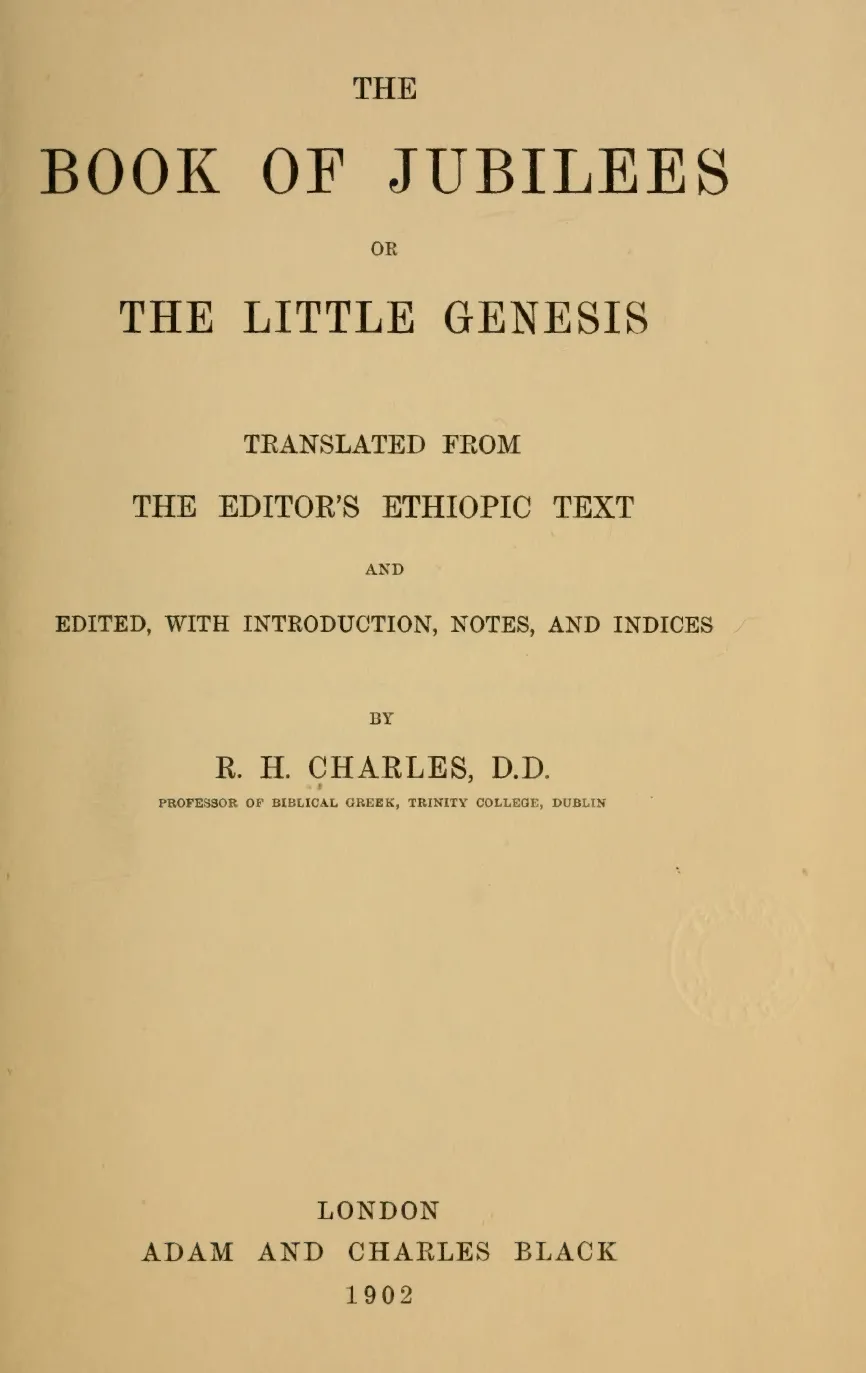
THE BOOK OF JUBILEES
OR
THE LITTLE GENESIS
OTHER WORKS BY THE SAME AUTHOR
The Apocalypse of Baruch. Translated from the Syriac: Chapters I. – LXXVIL., from the Sixth Century MS. in the Ambrosian Library of Milan, and Chapters LX XVIII. -LXXXVII.—The Epistle of Baruch. —From a New and Critical Text based on Ten MSS. and published herewith. Edited, with Introduction, Notes, and Indices. 7s, 6d. net. The Assumption of Moses. Translated from the Latin Sixth Century MS., the unemended Text of which is published herewith, together with the Text in its restored and critically emended Form. Edited, with Introduction, Notes, and Indices. 7s. 6d. A Critical History of the Doctrine of a Future Life in Israel, in Judaism, and in Christianity ; or Hebrew, Jewish, and Christian Eschatology, from pre-Prophetic Times till the Close of the New Testament Canon. 15s. The Ascension of Isaiah. ‘Translated from the Ethiopic Version, which, together with the New Greek Fragment, the Latin Versions, and the Latin Translation of the Slavonic, is here published in full, Edited with Introduction, Notes, and Indices. 7s. 6d. net.
A. ἃ C. BLACK, SOHO SQUARE, LONDON.
The Book of Enoch. Translated from Dillmann’s Ethiopic Text (emended and revised in accordance with hitherto uncollated Ethiopic MSS. and with the Gizeh and other Greek and Latin Fragments), with Introduction, Notes, and Indices. 8vo, 165, The Ethiopic Version of the Hebrew Book of Jubilees. Edited from Four MSS. and critically revised, emended, and restored in accordance with the Hebrew, Syriac, Greek, and Latin Fragments of this Book. 4to, 12s. 6d. The Book of the Secrets of Enoch. Translated from the Slavonic by W. R. MoRFILr, M.A., and edited, with Introduction, Notes, and Indices, by R. H. CHARLES, M.A. 8vo, 75. θᾶ,
THE CLARENDON PRESS, OXFORD.
OR
THE LITTLE GENESIS
TRANSLATED FROM
THE EDITOR’S ETHIOPIC TEXT
AND
EDITED, WITH INTRODUCTION, NOTES, AND INDICES
BY
R. H. CHARLES, D.D. PROFESSOR OF BIBLICAL GREEK, TRINITY COLLEGE, DUBLIN
LONDON ADAM AND CHARLES BLACK 1902
TO
The Reverend George Salmon, D.D.
D.C.L., LL.D., F.R.S.
PROVOST OF TRINITY COLLEGE, DUBLIN
WITH AN OLD PUPIL’S ADMIRATION AND GRATITUDE
PREFACE
I HAD hoped to issue this Commentary on the Book of Jubilees quite six years ago, as a sequel to my edition of the Ethiopic and other fragmentary versions of this work ; but after writing a large portion of it, I was obliged to abandon the task, as I felt that somehow I had failed to give a satisfactory interpretation of the text, though at the time I could not understand wherein my disability lay. A year or two later when making a special study of the Testaments of the XII. Patriarchs, I came to discover that the source of my failure lay in my acceptance of the traditional view that Jubilees was written in the first century of the Christian era. So long as I wrote from this standpoint, my notes became more and more a laboured apologetic for the composition of this work in the first century. The earliest approximation to the right date appeared in my article on the “ Testaments of the XII. Patriarchs ” in the Encyclopedia Biblica, i. 241, 1899, where, after giving grounds for the view that the main bulk of that work was written before 100 B.C., I concluded that we should “regard both works (i.e. the Testaments and Jubilees) as almost contemporary, and as emanating from the same school of thought.” This
view was advocated in the following year by Bohn and by Bousset on various grounds, and it is from this standpoint that the present Commentary is written. The difficulties that beset almost every page of Jubilees vanish for the most part when once we understand that it was written by a Pharisaic upholder of the Maccabean dynasty, who was also probably a priest. It is difficult to exaggerate the value of Jubilees. The fact that it is the oldest commentary in the world on Genesis, is in itself a distinction. But it is not on this ground that we value it, but rather for the insight it gives us into the religious beliefs of Judaism in the second century B.C. Its interests are many sided. It appeals to the textual critic, as it attests the form of the Hebrew text, which was current in that century. It appeals to the Old Testament scholar, as exhibiting further developments of ideas and tendencies which are only in their incipient stages in the Old Testament. It appeals to the New Testament scholar, as furnishing the first literary embodiment of beliefs which subsequently obtained an entrance into the New Testament, and as having in all probability formed part of the library of some of the apostolic writers. It appeals to the student. of theological doctrine, as providing certain indispensable links in the process of development. Finally, to the Jewish scholar, a Pharisaic work of the second century B.C. cannot fail to be of transcendent interest, as it gives the earlier forms of certain legislative enactments that appear in the Mishna, and of legends which in later Judaism have undergone much transformation. Although half a century has elapsed since the discovery
of Jubilees in its complete form in the Ethiopic Version, no scholar has hitherto attempted a commentary on the entire work. Some thirty years ago Rénsch edited a very learned and laborious work on the Latin Fragments, which constitute slightly more than one-fourth of the original writing, but since his time scholars have contented themselves with short studies on various views of our author. I cannot conclude without thanking Mr. Cowley for his help in verifying references in the Talmud.
17 BRADMORE ROAD, OXFORD, May, 1902.
CONTENTS
PAGE INTRODUCTION i i : : . Xxili-lxxxix § 1. Short Account of the Book (pp. xiii, xiv)—§ 2. The Various Titles of the Book (pp. xiv-xx)—§ 3. The Ethiopic Manuscripts (p. xx)—-§ 4. Editions of the Ethiopic Version (pp. xx, xxi)—§ 5. Translations (pp. xxi, xxiil)—-§ 6. Critical inquiries (pp. xxii-xxvi)—§ 7. The Versions of Jubilees—Greek, Ethiopic, Latin, Syriac (pp. xxvi-xxix)—§ 8. The Ethiopic and Latin Versions— Translations from the Greek (pp. xxx, xxxi)—§ 9. The Greek—a Translation from the Hebrew (pp. xxx-xxxili)— 8 10. Textual Affinities of the Text of the Book of Jubilees (pp. Xxxiii-xxxix)—§ 11. Lacunae, Dittographies and Dislocations in our Text (pp. xxxix-xlii)—§ 12. Poetical – Element in Jubilees (pp. xlii-xliii)—§ 13. Jubilees from one author but based on earlier books and traditions —~ (pp. xliv-xlvii)—§ 14. Jubilees—a Product of the midrashic tendency at work in the Old Testament Chronicler, but represented by its author as an Esoteric Tradition (pp. xlvii-li)—§ 15. Object of Jubilees—the Defence and Exposition of Judaism from the Pharisaic standpoint of the second century B.C. (pp. li-lvi)—§ 16. Angelology —— and Demonology of Jubilees (pp. lvi-lviii)—§ 17. The Date of Jubilees (pp. lviii-lxvi)—§ 18. The Jubilees and Years used by our author (pp. lxvii-lxviii)—§ 19. Value of Jubilees in determining the Dates of the various Sections _ of the Ethiopic Enoch and the Book of Noah (pp. Ixviii- Ixxii)—§ 20. The relation of Jubilees to the Testaments of the XII. Patriarchs (Dp. Ixxii)—-§ 21. The author—a Pharisee who recognised the Maccabean Pontificate and
PAGE was probably a priest (p. Ixxiii)—§ 22. Jubilees in Jewish, Samaritan and Christian non-canonical literature (pp. lxxiiilxxxiii)—§ 23. Influence of Jubilees on the New Testament (pp. Ixxxiii-lxxxvi)—§ 24. Views of the author on _ the Messiah, the Messianic Kingdom, the Priesthood of Melchizedek, the Law, Circumcision and the Sabbath, the Future Life, the Jewish Calendar (pp. 1xxxvii-]xxxix).
SYMBOLS AND BRACKETS USED IN THIS EDITION . 3 XC1 TRANSLATIONS AND NOTES ὶ : : 1 INDEX I. : : . : 263 INDEX II. : ὲ ἰ 5 1 J 267