
Table of Contents
In the system that links the Kabbalistic Tree of Life to the Tarot, the High Priestess goes with the Hebrew letter Gimel (ג). She stands for the path from Keter (Crown) to Tiphereth (Beauty) on the Tree of Life. Aleister Crowley’s The Book of Thoth gives the same path, Kether to Tiphareth, and gives the Moon as her planet (pages 24 and 266, as cited on Wikipedia’s “The High Priestess” page).
Key meanings of the High Priestess
The card stands for intuition and mystery. She is the bridge between the divine and the human, the part of the mind below waking thought that joins higher wisdom to personal experience. She points inward, toward hidden truths and spiritual insight.
She also stands for duality and balance. She sits between two pillars, Boaz and Jachin, which stand for pairs of opposites such as darkness and light, or severity and mercy. Behind her hangs a veil, the line between the waking world and the unseen spiritual realms.
The letter Gimel means camel. A camel can keep itself going on long journeys through harsh land. The page reads this as the High Priestess’s role: she guides the seeker through the “desert” of the unknown toward deeper understanding.
Path: Keter to Tiphereth
Keter, the Crown, is the divine source, pure potential and infinite light. Tiphereth, Beauty, is harmony and integration, the heart of spiritual experience on the Tree of Life.
The role of the High Priestess
The path from Keter to Tiphereth carries divine wisdom down into balanced, lived form. The High Priestess rules this path. She guards sacred knowledge and shows it to those who are ready to receive it.
Symbolism in Tarot
The Moon is often shown on her crown or behind her, for cycles, intuition and the hidden mind. She holds a scroll, often marked “TORA” or “TORAH”, for divine law and hidden truths. Water often appears at her feet or in her imagery, for the flow of intuition and feeling.
Spiritual lessons of the High Priestess
She teaches trust in inner guidance, listening to intuition rather than to outside distractions. She asks for balance between the seen and the unseen, the material world and spiritual awareness. She is also the gatekeeper to higher truths, who lets a person through only when they are spiritually ready.
In the Kabbalistic context
The High Priestess (Gimel) stands for a mystical path of inner exploration. She guides the seeker in bringing divine wisdom into the beauty of the heart. The page calls this the “camel’s journey”: crossing the desert of the unknown with faith, patience and a commitment to finding sacred truths.
The High Priestess card
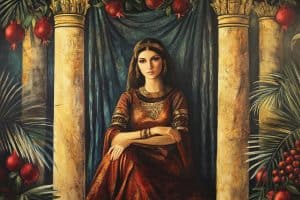
The High Priestess is shown in the Rider-Waite-Smith Tarot and other classic decks as a calm, mysterious figure seated between two pillars. Arthur Edward Waite, who designed the Rider-Waite-Smith deck with Pamela Colman Smith, describes the card in The Pictorial Key to the Tarot (1911).
Waite lists the moon, the crown and the cross.
She has the lunar crescent at her feet, a horned diadem on her head, with a globe in the middle place, and a large solar cross on her breast.
A. E. Waite, The Pictorial Key to the Tarot, Part II, § 2, "Two. The High Priestess"
Seated figure. She sits on a throne, as guardian of sacred knowledge and a steadying force between opposites. Her posture is calm and full of authority, showing her mastery of the inner and outer worlds.
Pillars. Two pillars stand beside her, one black and one white, marked Boaz (strength) and Jachin (establishment). They come from the entrance of Solomon’s Temple. The Bible names them in 1 Kings 7:21, KJV.
The pillars of the Temple are named in Kings.
And he set up the pillars in the porch of the temple: and he set up the right pillar, and called the name thereof Jachin: and he set up the left pillar, and called the name thereof Boaz.
1 Kings 7:21, KJV
The pillars stand for pairs such as masculine and feminine, darkness and light, and severity and mercy. The High Priestess sits between them, balancing them and acting as mediator between the two sides.
The veil. Behind her hangs a veil decorated with pomegranates and palm trees. Pomegranates stand for fertility, abundance and the mysteries of the divine feminine. Palm trees stand for victory and eternal life. The veil marks the line between the physical world and the spiritual or hidden realm: sacred knowledge is out of plain sight, and it takes insight to reach it.
Crown. On her head is a crown like the Triple Moon, a full moon with a crescent on each side. It stands for her link to the moon’s cycles, to intuition and to feminine power. The crown also ties her to ancient goddesses such as Isis and Hathor. Waite himself notes that she “has been called Occult Science on the threshhold of the Sanctuary of Isis”.
Scroll. She holds a scroll marked with the word “TORA”, for divine law or wisdom. The scroll is partly hidden, a sign that knowledge comes only to those who seek it sincerely and are ready.
Waite explains the word on the scroll.
The scroll in her hands is inscribed with the word Tora, signifying the Greater Law, the Secret Law and the second sense of the Word.
A. E. Waite, The Pictorial Key to the Tarot, Part II, § 2, "Two. The High Priestess"
Moon at her feet. A crescent moon lies at her feet, for intuition, cycles and the hidden mind. It also stands for her power to light the way through darkness and doubt.
Blue robe. Her flowing robe is usually blue, for calm, intuition and spiritual wisdom. The robe often runs into water or hints at it, which ties her to the hidden mind and to deep feeling.
Water. Water, sometimes shown as a stream or lake, stands for the flow of intuition and feeling and for the deeper layers of consciousness.
Atmosphere and expression
Her expression is calm, mysterious and impersonal, showing her neutrality and deep understanding. The card as a whole suggests stillness, looking inward and the presence of hidden truths.

