
Table of Contents
This page is part of The world’s beginnings, on the cosmology G.I. Gurdjieff sets out in “Beelzebub’s Tales to His Grandson.” Our Earth is the sixth level of the Ray of Creation, below the five higher levels and above the Moon.
6 Our Earth (The Microcosmos)
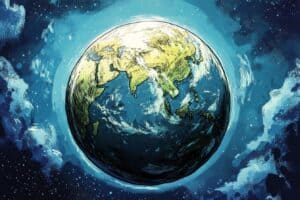
This level is the planet Earth, the focus of human existence and evolution. It is a unique environment designed to support the development of conscious life and human potential. It is governed by forty-eight laws. These show how many complex influences affect life on Earth.
The Forty-Eight Laws of “Our Earth”
The first group deals with the physical forces that hold the planet together and move it. The Law of Unity maintains the cohesion and integration of Earth’s ecosystems and systems, so that all components function together as a unified whole. The Law of Motion covers the movements and cycles of Earth’s systems, including the rotation and revolution of the planet. The Law of Gravity is the fundamental force that holds Earth’s components together and influences the interactions between masses, while the Law of Attraction and Repulsion shapes the forces behind the formation and stability of Earth’s structures and life forms. The Law of Magnetism concerns Earth’s magnetic field and its interactions with solar and cosmic forces.
Energy and time form a second group. The Law of Light and Heat directs the distribution of solar energy, providing the necessary conditions for life and climate. The Law of Energy Flow follows the flow and transformation of energy within Earth’s systems, supporting life and ecological processes. The Law of Thermodynamics sets the principles of energy transformation and entropy, and the Law of Conservation keeps energy and matter conserved as they transform. The Law of Cosmic Influence describes how cosmic forces, such as solar radiation and cosmic rays, act on Earth’s environments. Periodic change belongs here too: the Law of Cycles reflects the periodic nature of Earth’s phenomena, such as seasons, tides, and ecological cycles, and the Law of Temporal Cycles links cosmic and planetary cycles to the passage of time and seasonal changes.
Several laws describe Earth as a whole system. The Law of Balance maintains equilibrium between Earth’s systems and prevents drastic changes. The Law of Transformation covers the processes of change and evolution within those systems, including geological and biological transformations. The Law of Interaction deals with the interactions between Earth’s components, including the links between ecosystems and biogeochemical cycles. The Law of Hierarchy establishes the hierarchical order within Earth’s systems, with complex interactions and dependencies, and the Law of System Complexity adds that these dependencies contribute to resilience and adaptability. Through the Law of Feedback Loops, self-regulating mechanisms within ecosystems maintain balance and stability.
The chemistry and geology of the planet form their own group. The Law of Chemical Affinity covers the chemical interactions and reactions within Earth’s systems, and the Law of Mineralization the formation and distribution of minerals within Earth’s crust. The Law of Geophysical Processes concerns the geological processes that shape Earth’s surface and interior, including tectonics and volcanism. Air and water follow the Law of Atmospheric Dynamics, which moves gases within the atmosphere and influences weather and climate, and the Law of Hydrological Cycles, which moves and distributes water and influences climate and ecosystems. The Law of Climate Dynamics brings these together in the complex interactions between Earth’s climate systems and their impacts on life and ecosystems.
Living things have laws of their own. The Law of Evolution guides the evolutionary processes of life on Earth, including adaptation and speciation. The Law of Biological Evolution shapes the evolution and adaptation of life forms, influencing biodiversity and ecosystems, and the Law of Natural Selection is the process by which species adapt and evolve over time through survival and reproduction. The Law of Adaptation is the ability of organisms to adapt to changing environmental conditions. Plants convert solar energy into chemical energy under the Law of Photosynthesis, and organisms turn chemical energy into usable energy under the Law of Respiration. The Law of Reproduction covers how organisms reproduce and pass on genetic information, and the Law of Growth and Development how they grow and develop throughout their life cycles. The Law of Mortality is the natural process of aging and death, which contributes to ecological balance and renewal. The Law of Symmetry and Asymmetry describes the structural and functional symmetry and asymmetry found in organisms and systems.
Ecosystems bring the largest group. The Law of Ecological Interdependence concerns the relationships between living organisms and their environments, and the Law of Ecological Balance keeps the balance between species and their environments so that ecosystems stay stable. The Law of Symbiosis covers cooperation between species that benefits one or both parties, the Law of Predation the relations between predators and prey that shape population dynamics and ecosystem structure, and the Law of Competition the contest between species and individuals for resources. Under the Law of Biodiversity, the diversity of life forms within ecosystems adds to resilience and adaptability. The Law of Ecological Niches sets the roles and functions of species within ecosystems, contributing to diversity and stability. After a disturbance or the establishment of new communities, ecosystems change gradually under the Law of Succession. Organic matter breaks down under the Law of Decomposition, and the Law of Nutrient Cycling moves and recycles nutrients, supporting growth and productivity. Limits come from the Law of Limiting Factors, the constraints that limited resources and environmental conditions put on growth, and from the Law of Carrying Capacity, the maximum population an ecosystem can sustain given its resources and conditions. The Law of Adaptability and Resilience is the capacity of ecosystems and organisms to withstand and recover from disturbances.
The last law concerns people. The Law of Human Influence covers the impact of human activities on Earth’s systems, influencing climate, ecosystems, and biodiversity.
Understanding the Laws
The forty-eight laws reflect the complexity and limits of life on Earth, where natural systems interact and depend on each other in complex ways. They show how all parts of Earth’s systems are linked, and how much those systems rely on balance, harmony and resilience. Many of them directly affect the conditions for life on Earth, influencing ecological processes, climate, and the potential for biodiversity and adaptation.
The level below Earth is The Ninety-Six Laws of the Moon. The level above is described in Gurdjieff’s Ray of Creation. For the wider cosmology, return to The world’s beginnings.

